

Evolution of Custom Peptide Synthesis and Reference Material Availability in Life Sciences Research
The landscape of biochemical research has undergone a radical transformation over the last three decades. In 2024, the global peptide market was valued at approximately 15 billion USD, with a projected compound annual growth rate of 8.5% through 2030. This expansion is driven by the increasing demand for high-purity reference materials and custom synthesis capabilities in pharmaceutical development and academic research. Industry reports indicate that the shift from natural extraction to synthetic production has become the standard for reproducible scientific outcomes.
The Evolution of Synthesis Methodologies
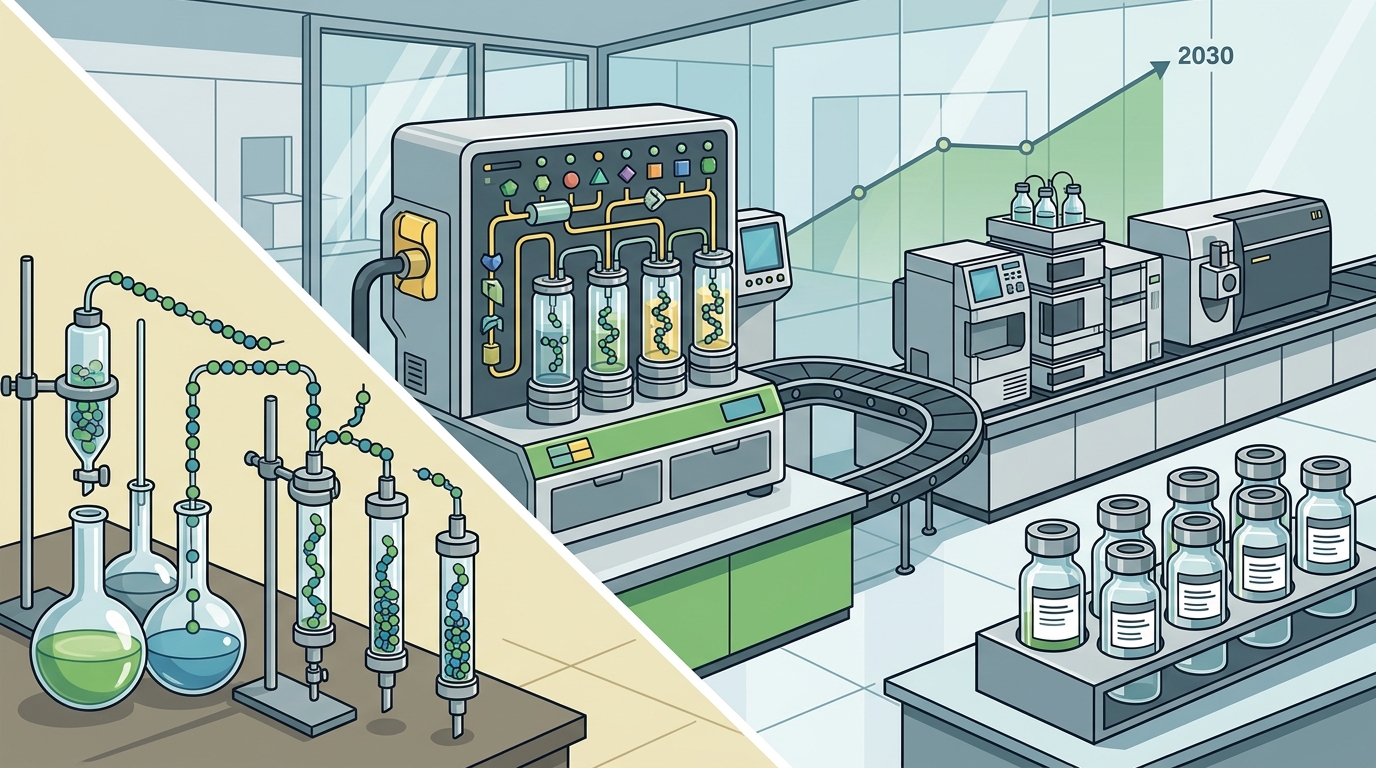
Peptide synthesis has moved from laborious manual processes to highly automated, high-throughput systems. The foundational breakthrough in this field was the development of solid-phase peptide synthesis (SPPS) by Bruce Merrifield in the 1960s. This method allowed for the rapid assembly of peptides by attaching the C-terminal amino acid to an insoluble polymer support. Nobel Prize records confirm that this innovation revolutionized organic chemistry by enabling the synthesis of complex biological molecules without the need for intermediate purification steps.
Today, the evolution of SPPS has introduced advanced coupling reagents and microwave-assisted synthesis techniques. These advancements have significantly reduced synthesis times and improved yields for difficult sequences. The ability to synthesize peptides with non-natural amino acids has further expanded the toolkit available to researchers. This flexibility is crucial for developing stable analogs for therapeutic and diagnostic applications.
Another significant development is the shift towards continuous flow chemistry. While batch SPPS remains dominant, flow chemistry offers better heat and mass transfer, leading to more consistent results for long peptides. This technological progression ensures that researchers can access higher quality materials with greater precision and reproducibility. (Privacy Policy Aevitas Research)
The Critical Role of Reference Materials
Reference materials are the cornerstone of analytical accuracy in life sciences. A reference material is a substance or material, sufficiently homogeneous and stable with respect to one or more specified properties, which has been established to be fit for its intended use in a measurement process. The availability of certified reference materials (CRMs) has become increasingly important as regulatory standards tighten.
In the context of peptide research, the availability of high-purity standards allows for the calibration of mass spectrometers and chromatography systems. Without these standards, data generated across different laboratories would lack comparability. ISO guidelines specify that reference materials must be traceable to international standards to ensure global consistency in scientific data.
The demand for custom reference materials has grown alongside the complexity of biological assays. Researchers often require peptides with specific modifications, such as phosphorylation or glycosylation, to study post-translational modifications. The ability to source these specialized materials quickly is a key factor in accelerating research timelines.
Quality Control and COA Standards
Quality control is non-negotiable in peptide synthesis. The Certificate of Analysis (COA) serves as the primary document verifying the identity and purity of a synthesized peptide. A comprehensive COA typically includes data from high-performance liquid chromatography (HPLC) and mass spectrometry (MS). These analytical techniques provide definitive proof of the peptide's structural integrity.
At Aevitas Research, we prioritize transparency by providing detailed COAs for all products. This commitment to verified quality ensures that researchers can trust the data generated from our materials. The availability of COAs is not just a regulatory requirement but a scientific necessity for publishing reproducible results.
Furthermore, the industry is moving towards more stringent purity standards. Peptides with purity levels exceeding 98% are now the standard for many applications. Achieving this level of purity requires advanced purification techniques and rigorous quality assurance protocols. Researchers must carefully evaluate the COA data to ensure the material meets their specific experimental needs.
Custom Peptide Synthesis Workflows
Custom peptide synthesis allows researchers to design molecules tailored to their specific experimental requirements. This process involves selecting the amino acid sequence, choosing appropriate modifications, and determining the desired purity level. The workflow typically begins with a detailed consultation to define the project scope.
One of the key advantages of custom synthesis is the ability to incorporate non-natural amino acids. These modified residues can enhance the stability, binding affinity, or solubility of the peptide. For example, D-amino acids are often used to increase resistance to proteolytic degradation. This level of customization is essential for developing novel therapeutics and diagnostic tools.
The scalability of custom synthesis is another critical factor. Researchers may start with milligram quantities for proof-of-concept studies and scale up to gram quantities for preclinical testing. A reliable supplier must be capable of handling this range of demands while maintaining consistent quality. Our product catalog highlights the range of synthesis capabilities available to support various research stages.
Comparison of Synthesis Approaches
Understanding the differences between various synthesis approaches is vital for selecting the right strategy. The table below compares common methods based on scale, purity, and application.
| Method | Typical Scale | Purity Level | Best Use Case |
|---|---|---|---|
| Batch SPPS | Milligram to Gram | 80-95% | General research and screening |
| Flow Chemistry | Gram to Kilogram | 90-98% | Long peptides and complex sequences |
| Native Chemical Ligation | Milligram to Gram | 95-99% | Large proteins and therapeutic candidates |
Each method has its strengths and limitations. Batch SPPS is cost-effective for short peptides but can struggle with longer sequences. Flow chemistry offers better control for difficult syntheses but requires specialized equipment. Native chemical ligation is ideal for large molecules but is technically demanding. Researchers must weigh these factors when planning their projects.
Key Takeaways
- The global peptide market is projected to reach 25 billion USD by 2030, driven by demand for custom synthesis.
- Solid-phase peptide synthesis (SPPS) remains the dominant method due to its automation and efficiency.
- Certified reference materials are essential for ensuring data reproducibility across laboratories.
- High-purity standards (98%+) are becoming the norm for critical research applications.
- Custom synthesis allows for the incorporation of non-natural amino acids for enhanced stability.
- Detailed Certificates of Analysis (COA) are critical for verifying peptide identity and purity.
- Flow chemistry is emerging as a superior method for synthesizing long and complex peptides.
Frequently Asked Questions
What is the difference between standard and custom peptide synthesis?
Standard synthesis involves producing common peptides that are available from stock. Custom synthesis is tailored to specific sequences and modifications requested by the researcher, offering greater flexibility for unique experimental needs.
Why is a Certificate of Analysis (COA) important?
A COA provides verified data on the purity, identity, and quality of the peptide. It ensures that the material meets the specified standards and is suitable for the intended research application.
Can non-natural amino acids be included in custom peptides?
Yes, custom synthesis allows for the incorporation of non-natural amino acids. These modifications can enhance peptide stability, binding affinity, and solubility.
What purity levels are typically available?
Purity levels typically range from 80% to over 98%. Higher purity levels are required for sensitive applications such as therapeutic development and structural biology.
How does flow chemistry improve peptide synthesis?
Flow chemistry offers better heat and mass transfer compared to batch synthesis. This leads to more consistent results and higher yields for difficult sequences.
What is the role of reference materials in research?
Reference materials are used to calibrate analytical instruments and validate assays. They ensure that data generated in different laboratories are comparable and accurate.
How can I request a custom peptide synthesis?
You can request custom synthesis by contacting our support team or submitting a detailed specification through our contact page. We will provide a quote and timeline based on your requirements.
Contact and Support
For detailed information on our custom synthesis capabilities, quality control standards, and reference material availability, please visit our contact page. Our team is ready to assist you with your specific research needs. We also provide comprehensive Certificates of Analysis for all our products to ensure transparency and trust. Explore our product catalog to see the range of materials available for your next project.