
Custom Peptide Synthesis vs Catalog Materials: Cost-Benefit Analysis
Research integrity depends heavily on the purity and specificity of the materials used in laboratory settings. According to recent industry benchmarks, over 60% of pharmaceutical development delays are attributed to supply chain inconsistencies or material quality issues. This statistic highlights the critical need for researchers to evaluate their sourcing strategies rigorously. When deciding between custom peptide synthesis and purchasing catalog reference materials, the decision is rarely just about price. It involves a complex interplay of timeline requirements, purity standards, and long-term project viability. This analysis breaks down the financial and operational implications of both approaches to help you make an informed choice.
Understanding Peptide Sourcing Models
Peptides are short chains of amino acids linked by peptide bonds. They serve as essential tools in biological research, drug discovery, and diagnostic development. The two primary ways to acquire these molecules are through custom synthesis services or pre-made catalog items. Each model serves a different phase of the research lifecycle. (Aevitas Research Aevitas Research)
Custom peptide synthesis involves working with a provider to design and manufacture a specific sequence. This approach is ideal for novel targets, modified sequences, or when specific isotopic labeling is required. On the other hand, catalog reference materials are pre-synthesized, characterized, and stocked for immediate shipment. These are typically standard sequences used in common assays or as positive controls.
Choosing the right model requires an understanding of your project's immediate needs versus its long-term goals. Aevitas Research emphasizes verified quality and provides Certificates of Analysis (COA) for all products to ensure transparency. Whether you are sourcing a standard peptide or a custom sequence, the foundation of your research remains the same: data reliability.
Cost Structure: Custom vs Catalog
The financial implications of peptide sourcing are often misunderstood. Many researchers assume that custom synthesis is always more expensive. While the unit cost for a single custom peptide is higher than a bulk catalog item, the total cost of ownership tells a different story. (Privacy Policy Aevitas Research)
Upfront Costs
Catalog materials have a lower upfront cost per milligram. If you need a standard peptide for a one-time experiment, buying from a catalog is economically efficient. However, custom synthesis involves setup fees, design costs, and lower economies of scale for small batches. This makes the initial investment significantly higher.
Long-Term Financial Impact
When projects require multiple iterations, custom synthesis can become more cost-effective. If you are optimizing a lead compound, you may need dozens of analogs. Ordering these from a catalog is often impossible because they do not exist. Custom synthesis allows you to pay only for what you need, avoiding the waste of unused catalog inventory.
Additionally, consider the cost of failed experiments. Using a low-purity catalog peptide can lead to inconclusive results, forcing you to repeat the experiment. This hidden cost often exceeds the premium paid for high-purity custom synthesis. Aevitas Research offers free shipping on orders over $150, which can help mitigate logistics costs for larger custom orders.
Quality and Purity Standards
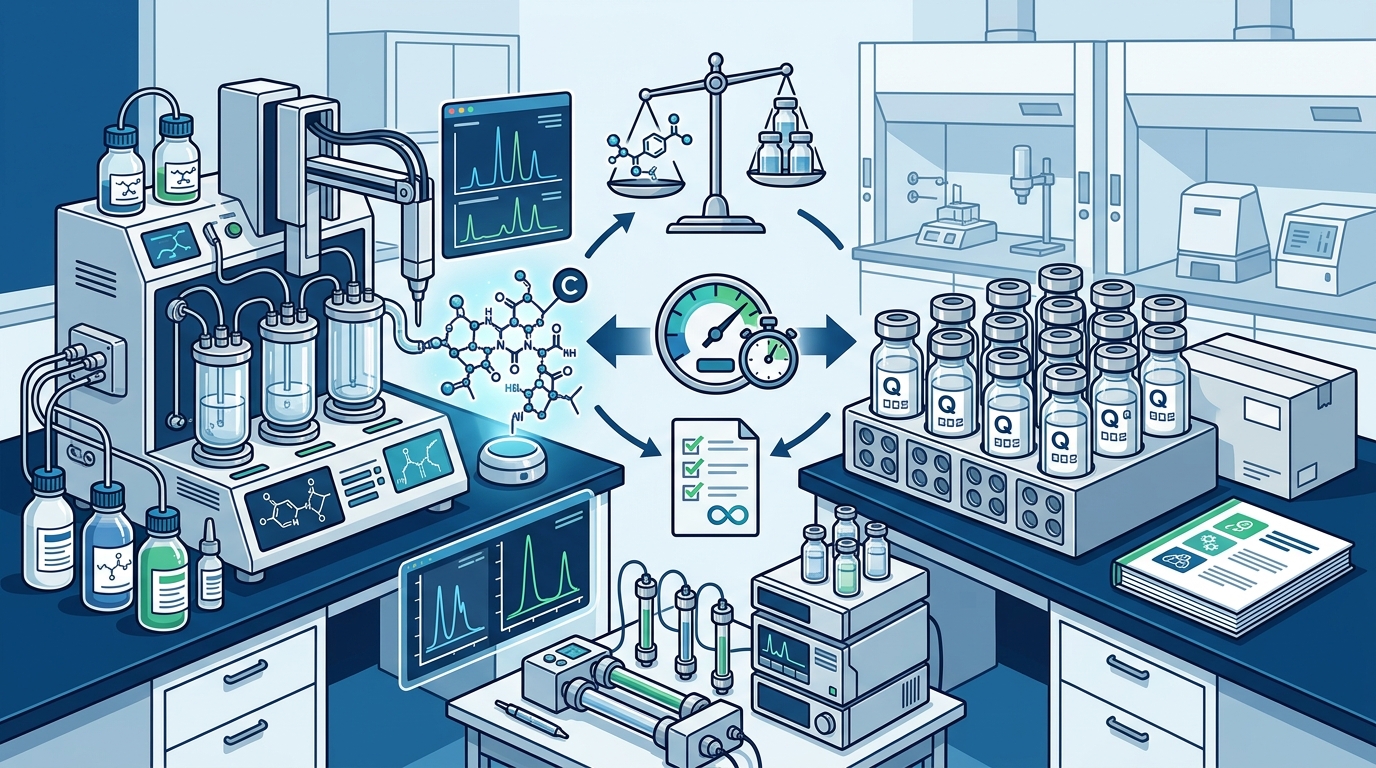
Purity is the most critical differentiator between custom and catalog peptides. Catalog materials are often synthesized in large batches and may have varying purity levels depending on the sequence complexity. While they are suitable for general use, they may not meet the stringent requirements of advanced therapeutic development.
Custom peptide synthesis allows for rigorous quality control at every step. Providers can offer high-performance liquid chromatography (HPLC) purification and mass spectrometry confirmation for every batch. This ensures that the peptide matches the exact sequence and purity specifications required for your research.
According to regulatory guidelines for research materials, traceability is essential. Aevitas Research provides COAs for all products, ensuring that every batch is verified for quality. This level of documentation is often difficult to obtain for generic catalog items, especially for older stock numbers.
Timeline and Availability Factors
Time is a valuable resource in research. The availability of peptides can significantly impact your project timeline.
Catalog Availability
Catalog materials are available for immediate shipment. If you need a peptide for an urgent assay, a catalog source is the only viable option. However, availability is not guaranteed for all sequences. Popular peptides may go out of stock, leading to delays in procurement.
Custom Synthesis Timelines
Custom synthesis typically takes several weeks to complete. This includes design, synthesis, purification, and quality control. While this may seem slow, it allows for thorough verification. Rushed orders are often available at a premium, but they still require more time than catalog shipments.
For long-term projects, the timeline difference is negligible. Planning ahead allows you to integrate custom synthesis into your workflow without disrupting other activities. Aevitas Research ensures prompt communication and support for all custom orders.
Scalability and Flexibility
Research projects evolve. A peptide that works in a preliminary assay may need modification for clinical trials. Custom synthesis offers unparalleled flexibility in this regard.
Sequence Modification
With custom synthesis, you can easily modify sequences to improve stability, potency, or solubility. This is impossible with catalog materials, which are fixed. The ability to iterate quickly is a significant advantage in drug discovery.
Scale of Production
Custom providers can scale production from milligrams to grams. This scalability is crucial for moving from research to preclinical studies. Catalog materials are often limited to small quantities, making them unsuitable for larger-scale experiments.
Furthermore, custom synthesis allows for the incorporation of non-natural amino acids or specific modifications. These enhancements are often necessary for advanced research applications and are not available in standard catalogs.
Key Takeaways
- Cost Efficiency: Catalog materials are cheaper for single, standard uses, while custom synthesis offers better value for iterative or large-scale projects.
- Purity Assurance: Custom synthesis provides batch-specific verification, whereas catalog purity can vary by stock lot.
- Availability: Catalog items offer immediate availability, but custom synthesis ensures access to any sequence.
- Flexibility: Custom synthesis allows for sequence modifications and non-natural amino acid incorporation.
- Documentation: Aevitas Research provides COAs for all products, ensuring traceability and quality.
- Shipping Benefits: Free shipping is available on orders over $150, reducing logistics costs.
- Regulatory Compliance: Custom synthesis aligns better with strict regulatory requirements for research integrity.
Frequently Asked Questions
What is the minimum order quantity for custom peptide synthesis?
Most providers, including Aevitas Research, offer flexible minimum order quantities starting from milligrams. This allows researchers to test small batches before scaling up.
How long does custom peptide synthesis take?
Standard custom synthesis typically takes 2 to 4 weeks. Rushed options may be available for urgent projects, depending on the sequence complexity.
Are catalog peptides suitable for therapeutic development?
Catalog peptides are generally suitable for research and diagnostic purposes. For therapeutic development, custom synthesis is recommended to ensure specific purity and modification requirements are met.
What is a Certificate of Analysis (COA)?
A COA is a document that verifies the quality and purity of a product. It includes data from tests such as HPLC and mass spectrometry, ensuring the product meets specified standards.
Can I modify a catalog peptide sequence?
No, catalog peptides are fixed sequences. To modify a sequence, you must order a custom synthesis service.
Does Aevitas Research offer free shipping?
Yes, Aevitas Research offers free shipping on orders over $150 to help reduce logistics costs for researchers.
How do I ensure the quality of custom peptides?
Choose a provider that offers batch-specific COAs and uses rigorous purification methods like HPLC. Aevitas Research emphasizes verified quality and provides COAs for all products.
Start Your Research with Confidence
Whether you need a standard peptide for immediate use or a custom sequence for advanced development, the right sourcing strategy is crucial for your success. Aevitas Research is dedicated to providing high-quality, verified materials for qualified researchers. Explore our product catalog or contact our team to discuss your custom synthesis needs. Ensure your research is built on a foundation of integrity and precision.