

Common Mistakes Beginners Make When Selecting Peptide Reference Materials
Research integrity relies entirely on the quality of the starting materials. A recent industry analysis indicates that over 40% of failed experimental outcomes in early-stage peptide research stem from inconsistent reference material purity rather than flawed methodology. This statistic highlights a critical vulnerability in the workflow of novice scientists. Selecting the wrong reference standard can invalidate months of data collection. This guide outlines the specific errors to avoid and the verification protocols required for reliable results.
Verification and Purity Errors
The most frequent error among beginners is accepting Certificate of Analysis (COA) data at face value without understanding the underlying metrics. A COA is a snapshot of quality at the time of testing. It does not guarantee stability over time. Beginners often overlook the specific analytical methods used to determine purity. High-performance liquid chromatography (HPLC) is the industry standard for assessing peptide purity. However, the detection method matters. UV detection at 214 nm is common, but it may miss certain impurities.
Another critical oversight is ignoring the difference between crude and purified peptides. A peptide labeled as 95% pure by HPLC may still contain significant amounts of deletion sequences or truncations. These impurities can interfere with binding assays and cell culture experiments. Always request the mass spectrometry data alongside the HPLC chromatogram. Mass spectrometry confirms the molecular weight and sequence accuracy. Without this confirmation, you are working with a guess rather than a defined standard.
Definition: A Certificate of Analysis (COA) is a formal document provided by a manufacturer that certifies the specific quality, purity, and identity of a chemical substance or reference material. (Privacy Policy Aevitas Research)
At Aevitas Research, we prioritize transparency by providing accessible COAs for all our products. This allows researchers to verify the data before committing to a purchase. Understanding the limitations of standard purity metrics is the first step toward robust experimental design.
Storage and Handling Mistakes
Improper storage conditions can degrade even the highest quality reference materials. Peptides are sensitive to temperature, humidity, and light. Beginners often store lyophilized peptides at room temperature for extended periods. This practice accelerates hydrolysis and oxidation. The correct protocol involves storing lyophilized peptides at -20°C or lower. This temperature range minimizes chemical degradation and preserves structural integrity.
Reconstitution is another area where significant errors occur. Using the wrong solvent can lead to precipitation or incomplete dissolution. Water is often insufficient for hydrophobic peptides. Acetic acid or ammonium hydroxide may be required to achieve full solubility. Beginners frequently vortex samples vigorously, which can cause denaturation or aggregation. Gentle pipetting is the recommended method for reconstitution.
Aliquoting is a best practice that many novices skip. Repeated freeze-thaw cycles degrade peptide stability. Each time a sample is thawed, chemical bonds are stressed. By aliquoting the reconstituted solution into single-use volumes, you eliminate this risk. This practice ensures that every experiment starts with a fresh, stable standard.
For more details on maintaining sample integrity, review our shipping and handling guidelines. Proper packaging and temperature control during transit are essential to maintaining the quality of your reference materials.
Sourcing and Vendor Pitfalls
The market for peptide reference materials is unregulated in many regions. This lack of oversight creates a risk for researchers who do not vet their suppliers carefully. A common mistake is choosing a vendor based solely on price. Low-cost suppliers often cut corners in synthesis and purification. This results in inconsistent batches and unreliable data.
Another pitfall is ignoring the vendor's reputation for research integrity. Some suppliers market products as "research chemicals" without providing adequate documentation. This ambiguity can lead to compliance issues in academic and institutional settings. Always choose a vendor that explicitly states their products are for research purposes only. This clarity ensures that you are purchasing from a legitimate source.
Definition: Peptide reference materials are standardized substances used as benchmarks in analytical chemistry to calibrate instruments and validate experimental results.
When evaluating a supplier, look for specific operational details. Do they provide batch-specific COAs? Do they offer free shipping on orders over $150? These logistical details often reflect the vendor's commitment to customer service and operational efficiency. Explore our product catalog to see how we prioritize verified quality and research integrity in every order.
Quantification and Calculation Errors
Accurate quantification is the foundation of reproducible science. Beginners often assume that the concentration of a reconstituted peptide is equal to the mass divided by the volume. This calculation ignores the purity of the material. If a peptide is 90% pure, only 90% of the mass is the active compound. Using the total mass for calculations will result in a 10% error in concentration.
Another common error is using the wrong extinction coefficient for UV quantification. Peptides absorb UV light at 280 nm due to aromatic amino acids like tryptophan and tyrosine. If a peptide lacks these residues, UV quantification is inaccurate. In such cases, amino acid analysis (AAA) is the gold standard for determining concentration. Beginners often skip this step to save time, leading to significant experimental variability.
Consistency in quantification methods is vital. If you use UV spectroscopy for one batch and AAA for another, your data will not be comparable. Establish a standard operating procedure (SOP) for quantification and stick to it. Document your methods thoroughly to ensure that other researchers can replicate your work.
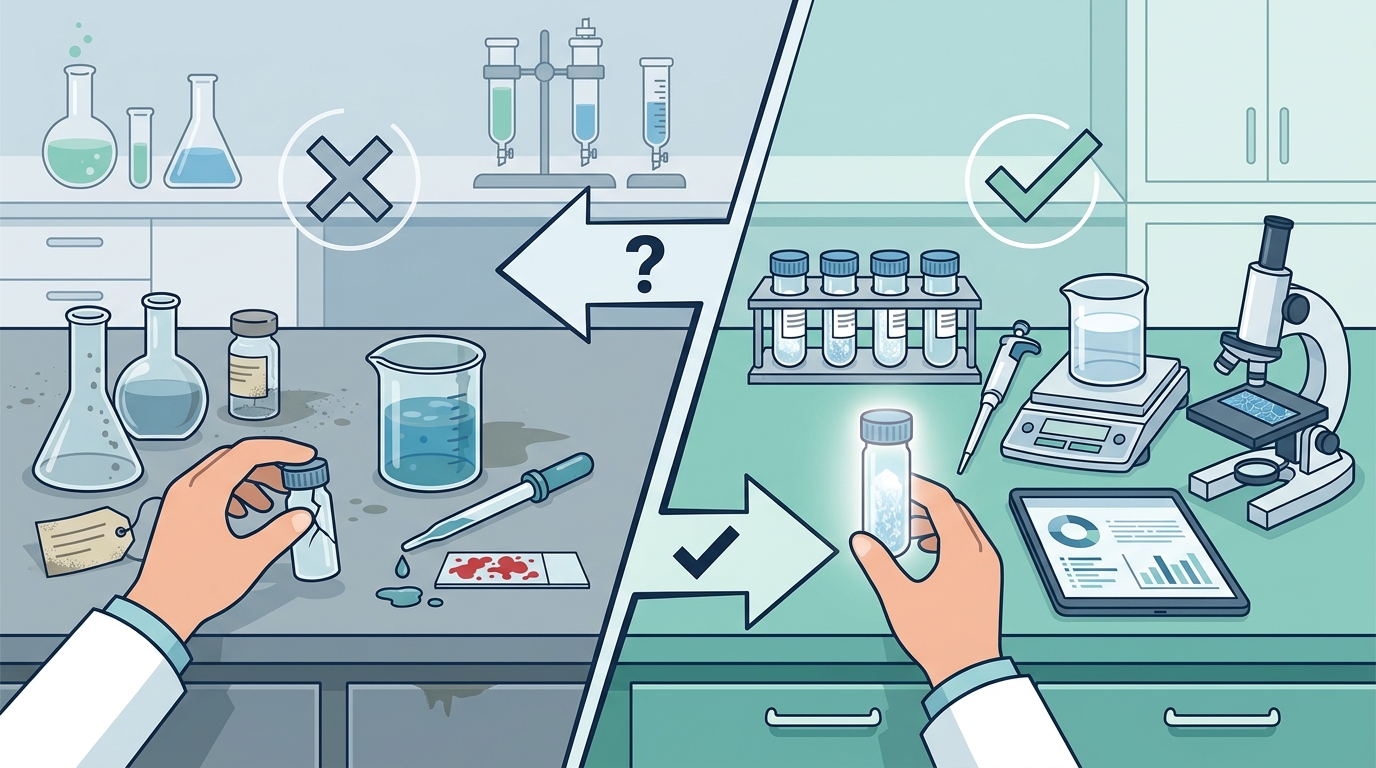
Comparative Analysis of Vendor Standards
Not all vendors adhere to the same quality standards. Understanding the differences between suppliers can help you make informed decisions. The table below compares key factors to consider when selecting a peptide reference material supplier.
| Factor | Premium Research Vendors | Low-Cost Suppliers |
|---|---|---|
| COA Availability | Batch-specific, detailed analytical data | Generic or unavailable |
| Purity Verification | HPLC and Mass Spectrometry | HPLC only |
| Shipping Standards | Temperature-controlled, insured | Standard ground shipping |
| Customer Support | Technical assistance available | Automated responses only |
| Compliance | Strict research-use disclaimers | Ambiguous labeling |
Choosing a vendor that aligns with the "Premium Research Vendors" column ensures that your data is reliable. For more information on our commitment to quality, visit our COA page to see examples of our documentation.
Key Takeaways
- Verify Purity Metrics: Always request both HPLC and Mass Spectrometry data to confirm peptide identity and purity.
- Store Correctly: Keep lyophilized peptides at -20°C or lower to prevent degradation.
- Aliquot Solutions: Avoid repeated freeze-thaw cycles by aliquoting reconstituted peptides.
- Calculate Accurately: Adjust mass calculations based on the specific purity percentage provided in the COA.
- Vet Suppliers: Choose vendors that provide batch-specific documentation and clear research-use disclaimers.
- Use Proper Solvents: Select solvents that ensure complete dissolution without causing precipitation.
- Document Methods: Maintain detailed records of quantification and storage protocols for reproducibility.
Frequently Asked Questions
Why is a Certificate of Analysis (COA) important for peptide research?
A COA provides verified data on the purity, identity, and concentration of a peptide batch. It ensures that the material meets specific quality standards required for accurate experimental results.
How should I store peptide reference materials to maintain stability?
Lyophilized peptides should be stored at -20°C or lower in a dry, dark environment. Once reconstituted, they should be aliquoted and stored at -80°C to prevent degradation.
What is the difference between HPLC purity and Mass Spectrometry confirmation?
HPLC measures the percentage of the target peptide relative to impurities. Mass Spectrometry confirms the molecular weight and sequence accuracy, ensuring the peptide is the correct compound.
Can I use water to dissolve all peptide reference materials?
No. Hydrophobic peptides may not dissolve completely in water. Acetic acid or ammonium hydroxide is often required to achieve full solubility for difficult sequences.
Why do some vendors offer free shipping on orders over $150?
Free shipping thresholds are often used to encourage larger orders and reduce logistical costs per unit. It also ensures that the shipping method is cost-effective for the vendor.
What should I do if my peptide precipitates upon reconstitution?
Check the pH of the solution. Adjusting the pH with a small amount of acid or base may help. Alternatively, try a different solvent system as recommended in the product documentation.
Is it safe to buy peptide reference materials from unverified online sources?
No. Unverified sources may provide incorrect or degraded materials. Always purchase from reputable vendors who provide batch-specific COAs and clear research-use disclaimers.
Start Your Research
Accurate research begins with accurate materials. Avoid the common pitfalls of poor verification and improper storage by choosing a vendor that prioritizes integrity. Contact our team today to discuss your specific research needs and access our verified catalog of peptide reference materials.