

The global market for custom peptide synthesis is experiencing rapid expansion as academic and private laboratories demand higher purity standards for complex biological studies. According to recent industry analysis, the peptide therapeutics and research supply sector is projected to grow at a compound annual growth rate exceeding 8% through 2030. This surge is driven by the increasing need for precise molecular tools in drug discovery and biomarker validation. Researchers must navigate a landscape where quality control is not merely a regulatory formality but a foundational requirement for reproducible data. At Aevitas Research, we prioritize verified quality and comprehensive Certificates of Analysis (COA) to ensure that every synthesis batch meets rigorous scientific standards.
Synthesis Methodologies and Chemical Stability
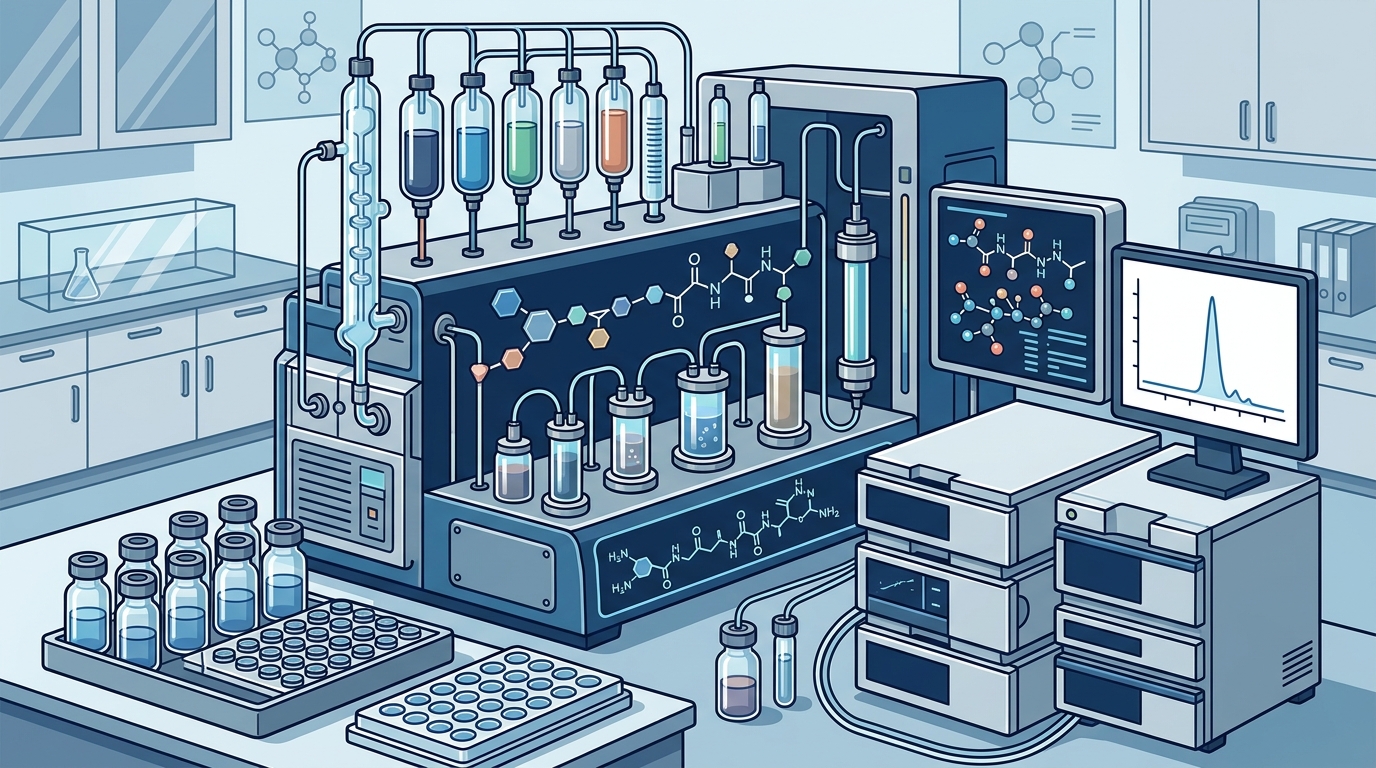
Custom peptide synthesis primarily relies on Solid Phase Peptide Synthesis (SPPS). This method allows for the stepwise addition of amino acids to a growing chain anchored to an insoluble resin. The process begins with the deprotection of the N-terminal amino group, followed by coupling with the next protected amino acid. This cycle repeats until the desired sequence is complete. The final step involves cleaving the peptide from the resin and removing side-chain protecting groups. (Aevitas Research Aevitas Research)
Chemical stability is a critical factor in peptide design. Peptides are susceptible to degradation through hydrolysis, oxidation, and aggregation. To mitigate these risks, researchers often incorporate non-natural amino acids or cyclize the peptide backbone. Aevitas Research utilizes advanced purification techniques to ensure that the final product maintains its structural integrity. For detailed information on our specific synthesis protocols, you can visit our Products page.
Acetylation and Amidation
Terminal modifications are common in custom peptide orders. Acetylation of the N-terminus and amidation of the C-terminus are frequently requested to stabilize the peptide charge and prevent enzymatic degradation. These modifications do not alter the core sequence but significantly impact the peptide's biological activity and solubility. Understanding these nuances is essential for designing effective research tools.
Quality Assurance and COA Verification
Quality assurance is the cornerstone of reliable research outcomes. A Certificate of Analysis (COA) provides essential data regarding the purity, concentration, and identity of the synthesized peptide. High-performance liquid chromatography (HPLC) is used to determine purity levels, while mass spectrometry confirms the molecular weight and sequence accuracy. At Aevitas Research, every batch is accompanied by a comprehensive COA to ensure transparency and traceability. (Privacy Policy Aevitas Research)
Verification of quality is not optional in high-stakes research. Inaccurate data can lead to wasted resources and flawed conclusions. Our commitment to verified quality means that we adhere to strict manufacturing guidelines. Researchers can access detailed COAs for each product via our dedicated COA portal. This ensures that you have immediate access to the analytical data required for your experimental protocols.
Purity Thresholds
Different research applications require different purity thresholds. For structural biology studies, purity levels exceeding 98% are often necessary. In contrast, preliminary screening assays may tolerate slightly lower purity if the cost-benefit analysis supports it. Aevitas Research offers tailored purification services to meet these specific requirements. We understand that budget constraints are real, but compromising on quality is never an option.
Procurement Logistics and Shipping Standards
Efficient procurement logistics are vital for maintaining the integrity of sensitive biological materials. Peptides are typically shipped in lyophilized form to enhance stability during transit. Proper packaging ensures that the product remains stable at room temperature for short durations, though long-term storage requires freezing. Aevitas Research provides free shipping on orders over $150, reducing the financial burden on researchers.
Compliance with international shipping regulations is mandatory for cross-border research supply. Our team ensures that all documentation is accurate and that hazardous material declarations are handled correctly. For questions regarding shipping and payment options, please refer to our Shipping & Payments page. We strive to make the procurement process as seamless as possible.
Storage and Handling
Proper storage is critical for preserving peptide functionality. Lyophilized peptides should be stored at -20°C or lower. Once reconstituted, peptides should be aliquoted to avoid repeated freeze-thaw cycles, which can degrade the sample. Aevitas Research provides detailed handling instructions with every order. You can also review our Refunds & Returns policy for any concerns regarding product delivery.
Research Applications and Target Specificity
Custom peptides are indispensable tools in various research domains. They are used in antibody production, epitope mapping, and enzyme inhibition studies. The ability to design peptides with specific sequences allows researchers to probe biological pathways with high precision. For example, custom peptides can be designed to mimic a specific protein domain, enabling the study of protein-protein interactions.
The versatility of custom peptides extends to diagnostic applications as well. They can be conjugated with fluorophores or biotin for detection assays. Aevitas Research supports a wide range of modifications to facilitate these applications. Our Contact team is available to discuss your specific research needs and provide expert guidance on peptide design.
Antibody Generation
One of the most common uses of custom peptides is in the generation of polyclonal antibodies. The peptide serves as the immunogen, stimulating an immune response that produces antibodies specific to the target protein. The quality of the resulting antibodies depends heavily on the purity and solubility of the peptide. Aevitas Research ensures that our peptides are optimized for this purpose.
Synthesis Options Comparison
Choosing the right synthesis option depends on the complexity of the peptide and the intended application. Below is a comparison of common synthesis approaches.
| Feature | Standard SPPS | Modified SPPS | Recombinant Expression |
|---|---|---|---|
| Sequence Length | Up to 50 residues | Up to 100 residues | Large proteins |
| Purity Level | High (>95%) | Very High (>98%) | Variable |
| Cost | Low | Medium | High |
| Customization | Limited | Extensive | High |
For more information on our service offerings, please visit our Shop. We provide transparent pricing and detailed specifications for each synthesis option.
Key Takeaways
- Custom peptide synthesis is essential for precise biological research and drug discovery.
- Solid Phase Peptide Synthesis (SPPS) is the industry standard for producing high-purity peptides.
- A Certificate of Analysis (COA) is critical for verifying peptide purity and identity.
- Aevitas Research offers verified quality products with comprehensive documentation.
- Proper storage and handling are necessary to maintain peptide stability.
- Free shipping is available on orders over $150 to support research budgets.
- Custom modifications such as acetylation and amidation enhance peptide functionality.
Frequently Asked Questions
What is the minimum order quantity for custom peptides?
Aevitas Research typically requires a minimum order quantity based on the purity level and sequence length. We recommend contacting our support team for specific details regarding your project.
How long does custom peptide synthesis take?
The synthesis timeline depends on the complexity of the peptide. Standard orders may take 2-4 weeks, while complex modifications can extend this period. We provide estimated timelines upon order confirmation.
Can I request specific modifications for my peptide?
Yes, we offer a wide range of modifications including acetylation, amidation, and fluorescent tagging. Please specify your requirements when placing your order.
What is the shelf life of lyophilized peptides?
Lyophilized peptides are stable for several years when stored at -20°C. Once reconstituted, they should be used promptly or stored at -80°C in aliquots.
Do you provide Certificates of Analysis for all products?
Yes, every custom peptide order is accompanied by a detailed COA including HPLC and mass spectrometry data. You can access these via our COA portal.
How do I track my order?
Tracking information is provided via email once your order has been shipped. You can also check our Shipping & Payments page for more details.
What is your refund policy?
We have a clear Refunds & Returns policy that outlines the conditions under which refunds or replacements are issued. Please review this page for specific guidelines.
Contact and Support
For expert guidance on custom peptide synthesis, contact Aevitas Research today. Our team is dedicated to supporting your research with high-quality products and reliable service. Visit our Contact page to get in touch. We look forward to partnering with you for your scientific endeavors.