

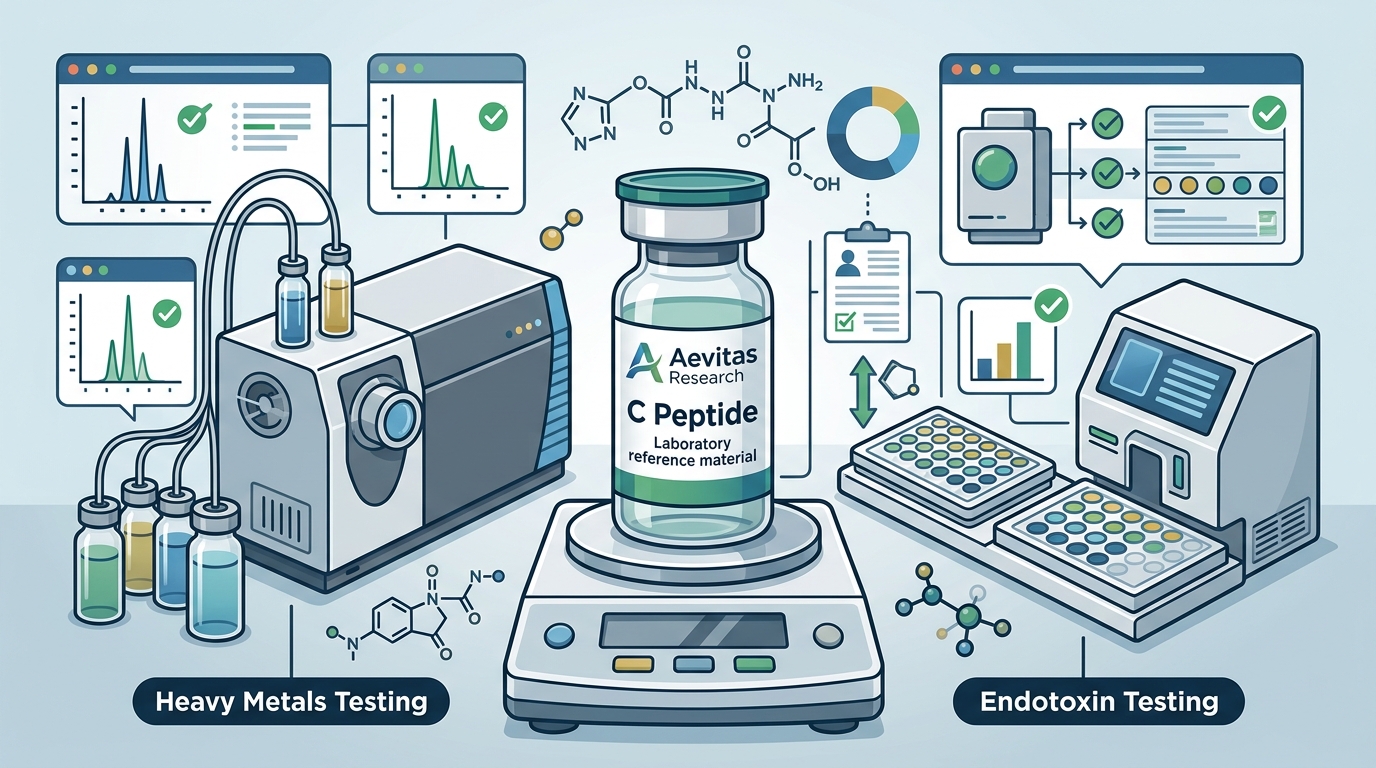
Most peptide suppliers only verify purity and identity. Aevitas Research tests for heavy metals and endotoxins on every batch. This guide explains the scientific rationale, testing methods, and quality standards that distinguish rigorous research-grade suppliers from basic vendors. according to C Peptide Test
Endotoxin Testing Standards
Endotoxin testing is a critical quality control step for any biological material intended for research applications. Endotoxins are lipopolysaccharides found in the outer membrane of Gram-negative bacteria. They are highly stable and can survive standard sterilization processes. In research settings, even trace amounts of endotoxin can compromise experimental validity by triggering unintended immune responses in cell cultures or animal models. according to Heavy Metal Testing
The pharmaceutical and biotechnology industries rely on established pharmacopeial standards to ensure safety and consistency. The United States Pharmacopeia (USP) and the European Pharmacopoeia (Ph. Eur.) provide the primary frameworks for endotoxin testing. These standards define acceptable limits based on the intended application of the material. For research-grade peptides, adherence to these pharmacopeial methods ensures that the material is free from bacterial contamination that could skew data.
Pharmacopeial Requirements
USP <85> is the standard test for bacterial endotoxins. It specifies the use of the Limulus Amebocyte Lysate (LAL) assay. This method detects endotoxins by measuring the coagulation of horseshoe crab blood cells. The test is highly sensitive and can detect endotoxin levels as low as 0.005 endotoxin units per milliliter. Laboratories must validate their testing procedures against these pharmacopeial guidelines to ensure accuracy and reproducibility.
Compliance with these standards is not optional for serious research. It is a baseline requirement for maintaining data integrity. Suppliers who do not test for endotoxins leave a significant gap in their quality assurance process. This gap can lead to failed experiments, wasted resources, and compromised publications.
Endotoxin Screening Methods
There are two primary methods for detecting endotoxins in peptide preparations: the gel-clot method and the turbidimetric method. Both methods are based on the LAL assay but differ in their sensitivity and application. Understanding these methods helps researchers evaluate the rigor of a supplier's testing protocols. according to HPLC Analysis and
Gel-Clot Method
The gel-clot method is a qualitative test. It involves mixing the sample with LAL reagent and observing whether a gel forms. If a gel forms, endotoxins are present. This method is simple and cost-effective but lacks quantitative precision. It is suitable for initial screening but not for determining exact endotoxin levels. Many basic suppliers rely solely on this method, which provides a pass/fail result without detailed data.
Turbidimetric Method
The turbidimetric method is a quantitative test. It measures the change in light scattering as the LAL reagent coagulates in the presence of endotoxins. This method provides a numerical value for endotoxin concentration. It is more sensitive and precise than the gel-clot method. Aevitas Research utilizes quantitative turbidimetric assays to ensure that every batch meets strict endotoxin limits. This approach provides verifiable data that researchers can include in their documentation. according to LCD Heavy Metal
Quantitative testing is essential for reproducibility. It allows researchers to track endotoxin levels across different batches and over time. This consistency is critical for long-term research projects. Suppliers who offer only qualitative testing do not provide the level of detail required for rigorous scientific inquiry. according to Joint association of
Heavy Metals Analysis
Heavy metal contamination is a significant concern in peptide synthesis. The chemical processes used to synthesize peptides can introduce trace metals from reagents, solvents, or equipment. Heavy metal testing is historically used to describe elements such as lead, arsenic, mercury, cadmium, and chromium. These metals can accumulate in biological systems and interfere with enzymatic reactions. In research, heavy metal contamination can lead to false results and compromised data integrity.
Environmental pollution with heavy metals can result in contamination of air, water, and soil, which can indirectly affect the raw materials used in peptide synthesis. Heavy metal toxicity is a well-documented phenomenon in toxicology. Even trace amounts can have significant biological effects. Therefore, rigorous testing for heavy metals is essential for ensuring the purity and safety of research-grade peptides.
Inductively Coupled Plasma Mass Spectrometry (ICP-MS)
ICP-MS is the gold standard for heavy metal analysis. It is a highly sensitive technique that can detect metals at parts-per-trillion levels. This method involves ionizing the sample in a plasma and measuring the mass-to-charge ratio of the ions. ICP-MS provides a comprehensive profile of multiple metals in a single run. It is the preferred method for laboratories that require high precision and low detection limits.
Atomic Absorption Spectroscopy (AAS)
AAS is another common method for heavy metal analysis. It measures the absorption of light by free atoms in the gas phase. AAS is less sensitive than ICP-MS but is still widely used for routine testing. It is suitable for detecting metals at parts-per-million levels. Some suppliers use AAS for their heavy metal testing, which may be sufficient for certain applications but lacks the sensitivity of ICP-MS.
Aevitas Research employs advanced analytical techniques to ensure that its peptides are free from heavy metal contamination. This commitment to quality extends beyond standard purity screening. It reflects a deep understanding of the potential risks associated with trace metal contamination in biological research. according to Study on the
Supplier Testing Comparison
Not all peptide suppliers adhere to the same testing standards. The table below compares the typical testing protocols of different supplier categories. This comparison highlights the importance of choosing a supplier that prioritizes comprehensive quality control.
| Supplier Category | Purity Testing | Endotoxin Testing | Heavy Metal Testing | Documentation |
|---|---|---|---|---|
| Basic Online Vendors | HPLC/MS | None or Qualitative | None | Basic COA |
| Mid-Tier Suppliers | HPLC/MS | Qualitative (Gel-Clot) | AAS | Standard COA |
| Aevitas Research | HPLC/MS | Quantitative (Turbidimetric) | ICP-MS | Full COA with Raw Data |
This comparison illustrates the significant differences in testing rigor among suppliers. Basic vendors often skip endotoxin and heavy metal testing entirely. Mid-tier suppliers may perform qualitative endotoxin testing and basic heavy metal analysis. Aevitas Research goes further by employing quantitative methods and advanced analytical techniques. This level of testing ensures that researchers receive materials that meet the highest standards of quality and purity.
Key Takeaways
- Endotoxin testing is a critical quality control step for research-grade peptides.
- The USP <85> standard defines the acceptable limits for bacterial endotoxins.
- Quantitative turbidimetric assays provide more precise data than qualitative gel-clot methods.
- Heavy metal contamination can compromise experimental validity and data integrity.
- ICP-MS is the gold standard for heavy metal analysis due to its high sensitivity.
- Aevitas Research tests for both endotoxins and heavy metals on every batch. according to Heavy Metal Toxicity
- Choosing a supplier with comprehensive testing protocols is essential for rigorous research.
- Full documentation, including raw data, is a hallmark of a trustworthy supplier.
Frequently Asked Questions
Why is endotoxin testing important for research peptides?
Endotoxins can trigger unintended immune responses in cell cultures or animal models. This can compromise experimental validity and lead to false results. Testing for endotoxins ensures that the peptide material is free from bacterial contamination.
What is the difference between qualitative and quantitative endotoxin testing?
Qualitative testing, such as the gel-clot method, provides a pass/fail result. Quantitative testing, such as the turbidimetric method, provides a numerical value for endotoxin concentration. Quantitative testing is more precise and suitable for rigorous research applications.
Which heavy metals are typically tested for in peptides?
Does Aevitas Research test for heavy metals and endotoxins?
Yes, Aevitas Research tests for both heavy metals and endotoxins on every batch. This comprehensive testing ensures that the peptides meet the highest standards of quality and purity.
What is a Certificate of Analysis (COA)?
A Certificate of Analysis is a document that provides detailed information about the quality and purity of a product. It includes results from various testing methods, such as HPLC, MS, endotoxin testing, and heavy metal analysis. A full COA with raw data is a hallmark of a trustworthy supplier.
Why do some suppliers skip endotoxin and heavy metal testing?
Some suppliers skip these tests to reduce costs and increase production speed. However, this approach compromises quality and can lead to failed experiments. Choosing a supplier that prioritizes comprehensive testing is essential for rigorous research.
How can I verify a supplier's testing protocols?
Request a sample Certificate of Analysis and review the testing methods used. Look for evidence of quantitative endotoxin testing and advanced heavy metal analysis. A trustworthy supplier will provide full documentation and raw data upon request.
What is the role of pharmacopeial standards in peptide testing?
Pharmacopeial standards, such as USP <85>, define the acceptable limits for endotoxins and other contaminants. Adherence to these standards ensures consistency and reliability in testing. Suppliers who follow pharmacopeial guidelines demonstrate a commitment to quality and research integrity.
Conclusion
Choosing the right peptide supplier is critical for the success of your research. Basic purity screening is not enough. You need a supplier that tests for endotoxins and heavy metals using rigorous, quantitative methods. Aevitas Research is committed to providing research-grade peptides that meet the highest standards of quality and purity. By choosing Aevitas Research, you ensure that your experiments are built on a foundation of verified data and scientific integrity. Visit Aevitas Research to explore our comprehensive testing protocols and learn more about our commitment to research excellence.