

Leading peptide suppliers like Aevitas Research test for heavy metals and endotoxins alongside standard purity screening to ensure reference material integrity. This guide covers the scientific methods behind these tests, why they matter for research reproducibility, and how to evaluate supplier transparency. It explains the difference between basic HPLC purity and advanced safety profiling, helping researchers select materials that meet rigorous laboratory standards.
Endotoxin Screening Methods
Endotoxin testing is a critical quality control step for peptide reference materials. Endotoxins are lipopolysaccharides found in the outer membrane of Gram-negative bacteria. They are potent pyrogens that can trigger immune responses in biological systems. For research-grade peptides, the presence of endotoxins can compromise experimental validity by introducing uncontrolled variables into cell culture or in vitro assays. For additional details, review the Privacy Policy Aevitas Research.
The Limulus Amebocyte Lysate (LAL) Assay
Why Endotoxin Limits Matter in Research
Endotoxin limits are typically expressed in Endotoxin Units (EU) per milligram of peptide. For research applications, limits are often set at or below 0.1 EU/mg, though stricter limits may apply for specific sensitive assays. Aevitas Research adheres to these rigorous standards, ensuring that every batch of reference material is screened for endotoxin contamination. This screening is not optional; it is a fundamental component of the quality assurance protocol. By controlling for endotoxin levels, researchers can attribute observed biological effects to the peptide itself rather than to bacterial contaminants. This level of control is essential for publishing reproducible and credible scientific data. For additional details, review the .
Heavy Metals Analysis
Heavy metal contamination is another critical quality parameter for peptide reference materials. Heavy metals such as lead, arsenic, cadmium, and mercury can leach into peptide solutions from manufacturing equipment, water sources, or reagents. These metals can act as catalysts for degradation reactions or interfere with enzymatic assays. Therefore, rigorous testing for heavy metals is a hallmark of a reputable peptide supplier. For additional details, review the Customer Experience.
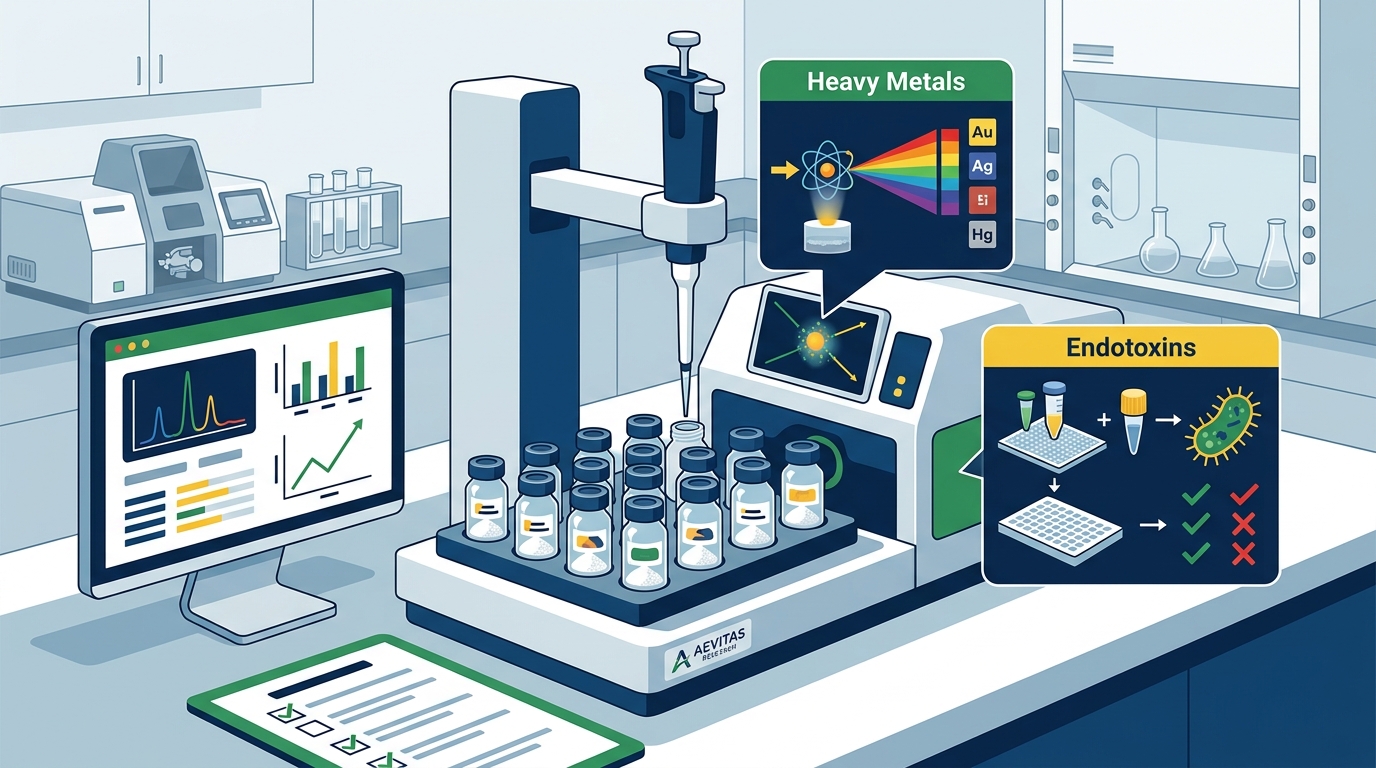
Inductively Coupled Plasma Mass Spectrometry (ICP-MS)
Pharmacopeial Standards for Heavy Metals
Heavy metal limits are often defined by pharmacopeial standards. The USP and EP provide specific limits for individual metals and total heavy metals. For example, the limit for lead is often set at 10 ppm (parts per million) or lower, depending on the intended application. By adhering to these standards, suppliers demonstrate their commitment to quality and safety. Researchers should look for suppliers who provide Certificates of Analysis (COA) that explicitly list heavy metal testing results. The absence of heavy metal data on a COA is a significant red flag, indicating that the supplier may not be performing this critical test. For additional details, review the Frequently Asked Questions.
Supplier Transparency and Documentation
The Role of the Certificate of Analysis
Testing Standards Comparison
The table below summarizes the key testing parameters for peptide reference materials. It highlights the difference between basic purity screening and advanced safety profiling. Researchers should use this table as a benchmark when evaluating potential suppliers.
| Test Parameter | Standard Method | Typical Limit | Importance for Research |
|---|---|---|---|
| Purity | HPLC or LC-MS | >98.0% | Ensures the peptide is free from synthesis byproducts and impurities. |
| Identity | MS/MS | Matches theoretical mass | Confirms the peptide sequence and structure. |
| Endotoxins | LAL Assay | <0.1 EU/mg | Prevents immune activation and ensures assay reproducibility. |
| Heavy Metals | ICP-MS | Per USP/EP limits | Prevents catalytic degradation and assay interference. |
Key Takeaways
- Endotoxin testing via the LAL assay is essential for preventing immune activation in biological assays.
- Heavy metal analysis using ICP-MS ensures that trace contaminants do not interfere with experimental results.
- Aevitas Research provides comprehensive Certificates of Analysis (COAs) for every batch of reference material.
- Transparency in testing documentation is a key indicator of a reputable peptide supplier.
- Pharmacopeial standards (USP/EP) provide the framework for acceptable limits of endotoxins and heavy metals.
- Researchers should verify that their supplier tests for both endotoxins and heavy metals, not just purity.
- High-quality reference materials are critical for ensuring the reproducibility and credibility of scientific research.
Frequently Asked Questions
What is the LAL assay used for?
The LAL assay is used to detect endotoxins, which are lipopolysaccharides from Gram-negative bacteria. It is the standard method for ensuring that peptide reference materials are free from pyrogenic contaminants.
Why are heavy metals a concern in peptides?
Heavy metals can leach into peptide solutions from manufacturing equipment or reagents. They can catalyze degradation reactions or interfere with enzymatic assays, compromising experimental validity.
What is a Certificate of Analysis (COA)?
Does Aevitas Research test for endotoxins?
Yes, Aevitas Research tests every batch of reference material for endotoxins using the LAL assay. The results are included in the COA provided with each product.
What are typical endotoxin limits for research peptides?
Typical endotoxin limits for research peptides are set at or below 0.1 EU/mg, though stricter limits may apply for specific sensitive assays.
How can I verify a supplier's testing standards?
You can verify a supplier's testing standards by requesting a sample COA and reviewing the tests performed. Look for explicit data on endotoxin levels and heavy metal content.