

Quality Documentation for Research Peptides: Aevitas Research Standards
Aevitas Research provides rigorous testing and transparent documentation to ensure the integrity of its research-grade peptide reference materials. This guide details the specific quality controls, including endotoxin testing, purity thresholds, and accessible Certificates of Analysis (COAs), that define the brand's commitment to scientific accuracy and reliability in the life sciences sector.
Endotoxin Testing
Endotoxin testing is a critical quality control measure that detects lipopolysaccharides (LPS) derived from the outer membrane of Gram-negative bacteria. In peptide research, the presence of endotoxins can introduce significant variability into experimental results, potentially leading to false positives or compromised data integrity. Aevitas Research recognizes that even trace amounts of bacterial contamination can interfere with biological assays, making rigorous screening essential for high-quality reference materials.
The Significance of LPS in Research
Lipopolysaccharides are potent immunostimulants that can trigger inflammatory responses in cell cultures. For researchers working with sensitive biological systems, ensuring that peptide samples are free from these contaminants is paramount. The testing process typically involves the Limulus Amebocyte Lysate (LAL) assay, a standardized method for detecting endotoxins. By subjecting every batch to this screening, Aevitas Research ensures that its products meet the stringent requirements of modern laboratory environments. For additional details, review the .
Impact on Experimental Validity
Purity Thresholds
Purity thresholds define the minimum acceptable concentration of the target peptide in a sample, excluding impurities, byproducts, and residual solvents. In the field of synthetic peptides, achieving high purity is a complex challenge due to the potential for incomplete reactions, oxidation, and deamidation during the synthesis process. Aevitas Research adheres to strict purity standards to ensure that researchers receive materials that accurately represent the intended chemical structure. For additional details, review the Customer Experience.
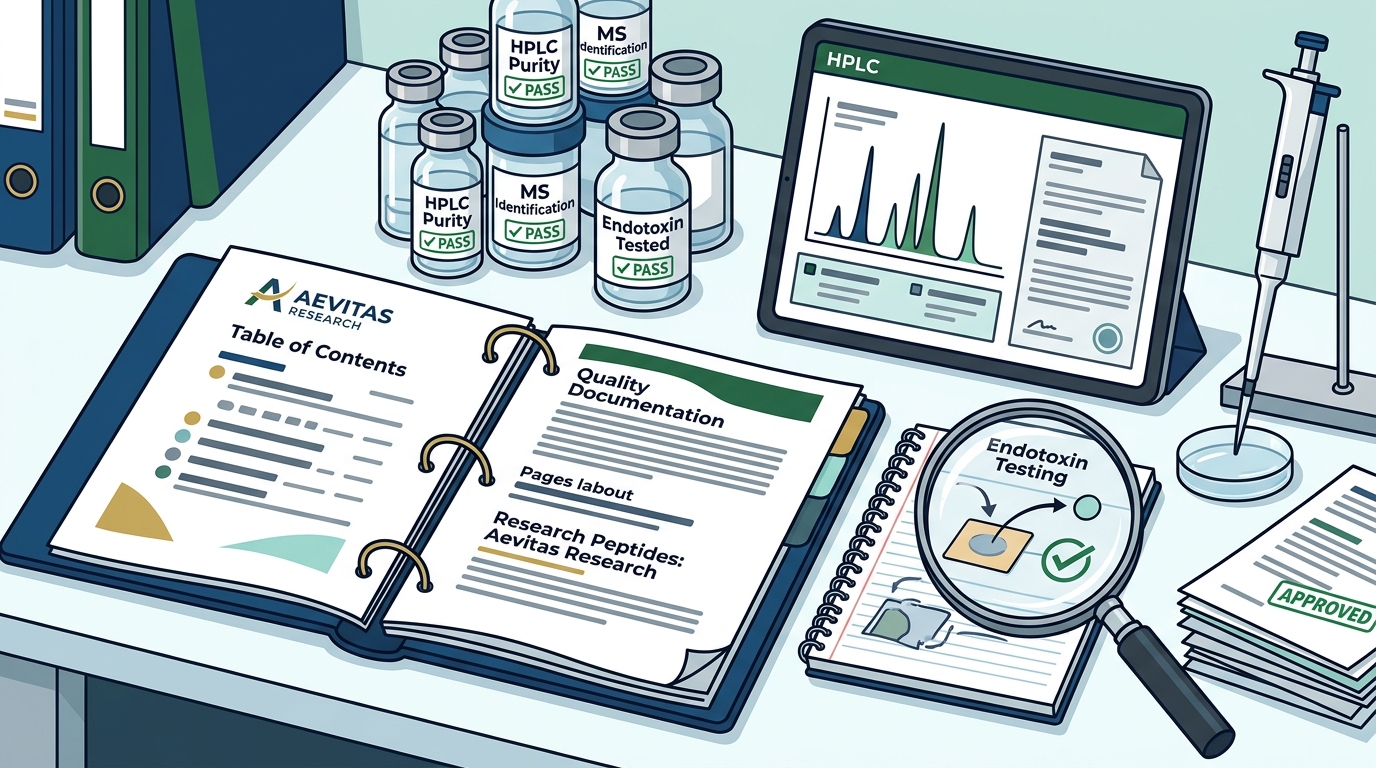
Defining Purity in Peptide Synthesis
Purity is not a binary state but a spectrum that must be carefully managed. High-purity peptides are essential for dose-response studies and structural analysis, where even minor impurities can skew results. The brand's quality assurance team monitors purity levels throughout the production cycle, ensuring that final products meet or exceed established benchmarks. This focus on precision helps maintain the consistency required for comparative studies across different laboratories.
Implications for Research Integrity
When purity falls below acceptable thresholds, the resulting data may lack reliability, leading to wasted resources and time. By enforcing high purity thresholds, Aevitas Research mitigates these risks, providing scientists with confidence in their materials. This approach aligns with the broader goal of advancing scientific understanding through accurate and reproducible research. The brand's commitment to purity reflects its dedication to supporting the highest standards of scientific inquiry.
Certificates of Analysis
A Certificate of Analysis (COA) is a formal document that provides detailed information about the identity, purity, and quality of a specific batch of a product. For research peptides, the COA serves as a critical record of the testing performed, including the methods used, the results obtained, and the acceptance criteria applied. Aevitas Research makes these documents readily available, ensuring transparency and accountability in its supply chain.
Components of a Comprehensive COA
Transparency and Trust
Transparency is fundamental to building trust between suppliers and researchers. By providing accessible COAs, Aevitas Research enables scientists to make informed decisions about the materials they use. This transparency extends to the methods employed, ensuring that the testing is conducted according to recognized standards. The brand's approach to documentation reflects its belief that quality should be verifiable and that researchers deserve full visibility into the processes that underpin their work.
Peptide Monographs
A peptide monograph is a detailed technical document that outlines the specific characteristics, synthesis methods, and quality standards for a particular peptide. Unlike a general COA, which focuses on a specific batch, a monograph provides a broader context for the peptide's properties and intended applications in research. Aevitas Research utilizes monographs to guide its quality assurance processes and to inform researchers about the nuances of each product.
Role in Quality Assurance
Monographs serve as the blueprint for quality control, defining the acceptable ranges for various parameters such as molecular weight, retention time, and impurity profiles. By adhering to these monographs, Aevitas Research ensures consistency across different batches and production runs. This standardization is crucial for maintaining the reliability of reference materials, as it allows for direct comparison between samples from different sources or time periods.
Guiding Research Applications
HPLC Purity Testing
High-Performance Liquid Chromatography (HPLC) is a widely used analytical technique for separating, identifying, and quantifying components in a mixture. In peptide analysis, HPLC is the gold standard for assessing purity, as it can effectively separate the target peptide from impurities, byproducts, and residual solvents. Aevitas Research employs advanced HPLC systems to ensure that its products meet the highest standards of purity and consistency.
Methodology and Precision
Interpretation of Results
The HPLC chromatogram provides a visual representation of the sample's composition, with peaks corresponding to different components. The area under the peak for the target peptide, relative to the total area, indicates the purity percentage. Aevitas Research's quality assurance team carefully reviews these results, ensuring that they meet the predefined acceptance criteria. This rigorous approach to HPLC testing underscores the brand's commitment to providing high-quality, reliable materials for scientific research.
COA Library Searchability
Enhancing User Experience
A well-organized COA library reduces the time and effort required to find relevant documentation. Researchers can search by product name, lot number, or date, ensuring that they can quickly access the information they need. This ease of access is particularly valuable in fast-paced research environments, where time is a critical resource. By prioritizing searchability, Aevitas Research demonstrates its commitment to supporting the practical needs of the scientific community.
Supporting Data Management
Key Takeaways
- Aevitas Research conducts rigorous endotoxin testing to ensure that its peptides are free from bacterial contaminants that could interfere with experimental results.
- Strict purity thresholds are enforced to guarantee that reference materials accurately represent the intended chemical structure, supporting data reliability.
- Certificates of Analysis (COAs) provide detailed, batch-specific documentation of testing methods and results, ensuring transparency and accountability.
- Peptide monographs serve as technical blueprints that define quality standards and guide the synthesis and analysis of specific peptides.
- HPLC purity testing is used as a primary method for assessing the composition and purity of peptide samples, ensuring high precision and consistency.
- The COA library is designed for easy searchability, allowing researchers to quickly access and download quality documentation for specific products and batches.
- These quality controls collectively support the integrity and reproducibility of scientific research, aligning with the highest standards of the life sciences industry.
Frequently Asked Questions
What is the purpose of endotoxin testing in peptide research?
Endotoxin testing detects lipopolysaccharides from Gram-negative bacteria, which can interfere with biological assays and compromise data integrity. Aevitas Research performs this testing to ensure that its peptides are free from contaminants that could affect experimental outcomes.
How does Aevitas Research define purity thresholds?
Purity thresholds define the minimum acceptable concentration of the target peptide in a sample. Aevitas Research enforces strict standards to ensure that its products meet high purity levels, supporting the reliability and reproducibility of research data.
What information is included in a Certificate of Analysis (COA)?
A COA includes detailed information about the identity, purity, and quality of a specific batch, including testing methods, results, and acceptance criteria. Aevitas Research provides these documents to ensure transparency and allow researchers to verify product quality.
What is a peptide monograph?
A peptide monograph is a technical document that outlines the specific characteristics, synthesis methods, and quality standards for a particular peptide. It serves as a blueprint for quality control and provides context for the peptide's properties and applications.
Why is HPLC purity testing important?
HPLC purity testing is a gold standard for assessing the composition and purity of peptide samples. It allows for precise separation and quantification of components, ensuring that reference materials meet high standards of consistency and reliability.
How can researchers access Aevitas Research COAs?
Researchers can access Aevitas Research COAs through a searchable digital library. This interface allows users to locate and download documentation by product name, lot number, or date, streamlining the process of verifying product quality.
Conclusion
Aevitas Research is committed to providing research-grade peptide reference materials that meet the highest standards of quality and transparency. Through rigorous endotoxin testing, strict purity thresholds, comprehensive Certificates of Analysis, detailed peptide monographs, advanced HPLC purity testing, and a searchable COA library, the brand supports the integrity and reproducibility of scientific research. By prioritizing these quality controls, Aevitas Research ensures that researchers have access to reliable materials that advance the understanding of complex biological systems. For more information on their quality standards and documentation, visit the Aevitas Research website.