

Researchers can find reliable research-grade peptides by selecting suppliers who provide third-party Certificate of Analysis (COA) documentation and adhere to strict analytical standards. This guide covers HPLC purity verification, supplier evaluation criteria, and the specific testing protocols that define high-integrity laboratory reference materials. For additional details, review the Privacy Policy Aevitas Research.
HPLC Purity Verification
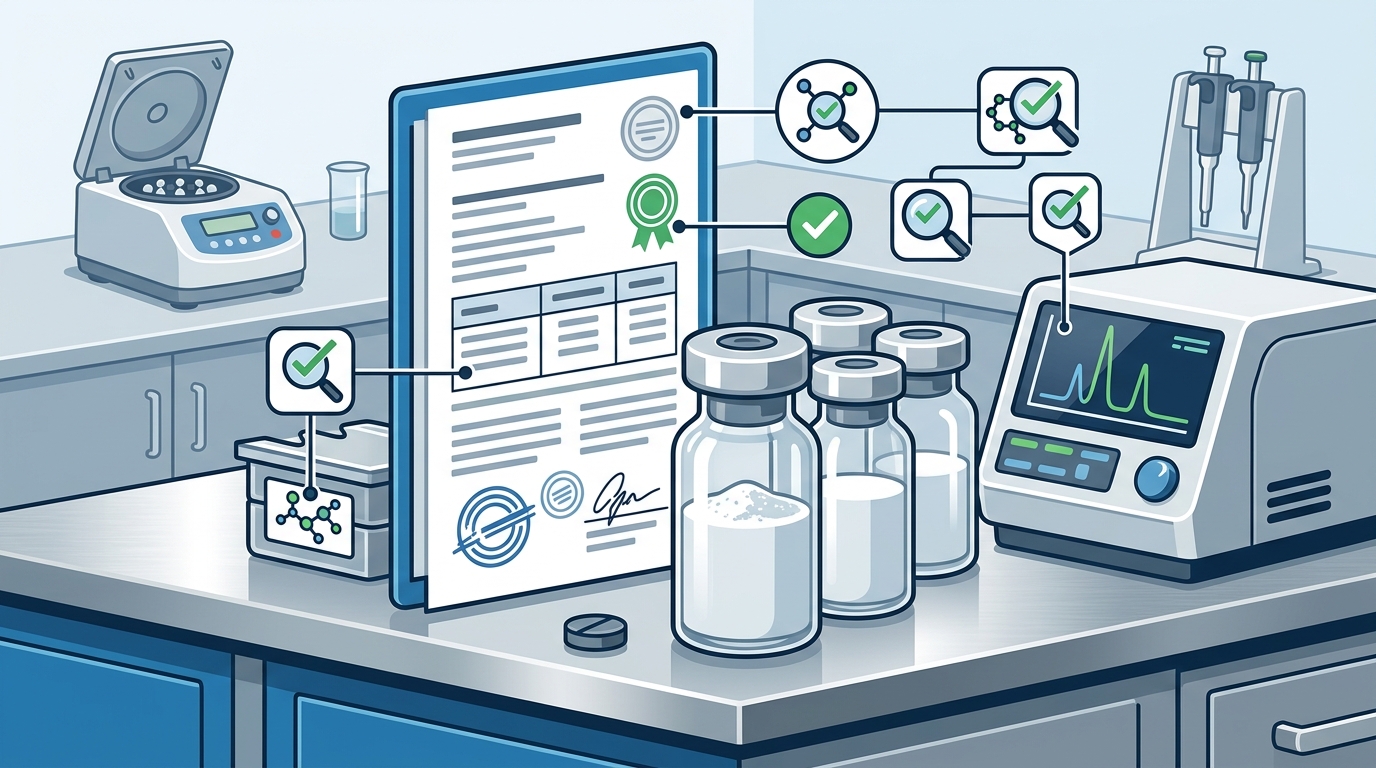
High-Performance Liquid Chromatography (HPLC) is the primary analytical technique used to determine the chemical purity of synthetic peptides. HPLC is a separation method that resolves complex mixtures into individual components based on their interaction with a stationary phase and a mobile phase. In the context of peptide research, HPLC provides a quantitative assessment of the target peptide relative to any impurities, byproducts, or degradation products present in the sample. For additional details, review the .
The Role of the Certificate of Analysis
Interpreting HPLC Chromatograms
When reviewing HPLC data, the area under the peak corresponding to the target peptide is compared to the total area of all peaks. A high purity percentage, often exceeding 95% or 98% for premium research materials, indicates a high concentration of the desired compound. The presence of multiple small peaks suggests the presence of deletion sequences, oxidation products, or other synthesis byproducts. Aevitas Research emphasizes that verified quality is a cornerstone of research integrity, ensuring that the data generated from these materials is reproducible and reliable.
Peptide Suppliers
The peptide market is diverse, ranging from large-scale pharmaceutical manufacturers to small-scale research chemical vendors. Understanding the different types of suppliers is critical for ensuring the integrity of your research. A peptide supplier is an entity that synthesizes, sources, and distributes peptide compounds for various applications. The reliability of a supplier is determined by their manufacturing capabilities, quality control protocols, and transparency in documentation.
Manufacturing Capabilities and Scale
Large-scale suppliers often utilize automated synthesizers and have established supply chains for raw materials. However, scale does not always equate to purity. Some large manufacturers may prioritize throughput over rigorous per-lot testing. Conversely, specialized research suppliers often focus on smaller batches with more intensive quality control. It is essential to verify whether a supplier synthesizes peptides in-house or sources them from third parties. In-house synthesis allows for tighter control over the manufacturing process, reducing the risk of contamination or mislabeling.
Transparency and Documentation
Research Peptide Suppliers
Research peptide suppliers specialize in providing high-purity compounds specifically for laboratory use. These suppliers understand the unique needs of scientists, including the requirement for precise molecular weights, specific modifications, and rigorous purity standards. A research peptide supplier is a vendor that caters to the scientific community by providing materials that meet the stringent requirements of academic and industrial research.
Specialization in Reference Materials
Compliance and Ethical Sourcing
Ethical sourcing and compliance with regulatory guidelines are critical for research suppliers. While research peptides are not intended for human consumption, suppliers must adhere to good manufacturing practices (GMP) and other quality standards. Compliance ensures that the materials are safe to handle in a laboratory setting and that the data generated from them is valid. Suppliers who clearly state that their products are for research purposes only and are not for human use demonstrate an understanding of the ethical and legal boundaries of the industry.
Purity Verification Standards
Purity verification standards are the set of protocols and criteria used to assess the quality of peptide compounds. These standards ensure that the materials meet the required specifications for research applications. Adherence to these standards is a key differentiator between high-quality research materials and low-quality bulk chemicals.
Mass Spectrometry and Purity
In addition to HPLC, mass spectrometry (MS) is a critical tool for verifying peptide purity and identity. Mass spectrometry is an analytical technique that measures the mass-to-charge ratio of ions. It is used to confirm the molecular weight of the peptide and to identify any impurities or modifications. The combination of HPLC and MS provides a comprehensive assessment of peptide quality. HPLC determines the purity percentage, while MS confirms the identity and structure of the compound.
Comparing Verification Methods
The following table compares the primary methods used for peptide purity verification:
| Method | Primary Function | Key Output | Limitations |
|---|---|---|---|
| HPLC | Separation and quantification of components | Purity percentage, chromatogram | Does not confirm molecular identity |
| Mass Spectrometry | Determination of molecular weight and structure | Molecular weight, mass spectrum | Does not quantify purity percentage |
| Elemental Analysis | Determination of elemental composition | Percentage of C, H, N, S | Does not identify specific impurities |
Industry Standards and Best Practices
Industry standards, such as those outlined by the United States Pharmacopeia (USP) and the International Organization for Standardization (ISO), provide guidelines for the testing and certification of chemical compounds. While these standards are often applied to pharmaceuticals, they are increasingly used as benchmarks for research-grade materials. Adherence to these standards ensures that the materials are of consistent quality and that the testing methods are validated and reliable. Aevitas Research commits to verified quality and the availability of COAs, aligning with the highest standards of research integrity.
Key Takeaways
- HPLC is the primary method for determining peptide purity, providing a quantitative assessment of the target compound relative to impurities.
- A Certificate of Analysis (COA) is a critical document that certifies the results of specific tests, including HPLC purity and mass spectrometry data.
- Researchers should verify that the COA matches the specific lot number of the product they are purchasing to ensure batch-specific quality control.
- Specialized research peptide suppliers often provide higher quality materials than bulk suppliers due to their focus on reference materials and rigorous testing.
- The combination of HPLC and mass spectrometry provides a comprehensive assessment of peptide purity and identity.
- Transparency in synthesis methods and testing protocols is a key indicator of a reputable supplier.
- Adherence to industry standards, such as USP and ISO guidelines, ensures consistent quality and reliable testing methods.
- Suppliers who clearly state that their products are for research purposes only demonstrate an understanding of ethical and legal boundaries.
Frequently Asked Questions
What is the difference between HPLC purity and mass spectrometry confirmation?
HPLC purity measures the percentage of the target compound in a mixture, while mass spectrometry confirms the molecular identity and weight of the compound. Both are necessary for a complete quality assessment.
Why is a lot-specific COA important?
A lot-specific COA ensures that the testing results correspond to the exact batch of material you are receiving. Generic COAs may not reflect the actual quality of the specific lot, leading to potential issues in research reproducibility.
What is solid-phase peptide synthesis (SPPS)?
SPPS is a method for chemically synthesizing peptides from N- to C-terminus. It is the standard method for producing synthetic peptides in research and pharmaceutical applications.
How can I verify if a supplier is reputable?
Look for suppliers who provide detailed COAs, transparent information about their synthesis methods, and clear statements about the intended use of their products. Reputable suppliers often have a strong track record in the scientific community.
Are research-grade peptides the same as pharmaceutical-grade peptides?
Research-grade peptides are intended for laboratory use and may not meet the strict regulatory requirements for pharmaceuticals. However, they often undergo rigorous testing to ensure high purity and quality for research applications.
What should I look for in a peptide supplier's COA?
Look for the HPLC purity percentage, the retention time of the target peak, the mass spectrometry data, and the lot number. The COA should be specific to the product you are purchasing and should be issued by a qualified laboratory.
Why is traceability important in peptide sourcing?
Traceability ensures that the origin of the raw materials and the manufacturing process are documented and verifiable. This is critical for ensuring the integrity of the research data and for complying with ethical and legal standards.
Can I use research-grade peptides for clinical trials?
No, research-grade peptides are not intended for human use or clinical trials. They are designed for laboratory research only. Clinical trials require pharmaceutical-grade materials that have undergone extensive regulatory review and approval.