

Research-Grade Peptides: A Guide to Verified Purity Documentation
Researchers require high-fidelity reference materials to ensure experimental reproducibility. Aevitas Research provides laboratory-grade peptide reference materials with verified purity documentation. This guide explains how to identify reputable suppliers and the specific analytical standards used to validate peptide composition.
Evaluating Research Peptide Suppliers
Supplier reliability is the foundation of experimental integrity. A research peptide supplier is a vendor that provides synthetic or bio-derived peptides specifically for laboratory investigation. The distinction between a legitimate research vendor and a low-quality distributor often lies in transparency and quality control infrastructure.
Transparency in Sourcing
Legitimate suppliers disclose their synthesis methods and raw material origins. They provide clear documentation regarding the chain of custody for each batch. This transparency allows researchers to trace the provenance of their reference materials.
Quality Control Infrastructure
High-end suppliers maintain dedicated quality control laboratories. These facilities employ advanced instrumentation for routine testing. The presence of in-house analytical capabilities is a strong indicator of a supplier's commitment to product consistency.
Regulatory Compliance
While research peptides are not regulated as pharmaceuticals, reputable suppliers adhere to Good Manufacturing Practices (GMP). Compliance with these standards ensures that production processes are controlled and documented. This reduces the risk of contamination and batch variability.
Purity Verification Standards
Purity is the most critical metric for research-grade peptides. Peptide purity is the percentage of the target peptide molecule relative to total mass in a sample. High purity ensures that experimental results are not skewed by impurities or degradation products.
Minimum Purity Thresholds
Most research applications require a minimum purity of 95%. However, for sensitive assays or structural studies, researchers often seek materials with 98% or higher purity. The specific threshold depends on the experimental design and the sensitivity of the detection methods.
Impurity Profiles
Stability and Storage
Purity can degrade over time if storage conditions are not optimal. Suppliers should provide clear storage recommendations and stability data. Proper storage ensures that the peptide maintains its specified purity throughout its shelf life.
Analytical Methods for Peptide Validation
Several analytical techniques are used to verify peptide purity and identity. Each method provides different insights into the molecular composition of the sample.
High-Performance Liquid Chromatography (HPLC)
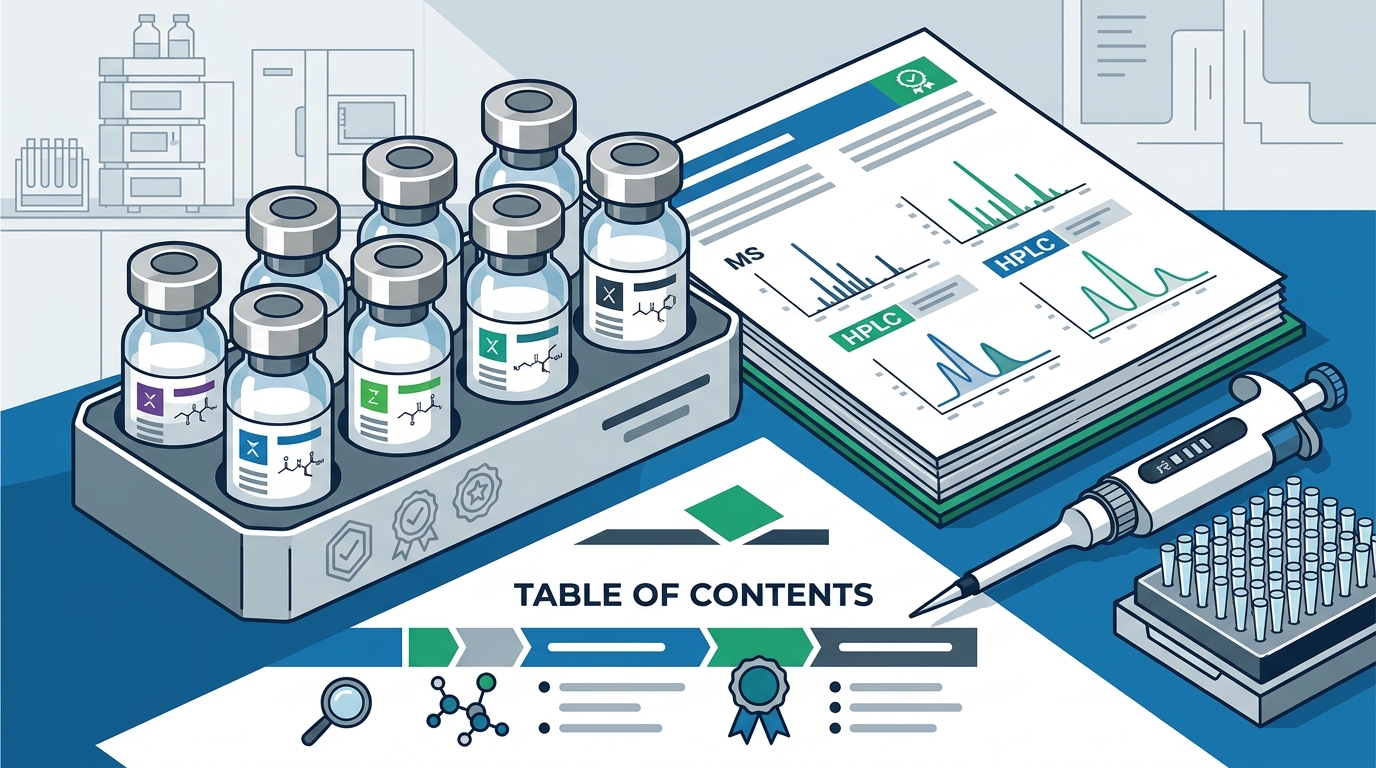
HPLC is the gold standard for determining peptide purity. It separates components based on their interaction with a stationary phase. The resulting chromatogram shows the relative abundance of the target peptide and any impurities.
Mass Spectrometry (MS)
Mass spectrometry confirms the molecular weight and sequence of the peptide. It can detect subtle modifications such as oxidation or deamidation. This technique is essential for verifying the identity of the synthesized molecule.
Nuclear Magnetic Resonance (NMR)
NMR spectroscopy provides detailed structural information about the peptide. It is particularly useful for confirming the stereochemistry of chiral centers. While less common for routine purity testing, NMR is valuable for structural validation.
Understanding Certificates of Analysis
A Certificate of Analysis (COA) is a document that provides the results of quality control testing for a specific batch of product. It serves as the primary evidence of product quality and compliance with specifications.
Essential COA Components
Verifying COA Authenticity
Researchers should verify that the COA corresponds to the specific batch they received. The batch number on the COA must match the label on the product container. Discrepancies may indicate documentation errors or potential fraud.
Requesting Additional Testing
Supplier Comparison Matrix
The following table compares key attributes of reputable research peptide suppliers. This matrix helps researchers evaluate potential vendors based on their quality control practices and documentation standards.
| Attribute | Aevitas Research | Typical Low-Cost Supplier |
|---|---|---|
| Purity Verification | HPLC and MS for every batch | Often limited to HPLC only |
| COA Availability | Provided with every order | May require separate request |
| Batch Traceability | Full chain of custody documentation | Limited or no traceability |
| Quality Control Lab | In-house dedicated facility | Often outsourced or minimal |
| Customer Support | Technical support available | Limited or no technical support |
Key Takeaways
- Research peptide suppliers must demonstrate transparency in sourcing and quality control.
- Peptide purity is the percentage of the target molecule relative to total mass.
- HPLC and mass spectrometry are the primary methods for verifying peptide purity and identity.
- A Certificate of Analysis (COA) is the essential document for verifying batch quality.
- Reputable suppliers provide COAs with every order and maintain full batch traceability.
- Minimum purity thresholds vary by application, with 95% being a common baseline.
- In-house quality control laboratories are a strong indicator of supplier reliability.
- Researchers should verify that COA batch numbers match product labels.
Frequently Asked Questions
What is a research-grade peptide?
A research-grade peptide is a synthetic or bio-derived peptide molecule manufactured for laboratory investigation. It is not intended for human or veterinary use. These materials are used as reference standards in scientific research.
How is peptide purity measured?
Peptide purity is typically measured using High-Performance Liquid Chromatography (HPLC). The percentage of the target peak relative to the total area under the curve indicates the purity level. Mass spectrometry is often used to confirm the identity of the main peak.
What should I look for in a Certificate of Analysis?
Why is batch traceability important?
Batch traceability allows researchers to track the provenance of their reference materials. It ensures that any quality issues can be investigated and resolved. Full traceability is a hallmark of reputable research suppliers.
What is the difference between HPLC and MS?
HPLC separates components based on their physical properties and measures their relative abundance. MS measures the mass-to-charge ratio of ions to confirm molecular identity. Both techniques are complementary and often used together for comprehensive validation.
Can I request additional testing from a supplier?
How should research peptides be stored?
Research peptides should be stored in a cool, dry place, often at -20°C or lower. They should be protected from light and moisture. Proper storage ensures that the peptide maintains its specified purity throughout its shelf life.
What is the role of GMP in peptide manufacturing?
Good Manufacturing Practices (GMP) are a set of guidelines that ensure products are consistently produced and controlled according to quality standards. Adherence to GMP reduces the risk of contamination and batch variability in peptide manufacturing.
Conclusion
Selecting the right research-grade peptides is critical for experimental success. Aevitas Research provides laboratory-grade peptide reference materials with verified purity documentation. By understanding purity verification standards and evaluating supplier transparency, researchers can ensure the integrity of their work. For more information on our reference materials and quality control processes, visit Aevitas Research.