

Peptide Quality Documentation: What You Need to Validate Research-Grade Materials
If you work in a research laboratory, you already know that the quality of your reference materials directly affects the reliability of your results. But how do you actually confirm that a research-grade peptide meets the standard it claims? The answer lies in documentation. From Certificates of Analysis to mass spectrometry reports, each document serves a distinct role in verifying identity, purity, and batch consistency. This guide breaks down every piece of documentation required to validate research-grade peptide quality, explains what to look for in each, and shows you how to spot gaps that could compromise your work.
What Is Peptide Quality Documentation?
Peptide quality documentation is the collection of analytical reports, certificates, and supporting records that verify the identity, purity, and consistency of a research-grade peptide. These documents create an auditable trail from synthesis through delivery, supporting both experimental reproducibility and institutional compliance.
Without proper documentation, researchers cannot independently confirm that the materials they receive match what was ordered. As the field grows, understanding why purity matters in research-grade peptides has become essential for any laboratory sourcing materials online.
The Certificate of Analysis (COA)
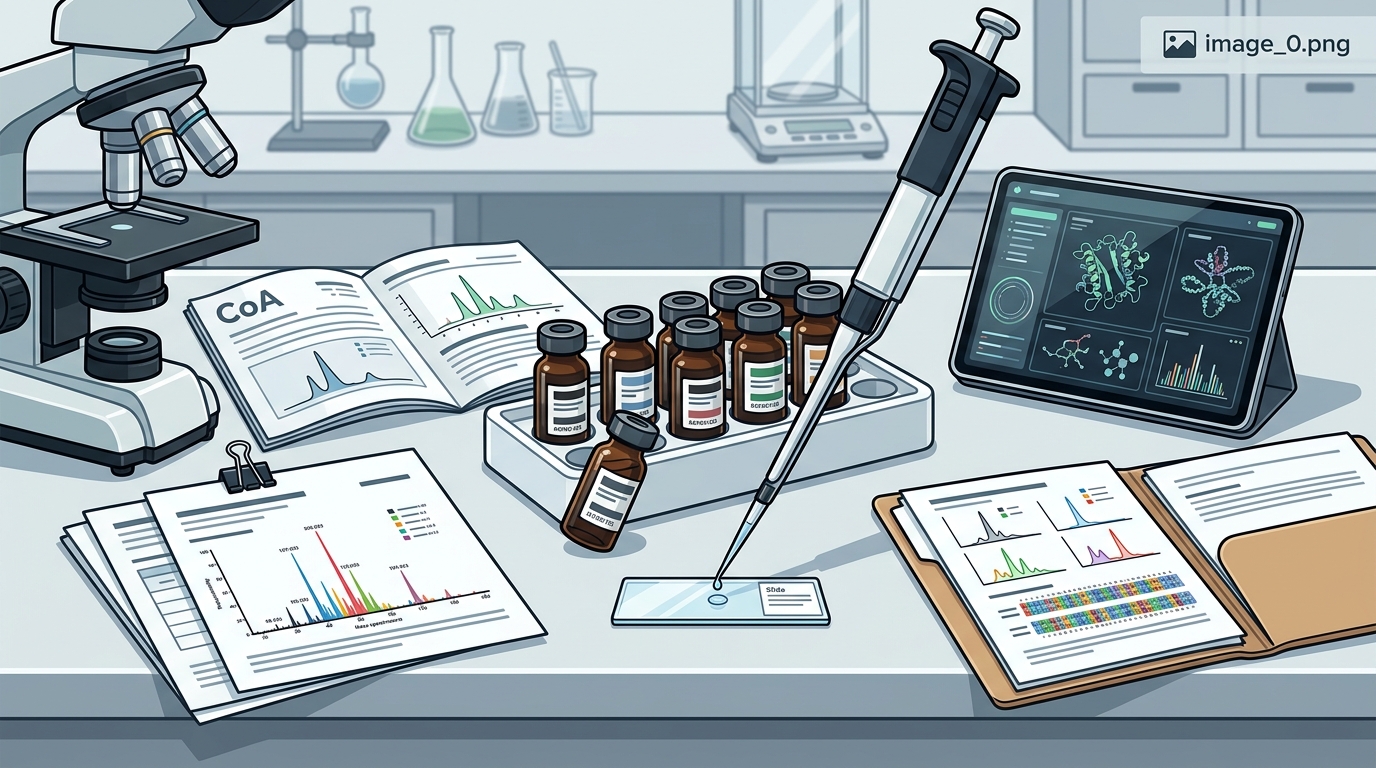
A Certificate of Analysis (COA) is a formal document issued by a laboratory that reports analytical test results for a specific batch of product. It serves as the primary record linking a peptide to verified quality data. A standard COA should include the peptide name, amino acid sequence, batch or lot number, purity percentage, analytical methods used, storage conditions, and the issuing laboratory's credentials.
What a Complete COA Contains
Look for these elements on every COA you receive:
- Compound name, sequence, and CAS number
- Unique batch/lot number for traceability
- HPLC purity percentage with chromatogram
- Mass spectrometry data with observed vs. theoretical molecular weight
- Analysis date and laboratory identification
Aevitas Research provides batch-specific COAs accessible through their COA library, giving researchers direct access to verify documentation before and after purchase. For a deeper dive into reading these documents, visit our guide on peptide Certificates of Analysis.
HPLC Purity Testing Reports
High-Performance Liquid Chromatography (HPLC) is an analytical separation technique that partitions compounds between a stationary phase and a mobile phase to measure sample purity. The purity percentage is calculated as the target peptide's peak area divided by the total area under all detected peaks.
Reading the Chromatogram
A quality HPLC report includes the full chromatogram image, not just a number. A single dominant peak with minimal secondary peaks indicates high purity. Symmetrical peak shape suggests a pure compound, while tailing may indicate degradation. The report should also specify column type, mobile phase, gradient, flow rate, and detection wavelength.
Purity Benchmarks
| Purity Level | Classification | Typical Use |
|---|---|---|
| ≥98% | Research-grade standard | Cell culture, animal studies, reproducible assays |
| 95-97% | Acceptable for limited applications | Preliminary screening, non-sensitive protocols |
| <95% | Below research-grade | May contain significant impurities; not recommended |
It is important to remember that HPLC confirms how pure a sample is but does not confirm that the dominant peak is the correct compound. This is why verifying peptide purity requires more than one analytical method.
Mass Spectrometry Identity Confirmation
Mass spectrometry (MS) is an analytical method that measures the mass-to-charge ratio of ionized molecules, providing direct confirmation of molecular identity. While HPLC tells you the proportion of pure material, MS confirms that the material is actually the compound on the label.
On a COA, the observed molecular weight should match the theoretical weight within ±1 Da for small peptides. Common notation includes [M+H]⁺ for singly charged ions and [M+2H]²⁺ for doubly charged ions. A mismatch between observed and expected mass is a critical red flag that warrants immediate investigation.
Together, HPLC and MS form the minimum analytical standard for research-grade peptide lab reference materials.
Third-Party vs. In-House Testing
A third-party COA is issued by an independent laboratory, providing unbiased verification of results. An in-house COA is generated by the manufacturer's own lab. Both can be legitimate, but third-party reports are generally considered more reliable because they eliminate potential conflicts of interest.
When evaluating a supplier, check whether the COA references an identifiable, accredited laboratory. Look for compliance with ISO 17025 standards, which govern the competence of testing and calibration laboratories. Suppliers that provide third-party documentation alongside in-house results demonstrate a higher commitment to transparency.
Additional Documentation to Request
Endotoxin Testing
For peptides used in cell culture or biological systems, endotoxin testing via Limulus Amebocyte Lysate (LAL) assays is critical. Results should show levels below the research-grade threshold, typically <1 EU/mg.
Storage and Handling Guidelines
Proper documentation should include storage temperature recommendations and reconstitution instructions. For best practices, review our guide on storing research-grade peptides.
Water Content and Residual Solvents
Some COAs include moisture analysis (Karl Fischer titration) and residual solvent data. These values help researchers calculate accurate concentrations during reconstitution and ensure the material is free of harmful solvent residues.
Key Takeaways
- A Certificate of Analysis (COA) is the foundational document for validating peptide quality and should accompany every batch.
- HPLC purity of ≥98% is the widely accepted research-grade threshold.
- Mass spectrometry confirmation is essential because HPLC alone cannot verify molecular identity.
- Third-party testing from accredited laboratories provides the strongest quality assurance.
- Endotoxin testing is necessary for peptides used in biological assay systems.
- Complete documentation includes batch numbers, chromatograms, MS spectra, and storage guidelines.
- Always cross-reference the batch number on the COA with the label on the product you receive.
Frequently Asked Questions
What is a Certificate of Analysis (COA) for peptides?
A Certificate of Analysis is a formal document prepared by a laboratory that details analytical test results, including purity and identity data, for a specific batch of peptide material. It serves as documented proof that the product meets stated specifications.
What purity level qualifies as research-grade?
A purity of ≥98% as measured by HPLC is the commonly accepted standard for research-grade peptides. Peptides below 95% may contain significant impurities that could affect experimental outcomes.
Why is mass spectrometry needed alongside HPLC?
HPLC measures what proportion of the sample is the main compound, but it does not confirm the identity of that compound. Mass spectrometry verifies molecular weight directly, ensuring the peptide matches the intended structure.
What is the difference between third-party and in-house COAs?
A third-party COA comes from an independent laboratory with no financial interest in the product. An in-house COA is produced by the supplier's own lab. Third-party testing is generally considered more objective and reliable.
What is endotoxin testing and when is it needed?
Endotoxin testing detects bacterial endotoxins that can interfere with biological assays. It is important for any peptide used in cell culture, in vivo studies, or other biologically sensitive research applications.
How do I verify that a COA is authentic?
Check that the COA includes a unique batch number, identifiable laboratory credentials, the actual chromatogram (not just a purity number), and MS data with observed vs. theoretical weight. Cross-reference the batch number with the product label.
Should I request documentation before purchasing?
Yes. Reputable suppliers like Aevitas Research make COAs available through their website before purchase. If a supplier cannot provide documentation on request, consider it a significant red flag.
What additional tests might appear on a peptide COA?
Beyond HPLC and MS, you may see amino acid analysis, water content (Karl Fischer), residual solvent analysis, appearance testing, and solubility data. The specific tests depend on the peptide and its intended research application.
Start Validating Your Research Materials Today
Quality documentation is not optional; it is the foundation of reproducible science. Explore the Aevitas Research catalog to browse research-grade peptide reference materials backed by batch-specific COAs, HPLC chromatograms, and mass spectrometry data.