

Quality Documentation and Testing Standards for Research Peptides
Certificates of Analysis
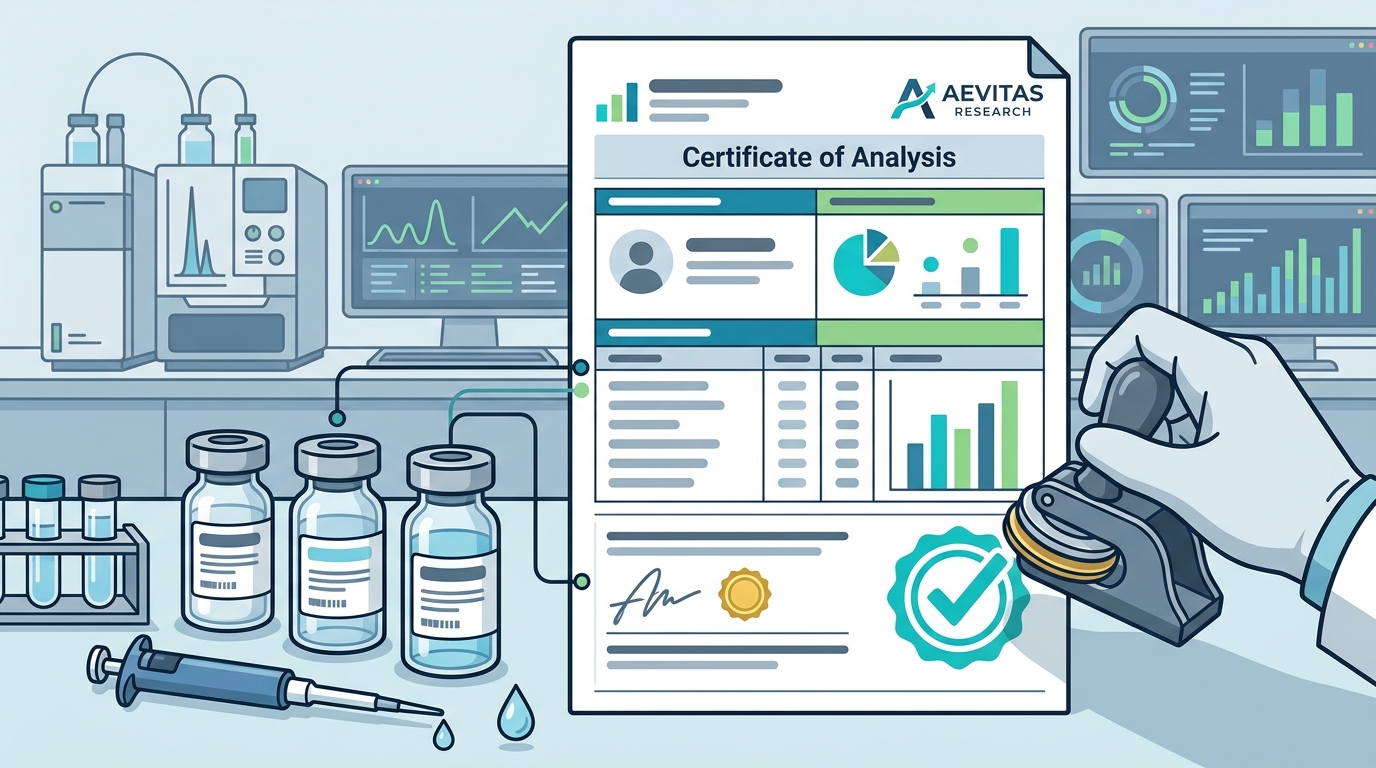
A Certificate of Analysis (COA) is a formal document that provides a detailed summary of the test results for a specific batch of a chemical or biological product. For research peptides, the COA serves as the primary evidence of quality, confirming that the material meets the specified standards for identity, purity, and stability. At Aevitas Research, every product is accompanied by a verified COA, ensuring that researchers can trace the quality of their reference materials back to specific analytical data.
Components of a Standard COA
Traceability and Batch Specificity
Traceability is essential in research environments where reproducibility is paramount. Aevitas Research ensures that each COA is batch-specific, meaning the data reflects the exact lot of material received by the customer. This approach prevents the use of generic or historical data that may not accurately represent the current inventory. By linking the COA directly to the physical product, researchers can maintain rigorous records for their laboratory notebooks and grant reporting.
Purity Thresholds and Identity Verification
Peptide purity is a measure of the proportion of the desired peptide sequence in a sample, excluding impurities, byproducts, and residual solvents. High purity is critical for research applications because impurities can interfere with biological assays, leading to skewed data or false conclusions. Aevitas Research adheres to strict purity thresholds, typically requiring a minimum of 95% purity for its reference materials, as verified by analytical HPLC.
Role of HPLC in Purity Assessment
High-Performance Liquid Chromatography (HPLC) is the gold standard for assessing peptide purity. This technique separates the components of a mixture based on their chemical properties. By analyzing the chromatogram, scientists can determine the area under the peak corresponding to the desired peptide. Aevitas Research utilizes HPLC to ensure that the reported purity accurately reflects the composition of the sample. This method provides a quantitative assessment that is both reproducible and reliable. For additional details, review the .
Identity Confirmation via Mass Spectrometry
While HPLC measures purity, mass spectrometry (MS) confirms identity. Peptide identity is the verification that the molecular weight and sequence of the sample match the intended target. Aevitas Research employs mass spectrometry to validate the molecular mass of each peptide. This dual approach, combining HPLC for purity and MS for identity, provides a comprehensive quality profile. It ensures that the material is not only pure but also the correct chemical entity. For additional details, review the Customer Experience.
Endotoxin Testing and Safety Screening
Endotoxin testing is a critical safety screening process that detects the presence of bacterial endotoxins, which are lipopolysaccharides found in the outer membrane of Gram-negative bacteria. Endotoxins are potent pyrogens that can cause significant biological reactions if present in research materials. For laboratory reference materials, the absence of endotoxins is a key quality metric, ensuring that the peptides do not introduce confounding variables into sensitive biological experiments.
Why Endotoxin Levels Matter in Research
In cell culture and in vitro studies, even trace amounts of endotoxins can alter cell behavior, leading to inaccurate results. Aevitas Research conducts endotoxin testing on its peptide products to ensure they meet low-level thresholds suitable for sensitive research applications. This testing is typically performed using the Limulus Amebocyte Lysate (LAL) assay, a highly sensitive method for detecting endotoxins. By controlling for endotoxin levels, Aevitas Research helps researchers maintain the integrity of their experimental systems.
Standards and Thresholds
Quality standards for endotoxins in research materials are often defined by regulatory bodies and industry guidelines. Aevitas Research aligns its testing with these standards, ensuring that its products are free from significant endotoxin contamination. The COA will explicitly state the endotoxin levels, providing transparency to the researcher. This documentation allows scientists to make informed decisions about the suitability of the material for their specific experimental protocols.
Peptide Monographs and Standardization
A peptide monograph is a standardized document that outlines the specific quality attributes, testing methods, and acceptance criteria for a particular peptide. Monographs serve as a reference for both manufacturers and researchers, ensuring consistency in how peptides are produced, tested, and evaluated. At Aevitas Research, monographs provide a framework for quality assurance, detailing the expected purity, identity, and stability characteristics of each reference material.
Standardization Across Batches
Documentation and Transparency
Transparency in quality documentation builds trust between the supplier and the researcher. Aevitas Research commits to providing clear and accessible documentation, including COAs and monograph details, for its products. This approach supports the scientific community by providing the necessary information to validate the quality of reference materials. Researchers can rely on this documentation to ensure that their experiments are built on a foundation of verified, high-quality inputs.
Comparison of Quality Documentation Elements
| Documentation Element | Purpose | Key Method | Relevance to Research |
|---|---|---|---|
| Certificate of Analysis (COA) | Batch-specific quality verification | Comprehensive lab testing | Traceability and compliance |
| Purity Report | Quantify desired peptide content | HPLC | Assay accuracy and reproducibility |
| Identity Test | Confirm molecular sequence and mass | Mass Spectrometry | Prevention of mislabeled materials |
| Endotoxin Test | Detect bacterial contamination | LAL Assay | Cell culture integrity |
Key Takeaways
- Aevitas Research provides a verified Certificate of Analysis (COA) for every batch of research peptides.
- Purity is assessed using High-Performance Liquid Chromatography (HPLC) to ensure high-quality material.
- Identity is confirmed through mass spectrometry to validate the molecular sequence.
- Endotoxin testing is performed to ensure the safety and suitability of materials for sensitive biological assays.
- Peptide monographs standardize quality attributes, ensuring consistency across different production batches.
- Transparent quality documentation builds trust and supports the integrity of life sciences research.
Frequently Asked Questions
What is a Certificate of Analysis (COA) for research peptides?
A Certificate of Analysis is a document that provides the test results for a specific batch of a product, verifying its identity, purity, and safety. It serves as proof that the material meets the specified quality standards.
How does Aevitas Research verify peptide purity?
Why is endotoxin testing important for research materials?
Endotoxin testing detects bacterial contaminants that can interfere with biological assays. Ensuring low endotoxin levels is critical for maintaining the integrity of cell culture and in vitro experiments.
What is a peptide monograph?
A peptide monograph is a standardized document that outlines the quality attributes, testing methods, and acceptance criteria for a specific peptide. It ensures consistency in production and testing.
Are the COAs provided by Aevitas Research batch-specific?
Yes, Aevitas Research provides batch-specific COAs, ensuring that the quality data reflects the exact lot of material received by the customer.
How does Aevitas Research ensure traceability?
Traceability is ensured by linking each COA to a specific lot number and product catalog number. This allows researchers to track the quality of their materials throughout their experiments.
What role does mass spectrometry play in quality control?
Mass spectrometry is used to confirm the identity of the peptide by verifying its molecular mass and sequence. This ensures that the material is the correct chemical entity.