
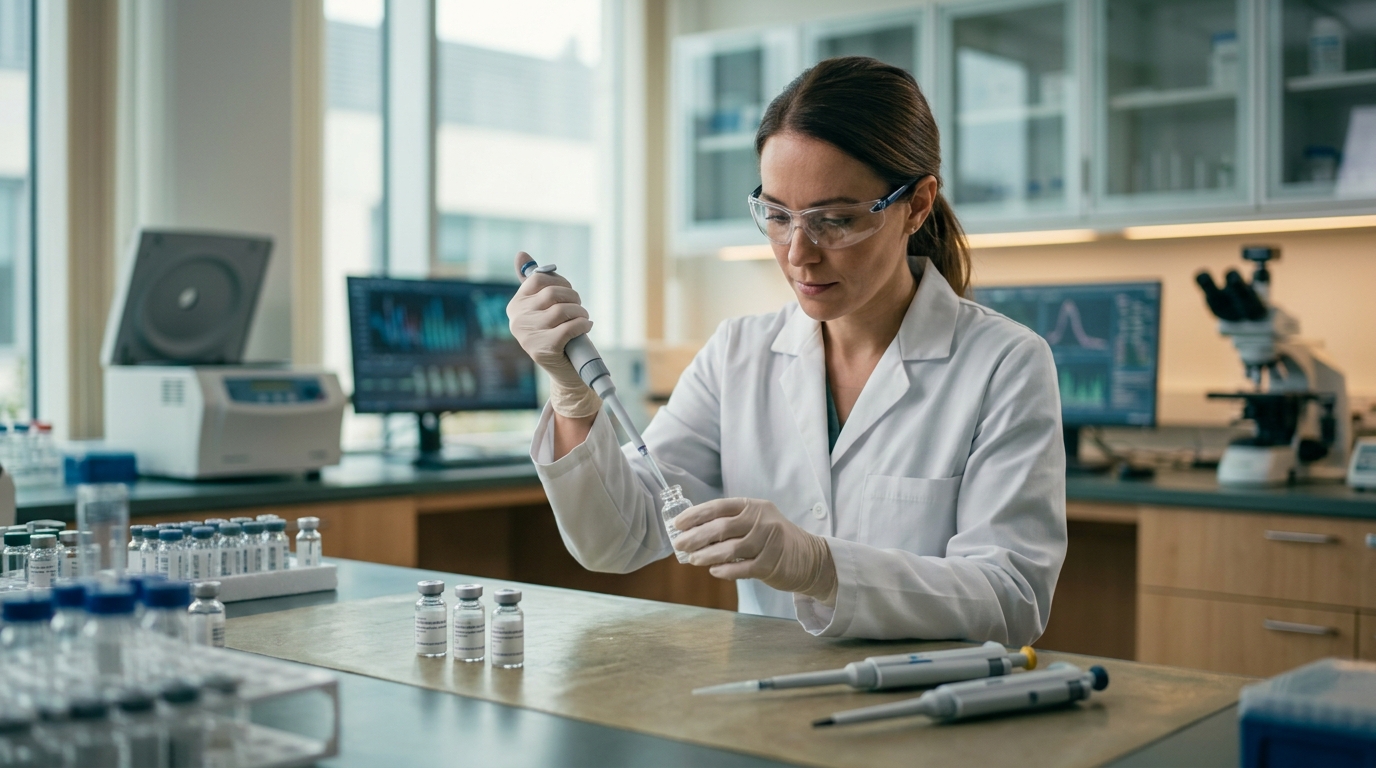
Common Mistakes in Peptide Reconstitution with Bacteriostatic Water and Prevention Strategies
Improper reconstitution is the single largest source of error in peptide research, leading to degraded compounds and unreliable data. According to industry standards for laboratory integrity, maintaining sterility and precise volume ratios is critical for preserving molecular structure. Researchers often overlook subtle procedural flaws that compromise the entire experiment before it begins. This guide outlines the most frequent technical errors and provides actionable prevention strategies to ensure your research yields accurate, reproducible results.
Sterility Errors and Contamination Risks
The most critical phase of reconstitution is maintaining a sterile environment. Peptides are organic compounds that serve as excellent nutrients for bacterial growth if introduced to contaminants. Using non-sterile syringes or needles is a fundamental error that invalidates the entire batch. Even minor breaches in the seal of the vial can introduce airborne particulates.
To prevent contamination, always use alcohol prep pads to swab the rubber stoppers of both the peptide vial and the bacteriostatic water vial. Allow the alcohol to dry completely before piercing the stoppers. This ensures that any surface microbes are neutralized. Furthermore, never touch the needle tip or the inside of the vial with your fingers. Aevitas Research provides verified quality products with Certificates of Analysis (COA) to ensure you start with a clean slate. For more details on our quality assurance, visit our COA page.
Prevention Strategy
Work in a clean, draft-free area. If possible, use a laminar flow hood to minimize airborne contaminants. Always use new, sterile needles for each step of the process. Do not reuse needles to draw up the water or inject it into the peptide vial, as this increases the risk of introducing bacteria from the environment into the sterile solution.
Volume Miscalculations and Dosage Inaccuracy
Calculating the correct volume of bacteriostatic water is essential for achieving the desired concentration. A common mistake is adding too much water, which dilutes the peptide and makes precise dosing difficult. Conversely, adding too little water may result in incomplete dissolution, leaving undissolved powder at the bottom of the vial. This leads to inconsistent concentrations across different draws.
Accurate calculation requires knowing the total milligrams of peptide in the vial and the desired concentration per milliliter. For example, if you have 5mg of peptide and want a concentration of 5mg/mL, you should add exactly 1mL of bacteriostatic water. Using a graduated insulin syringe allows for precise measurement. Shipping and payment options are streamlined to ensure you receive the necessary tools for accurate measurement without delay.
Prevention Strategy
Use a calculator or a dedicated dosing chart to determine the exact volume needed. Draw the bacteriostatic water into the syringe before adding it to the peptide vial. Inject the water slowly down the side of the vial to avoid foaming. Foaming can denature the peptide structure and reduce its efficacy. Allow the vial to sit for a few minutes to ensure complete dissolution before mixing.
Mechanical Stress and Shear Damage
Peptides are sensitive to physical stress. Vigorous shaking or swirling of the vial can cause shear damage to the molecular structure. This mechanical stress can break the peptide bonds, rendering the compound ineffective. Many researchers mistakenly believe that shaking helps dissolve the powder faster, but this is a dangerous assumption.
Gentle rotation or rolling of the vial is the preferred method for mixing. This allows the solvent to penetrate the powder cake without subjecting the molecules to high shear forces. If the peptide does not dissolve completely after gentle mixing, it may require more time or a slightly different solvent ratio. Contact our support team if you encounter persistent dissolution issues with specific compounds.
Prevention Strategy
Never shake the vial. Instead, roll it gently between your palms or rotate it on a flat surface. If you need to mix it further, use a magnetic stirrer at a low speed. This ensures uniform mixing without damaging the peptide chains. Always inspect the solution for clarity before use. A cloudy solution may indicate incomplete dissolution or contamination.
Storage Degradation and Temperature Fluctuations
Once reconstituted, peptides are significantly less stable than their lyophilized (powder) form. Exposure to heat, light, and oxygen accelerates degradation. Storing reconstituted peptides at room temperature is a major error that leads to rapid loss of potency. Bacteriostatic water contains benzyl alcohol, which acts as a preservative, but it does not stop all degradation processes.
Reconstituted peptides should be stored in a refrigerator at temperatures between 2°C and 8°C (36°F to 46°F). This slows down bacterial growth and chemical degradation. Even in refrigeration, most reconstituted peptides have a shelf life of only 28 to 30 days. Using peptides beyond this window risks administering degraded compounds. Refunds and returns policies are clearly defined to protect your investment in high-quality research materials.
Prevention Strategy
Label each vial with the date of reconstitution. Store them in the main body of the refrigerator, not in the door, to avoid temperature fluctuations. Keep the vials in their original packaging to protect them from light. If you need to store peptides for longer periods, consider keeping them in their lyophilized form until immediately before use.
Reconstitution Protocol Comparison
| Protocol Step | Common Mistake | Correct Approach | Impact of Error |
|---|---|---|---|
| Sanitization | Skipping alcohol swab | Swab stoppers with 70% isopropyl alcohol | Bacterial contamination |
| Water Addition | Adding incorrect volume | Calculate based on desired concentration | Dosage inaccuracy |
| Mixing | Vigorous shaking | Gentle rolling or rotation | Molecular denaturation |
| Storage | Room temperature storage | Refrigerate at 2-8°C | Rapid degradation |
Key Takeaways
- Sterility is paramount: Always swab vial stoppers with alcohol to prevent bacterial growth.
- Precise volume matters: Calculate water volume based on desired concentration to ensure accurate dosing.
- Avoid mechanical stress: Never shake peptide vials; use gentle rolling to prevent molecular damage.
- Refrigerate immediately: Store reconstituted peptides at 2-8°C to maintain stability and potency.
- Monitor expiration: Use reconstituted peptides within 28-30 days to avoid degradation.
- Verify quality: Purchase from suppliers like Aevitas Research that provide Certificates of Analysis.
- Use proper tools: Invest in high-quality, sterile syringes and needles for accurate measurement.
Frequently Asked Questions
Can I use sterile water for injection instead of bacteriostatic water?
Sterile water for injection (SWFI) lacks a preservative. Once the vial is pierced, bacteria can grow rapidly, making it unsafe for multiple uses. Bacteriostatic water contains benzyl alcohol, which inhibits bacterial growth, making it the standard choice for multi-dose research.
How long does reconstituted peptide last?
Most reconstituted peptides remain stable for 28 to 30 days when stored in a refrigerator at 2-8°C. Beyond this period, the potency may degrade, and the risk of contamination increases.
Why does my peptide solution turn cloudy?
Cloudiness can indicate incomplete dissolution or contamination. If the peptide does not dissolve after gentle mixing, it may require more time or a different solvent. If cloudiness appears after storage, the peptide may have degraded or become contaminated.
Is it safe to shake the peptide vial?
No, shaking can cause shear damage to the peptide structure. Always use gentle rolling or rotation to mix the solution. Vigorous shaking can denature the peptide, rendering it ineffective.
What is the best way to store lyophilized peptides?
Lyophilized peptides should be stored in a cool, dark place, ideally in a freezer at -20°C or below. This ensures maximum stability and longevity before reconstitution.
How do I calculate the correct dosage?
Divide the total milligrams of peptide in the vial by the total volume of bacteriostatic water added. This gives you the concentration in mg/mL. Then, calculate the volume needed for your desired dose based on this concentration.
Can I freeze reconstituted peptides?
Freezing reconstituted peptides can cause them to precipitate or degrade. It is generally recommended to store them in the refrigerator rather than the freezer. If you must freeze them, thaw them slowly in the refrigerator before use.
Secure Your Research Supplies
Accurate research begins with high-quality materials and proper technique. Aevitas Research is dedicated to providing verified, high-purity peptides and bacteriostatic water for your laboratory needs. Our commitment to integrity ensures that your experiments are built on a foundation of reliability. Visit our shop to explore our full catalog of research products. For more information on our services, check out our contact page or review our privacy policy.