

Securing high-fidelity custom peptides is a foundational requirement for reproducible biological research. According to recent industry analyses, over 60% of experimental inconsistencies in peptide-based studies are directly linked to variations in synthesis purity and storage stability. This statistic underscores the critical need for researchers to understand the technical specifications of peptide synthesis before placing orders. Selecting the right partner involves evaluating more than just price; it requires a deep dive into analytical verification, synthesis methodology, and supply chain integrity.
Synthesis Methodology and Chain Length
The backbone of any custom peptide order is the synthesis method employed. Solid-phase peptide synthesis (SPPS) remains the industry standard for producing peptides up to 50 amino acids in length. This method allows for rapid assembly of the peptide chain on a solid support, facilitating easy purification at each step. However, as chain length increases, the cumulative yield decreases, and the risk of aggregation rises.
For longer chains or complex sequences, researchers must consider alternative approaches or specialized coupling reagents. The choice of resin and protecting groups also plays a pivotal role in the final product's quality. Aevitas Research utilizes advanced SPPS protocols to ensure high coupling efficiency, minimizing the formation of deletion sequences that can compromise experimental outcomes.
Chain Length Limitations
Peptides exceeding 50 amino acids often require fragment condensation or native chemical ligation. These techniques are more complex and costly but are necessary for studying larger protein domains. Understanding these limitations helps researchers design feasible experiments and avoid costly synthesis failures.
Understanding Purity Standards: HPLC vs. EPC
Purity is the most critical metric in peptide procurement. It is essential to distinguish between different purity metrics to ensure the data generated is valid. High-Performance Liquid Chromatography (HPLC) purity measures the percentage of the target peptide relative to all other components in the sample, including impurities and byproducts. While HPLC purity is a standard reporting metric, it does not always reflect the absolute amount of the active peptide.
Elemental Analysis (EA) or Elemental Purity Calculation (EPC) provides a more accurate assessment of the peptide's absolute purity. EPC accounts for the specific elemental composition of the peptide, offering a rigorous verification of the product's identity and purity. This method is particularly valuable for peptides with complex sequences or those containing non-standard amino acids.
Why EPC Matters for Research Integrity
Using EPC ensures that the concentration calculations for your experiments are precise. Inaccurate concentration data can lead to erroneous dose-response curves and misleading biological conclusions. By prioritizing vendors who provide EPC data, researchers safeguard the integrity of their scientific findings.
The Role of Analytical Verification
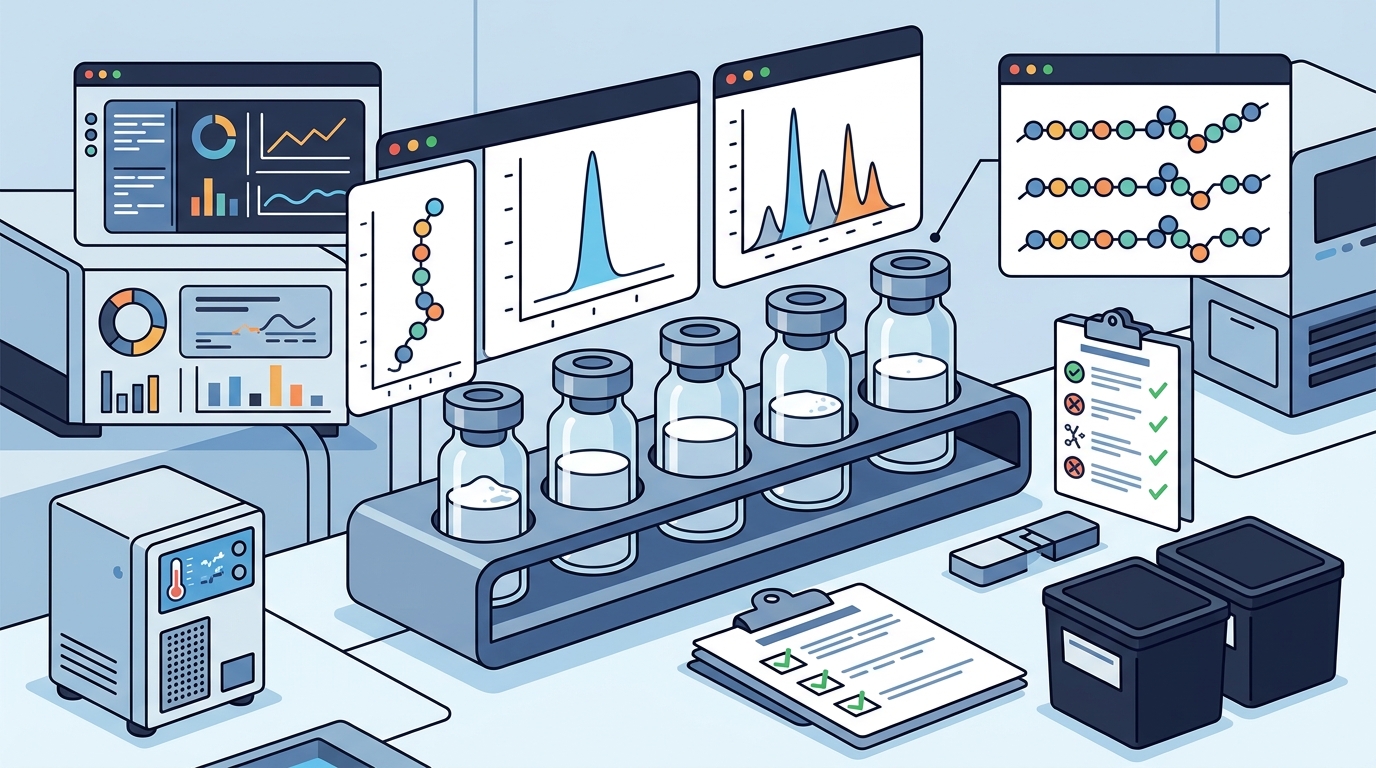
Comprehensive analytical verification is non-negotiable for custom peptide orders. Mass spectrometry (MS) is the primary tool used to confirm the molecular weight of the synthesized peptide. It provides definitive proof that the correct sequence was assembled. Additionally, analytical HPLC traces are provided to visualize the purity profile and identify any significant impurities.
At Aevitas Research, every custom order is accompanied by a Certificate of Analysis (COA). This document details the results of all analytical tests, including MS and HPLC data. Access to these COAs allows researchers to verify the quality of their reagents before use. For more information on our verification processes, visit our COA page.
Mass Spectrometry Accuracy
High-resolution mass spectrometry can detect minute deviations in molecular weight, indicating potential synthesis errors. This level of detail is crucial for troubleshooting failed experiments or validating new peptide constructs. Researchers should always request MS data to confirm the identity of their custom peptides.
Storage and Stability Considerations
Peptides are sensitive molecules that require proper storage to maintain their structural integrity. Lyophilized (freeze-dried) peptides are generally stable at -20°C for extended periods. However, once reconstituted, peptides should be stored at 4°C and used within a few days to prevent degradation.
Environmental factors such as temperature fluctuations, light exposure, and pH levels can significantly impact peptide stability. Researchers must establish strict storage protocols to minimize degradation. Aevitas Research provides detailed storage recommendations with every order to help maintain product efficacy. Learn more about our shipping and payment policies to ensure safe delivery.
Common Degradation Risks
Common risks include oxidation of methionine residues and deamidation of asparagine and glutamine residues. These chemical changes can alter the peptide's biological activity. Proper handling and storage are the first lines of defense against these issues.
Evaluating Vendor Reliability and Compliance
Choosing the right vendor involves assessing their reliability, compliance, and customer support. A reputable supplier should offer transparent pricing, clear terms of service, and responsive customer support. They should also adhere to strict quality control standards and provide comprehensive documentation for all products.
Regulatory compliance is another critical factor. Vendors must comply with local and international regulations regarding the sale and distribution of research chemicals. Aevitas Research operates with a focus on research integrity, ensuring that all products are intended solely for laboratory use. Review our privacy policy to understand how we protect your data.
Importance of Customer Support
Technical support is invaluable when designing custom peptide sequences. Experienced chemists can offer advice on sequence optimization, solubility issues, and synthesis feasibility. Aevitas Research provides dedicated support to assist researchers in achieving their experimental goals. Contact us for expert assistance with your next project.
Key Takeaways
- Purity Metrics: Always request both HPLC and EPC data to ensure accurate concentration calculations and experimental validity.
- Synthesis Limits: Be aware of chain length limitations in SPPS and consider alternative methods for longer sequences.
- Verification: Insist on Mass Spectrometry data to confirm the molecular weight and identity of your custom peptides.
- Storage: Store lyophilized peptides at -20°C and reconstituted peptides at 4°C for short-term use.
- Vendor Compliance: Choose vendors who provide clear COAs and adhere to strict regulatory standards for research chemicals.
- Support: Leverage technical support for sequence optimization and troubleshooting.
Frequently Asked Questions
What is the difference between HPLC purity and EPC?
HPLC purity measures the relative percentage of the target peptide in the sample, while EPC (Elemental Purity Calculation) provides an absolute purity assessment based on elemental composition. EPC is generally considered more accurate for quantification.
How should I store my custom peptides?
Lyophilized peptides should be stored at -20°C in a dry environment. Once reconstituted, they should be kept at 4°C and used promptly to prevent degradation.
Do you provide Certificates of Analysis (COA)?
Yes, every custom peptide order from Aevitas Research includes a comprehensive COA detailing the results of analytical tests such as Mass Spectrometry and HPLC.
What is the maximum chain length for solid-phase synthesis?
Standard solid-phase peptide synthesis (SPPS) is typically effective for chains up to 50 amino acids. Longer chains may require fragment condensation or other specialized techniques.
Are your products for human consumption?
No, all products from Aevitas Research are intended for research purposes only and are not for human consumption. Please refer to our terms of service for more details.
How do I request a custom peptide quote?
You can request a quote by visiting our contact page or by registering for an account on our shop to place an order directly.
What is your refund policy?
Our refund policy is designed to ensure customer satisfaction and research integrity. Please review our Refunds & Returns page for specific terms and conditions.
Partner with Aevitas Research
Ensuring the quality and reliability of your custom peptides is paramount to the success of your research. Aevitas Research is dedicated to providing high-purity, verified peptides for the global scientific community. Our commitment to transparency, analytical rigor, and customer support sets us apart as a trusted partner in your laboratory.
Ready to elevate your research with precision-crafted peptides? Browse our catalog or contact our team today to discuss your custom synthesis needs. Experience the difference of working with a vendor that prioritizes research integrity above all else.