

Verifying a peptide supplier's quality certifications requires cross-referencing independent laboratory data against recognized accreditation standards. Researchers must confirm that Certificates of Analysis (COAs) originate from accredited third-party labs rather than the manufacturer alone. This process ensures the chemical identity and purity of reference materials meet rigorous scientific standards. For additional details, review the Privacy Policy Aevitas Research.
Understanding Accreditation Standards
Accreditation is a formal recognition that a laboratory meets specific international standards for competence and reliability. In the life sciences sector, the most widely recognized standard is ISO/IEC 17025. This standard governs the competence of testing and calibration laboratories. When a supplier claims their products are tested, they should specify which body granted the accreditation. For additional details, review the .
ISO/IEC 17025 vs. In-House Testing
In-house testing is performed by the manufacturer's own staff. While useful for internal quality control, it lacks the independence required for high-stakes research validation. ISO/IEC 17025 accreditation, however, is granted by an independent body after a rigorous audit of the lab's methods, personnel, and equipment. A supplier relying solely on in-house data cannot claim independent verification. For additional details, review the Customer Experience.
Validating the Certificate of Analysis
Key Data Points to Verify
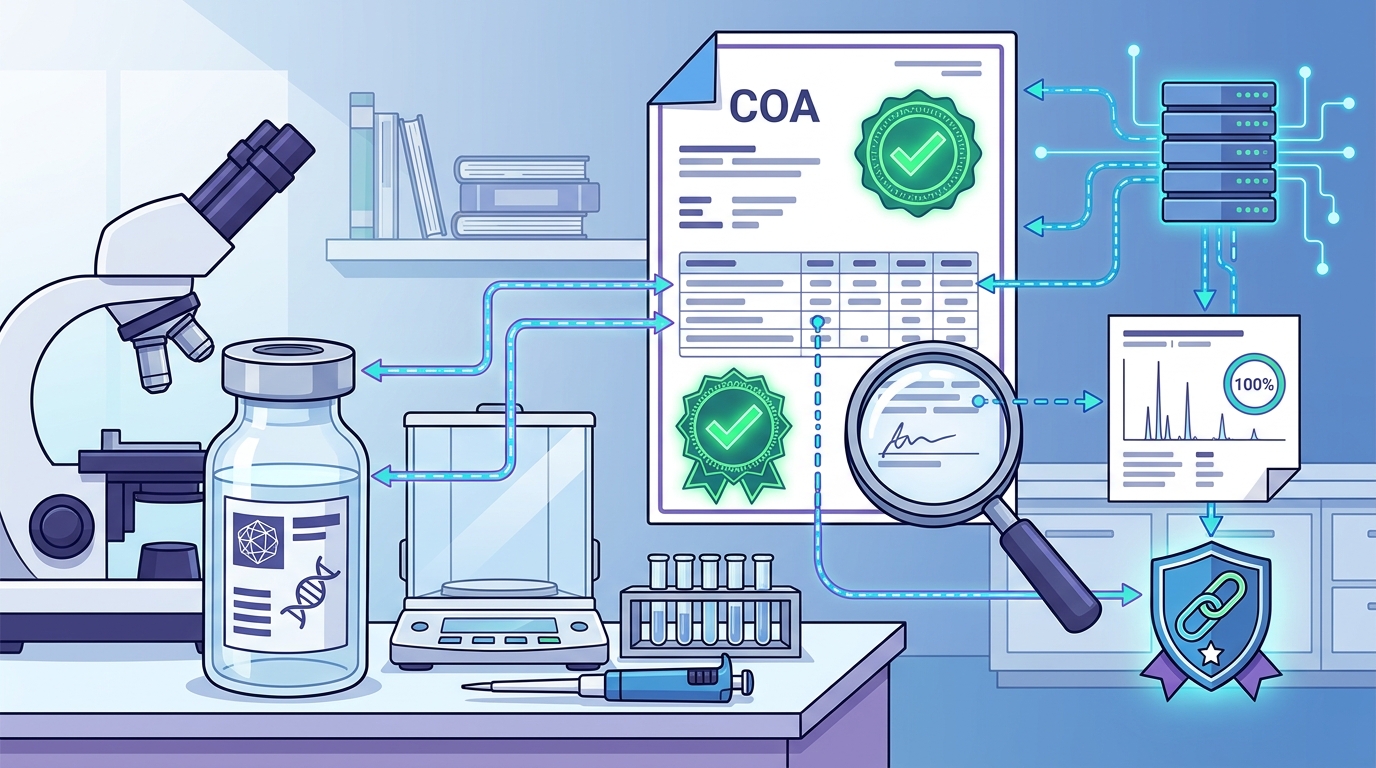
Look for the identity of the testing lab. Is it a recognized third-party facility? Does the lab hold current ISO/IEC 17025 accreditation? The COA should also report the method used for purity testing. High-performance liquid chromatography (HPLC) is the standard method for determining peptide purity. The reported purity percentage should align with the supplier's stated specifications. If the COA lacks a method description or a lab signature, its validity is questionable. For additional details, review the Frequently Asked Questions.
Checking Accreditation Databases
Accreditation bodies maintain public databases where researchers can verify the status of a laboratory's certification. This step is crucial because accreditations can be suspended or revoked. To verify a lab, researchers should visit the website of the national accreditation body. In the United States, the American Association for Laboratory Accreditation (A2LA) maintains a searchable directory. In Europe, the European Network for Accreditation of Laboratories (ENAL) provides similar resources.
How to Search the Database
This verification step takes only a few minutes but provides significant assurance. It confirms that the laboratory has undergone a recent audit and continues to meet the required standards. Researchers should document this verification process for their lab notebooks or compliance files. It demonstrates due diligence in sourcing reference materials.
Assessing Supplier Transparency
Supplier transparency is a strong indicator of quality and legitimacy. Reputable suppliers make their quality documentation easily accessible. They should provide COAs for every batch upon request. They should also be willing to answer technical questions about their testing methods and accreditation status. A supplier that is evasive or reluctant to share detailed data may be hiding quality issues.
Red Flags in Supplier Communication
Watch for vague language in supplier communications. Phrases like "internally verified" or "quality assured" without specific references to ISO standards are red flags. Legitimate suppliers use precise terminology. They reference specific ISO standards, named testing laboratories, and detailed analytical methods. They also provide contact information for their quality assurance team. This allows researchers to ask specific questions about the testing process.
Aevitas Research is committed to transparency in the peptide reference material market. We provide comprehensive documentation for all our products, including detailed COAs and accreditation information. Our commitment to research integrity ensures that scientists can trust the data they receive. This transparency is a core part of our brand identity and operational philosophy.
Building a Verification Protocol
Steps for a Standard Protocol
First, request the COA for the specific batch you intend to purchase. Second, verify the testing lab's accreditation status in the relevant database. Third, check the scope of accreditation to ensure it covers the tests on the COA. Fourth, review the COA for completeness, including batch number, date, and method. Fifth, contact the supplier if any information is missing or unclear. Documenting each step creates an audit trail that supports your research integrity.
Implementing this protocol helps your laboratory maintain high standards. It reduces the risk of receiving substandard materials. It also demonstrates to peers and reviewers that your laboratory follows best practices in sourcing. This level of rigor is essential for advancing scientific understanding in complex biological systems.
Key Takeaways
- ISO/IEC 17025 accreditation is the gold standard for testing laboratory competence.
- Verify the testing lab's accreditation status in public databases like A2LA or ENAL.
- The scope of accreditation must match the specific tests reported on the COA.
- Supplier transparency and willingness to provide detailed data are strong indicators of quality.
- Implement a standard verification protocol to ensure consistency in your laboratory.
Frequently Asked Questions
What is the difference between a COA and a COC?
A Certificate of Analysis (COA) reports the results of specific tests performed on a batch. A Certificate of Conformance (COC) is a statement that the product meets specified requirements. A COA provides the raw data, while a COC is a summary. For research purposes, a COA is generally preferred because it allows for independent verification.
How do I verify if a lab is ISO/IEC 17025 accredited?
Is in-house testing sufficient for research-grade peptides?
In-house testing is useful for internal quality control but lacks independence. For high-stakes research, third-party testing by an accredited lab is preferred. It provides an unbiased assessment of the product's quality and purity.
What should I do if a supplier refuses to provide a COA?
If a supplier refuses to provide a COA, it is a significant red flag. You should consider sourcing from a different supplier who is transparent about their quality documentation. Reputable suppliers are happy to share their COAs.
How often should I re-verify a supplier's accreditation?
You should re-verify a supplier's accreditation status periodically, such as annually. Accreditations can be suspended or revoked. Regular checks ensure that your supplier continues to meet the required standards.
What is the role of Mass Spectrometry in peptide verification?
Mass Spectrometry is used to confirm the chemical identity of a peptide. It analyzes the mass-to-charge ratio of ions to determine the molecular weight. This helps verify that the peptide has the correct sequence and structure.
Conclusion
Verifying the legitimacy of a peptide supplier's quality certifications is a critical step in ensuring research integrity. By understanding accreditation standards, validating Certificates of Analysis, and checking public databases, researchers can make informed sourcing decisions. Aevitas Research is dedicated to providing transparent, high-quality reference materials that meet the highest standards of the life sciences industry. To explore our range of research-grade peptides and view our quality documentation, visit our main website.