

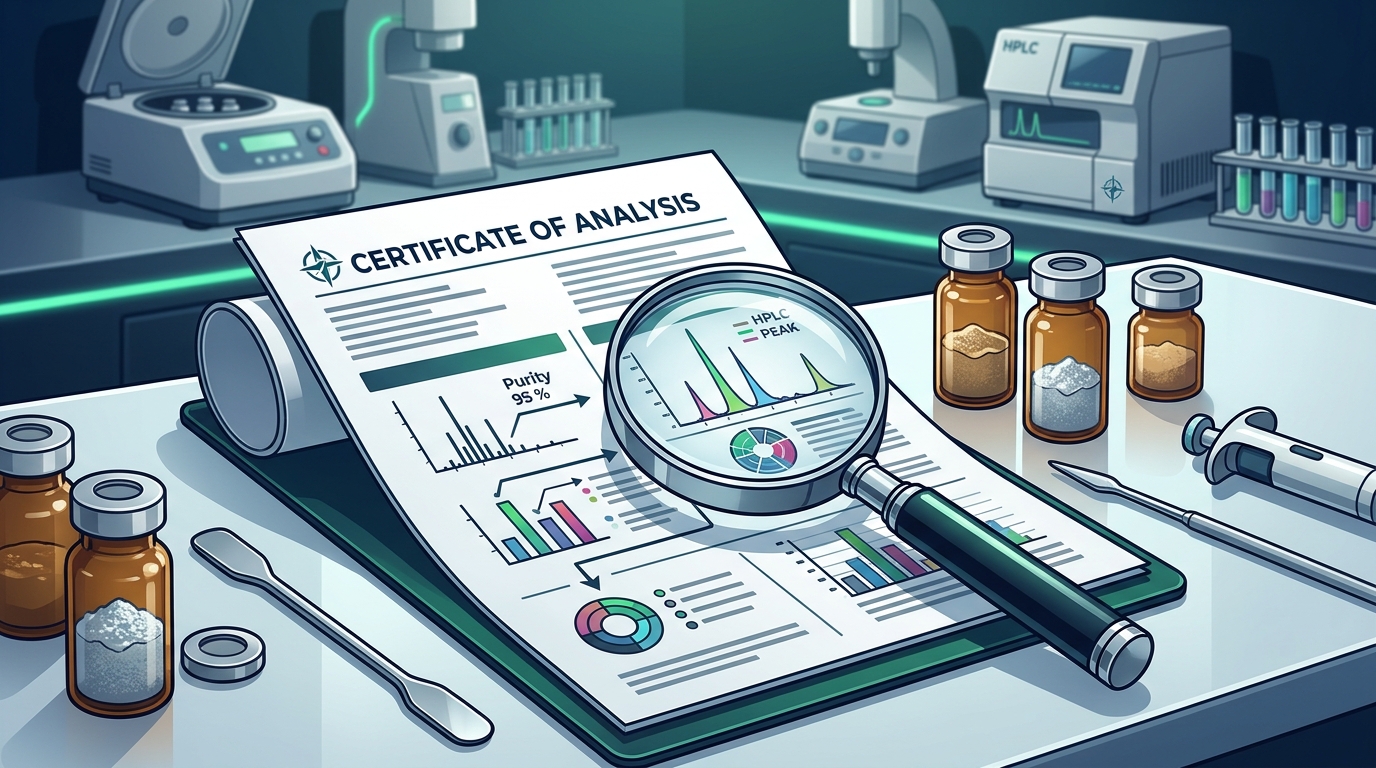
A certificate of analysis (CoA) is a formal document that provides a snapshot of a specific peptide batch's chemical identity, purity, and physical characteristics. It serves as the primary evidence that a laboratory reference material meets the rigorous standards required for reproducible scientific research. At Aevitas Research, we treat the CoA not as a mere formality, but as a critical transparency tool that allows scientists to verify the integrity of the materials they use to advance biological understanding.
The Core Components of a Valid CoA
Understanding what a CoA actually tells you begins with recognizing its standard data fields. A robust document always identifies the specific lot or batch number, the date of manufacture, and the expiration date. These identifiers are crucial because peptide stability can degrade over time, and a CoA without a specific lot number is essentially useless for traceability. The document must also clearly state the identity of the peptide, often including the sequence or chemical name, to prevent mix-ups in high-throughput laboratories. For additional details, review the My account Aevitas Research.
Beyond basic identification, the CoA lists the results of specific analytical tests. These results are the heart of the document. They provide quantitative data on purity, mass, and structural integrity. For researchers, this data is the bridge between the supplier's claim and the actual physical reality of the vial on the bench. Without these specific data points, a supplier is merely making an assertion rather than providing proof. For additional details, review the .
Mass Spectrometry and Structural Verification
One of the most critical sections of a peptide CoA is the mass spectrometry data. Mass spectrometry is an analytical technique that measures the mass-to-charge ratio of ions to determine the molecular weight and structure of a compound. In the context of peptides, this technique verifies that the synthesized molecule matches the intended sequence exactly. A deviation in mass can indicate a missing amino acid, an extra residue, or a modification that compromises the molecule's function in an experiment. For additional details, review the Customer Experience.
High-resolution mass spectrometry allows for the detection of even minor impurities or byproducts. For example, a CoA might report a theoretical mass versus an observed mass. If these numbers align within a tight tolerance, it confirms the structural integrity of the batch. This level of detail is essential for researchers working with complex biological systems where a single amino acid change can alter protein binding affinity or signaling pathways. At Aevitas Research, we prioritize high-resolution data to ensure that every reference material is structurally sound.
Purity Metrics and Chromatographic Evidence
Purity is often the first metric researchers look for on a CoA, but the method used to determine it matters just as much as the number itself. High-Performance Liquid Chromatography (HPLC) is the industry standard for assessing peptide purity. HPLC is a separation technique that isolates the target peptide from any impurities, byproducts, or starting materials. The CoA will typically report a percentage purity, often accompanied by a chromatogram or a reference to the specific method used.
A purity reading of 98% or higher is generally considered acceptable for many research applications, but the context is key. The CoA should specify whether the purity was determined by UV absorbance or mass spectrometry. UV-based purity can sometimes be misleading if impurities absorb light at the same wavelength as the peptide. Therefore, a CoA that includes both UV and mass-based purity data provides a more comprehensive view of the sample's quality. This dual verification ensures that the reported purity is not an artifact of the measurement method.
Water Content and Physical State
While less discussed than mass and purity, water content is a vital parameter in a peptide CoA. Peptides are often supplied as lyophilized (freeze-dried) powders, and the residual water content affects their stability and shelf life. A CoA will typically report the water content as a percentage, determined through methods like Karl Fischer titration. Lower water content generally correlates with better long-term stability, as water can facilitate hydrolysis and other degradation reactions over time.
Why Traceability Matters in Research
The ultimate value of a CoA lies in its role in traceability and reproducibility. In scientific research, reproducibility is the cornerstone of validity. If an experiment yields unexpected results, the first step in troubleshooting is often to verify the integrity of the reagents used. A detailed CoA allows researchers to trace any anomalies back to the specific batch, manufacturing date, and testing results. This traceability is essential for publishing high-quality data and for maintaining the integrity of the scientific record.
Furthermore, a CoA serves as a legal and quality assurance document. It demonstrates that the supplier has adhered to Good Manufacturing Practices (GMP) or equivalent standards. For institutions and grant-funded projects, having a CoA for every reagent is often a requirement for audit compliance. At Aevitas Research, we ensure that every CoA is accessible and detailed, supporting the rigorous standards of the life sciences community. This commitment to transparency helps build trust between the supplier and the researcher, fostering a collaborative environment focused on scientific discovery.
Key Takeaways
- A certificate of analysis is a formal document that verifies the identity, purity, and stability of a specific peptide batch.
- Mass spectrometry data on a CoA confirms that the molecular structure matches the intended sequence.
- HPLC purity metrics should be supported by chromatographic evidence to ensure accuracy.
- Water content and physical state data are critical indicators of long-term stability and manufacturing control.
- Traceability provided by a CoA is essential for reproducibility and audit compliance in research.
Frequently Asked Questions
What is the primary purpose of a peptide certificate of analysis?
The primary purpose is to provide documented evidence that a specific batch of peptide meets defined quality standards for identity, purity, and stability.
How does mass spectrometry verify peptide identity?
Mass spectrometry measures the molecular weight of the peptide, allowing researchers to confirm that the synthesized molecule matches the theoretical mass of the intended sequence.
Why is HPLC used for purity testing?
HPLC separates the target peptide from impurities, allowing for a precise quantification of the percentage of the desired compound in the sample.
What does water content indicate on a CoA?
Water content indicates the residual moisture in the lyophilized powder, which is a key factor in determining the long-term stability and shelf life of the peptide.
Can a CoA guarantee the biological activity of a peptide?
No, a CoA verifies chemical identity and purity, but it does not test for biological activity. Biological activity must be verified through separate functional assays in the laboratory.
How often should a CoA be updated?
A CoA is specific to a single batch and is issued at the time of release. It does not need to be updated unless the batch is re-tested or if stability data changes over time.