

Verifying Legitimate Quality Certifications for Research Peptide Suppliers
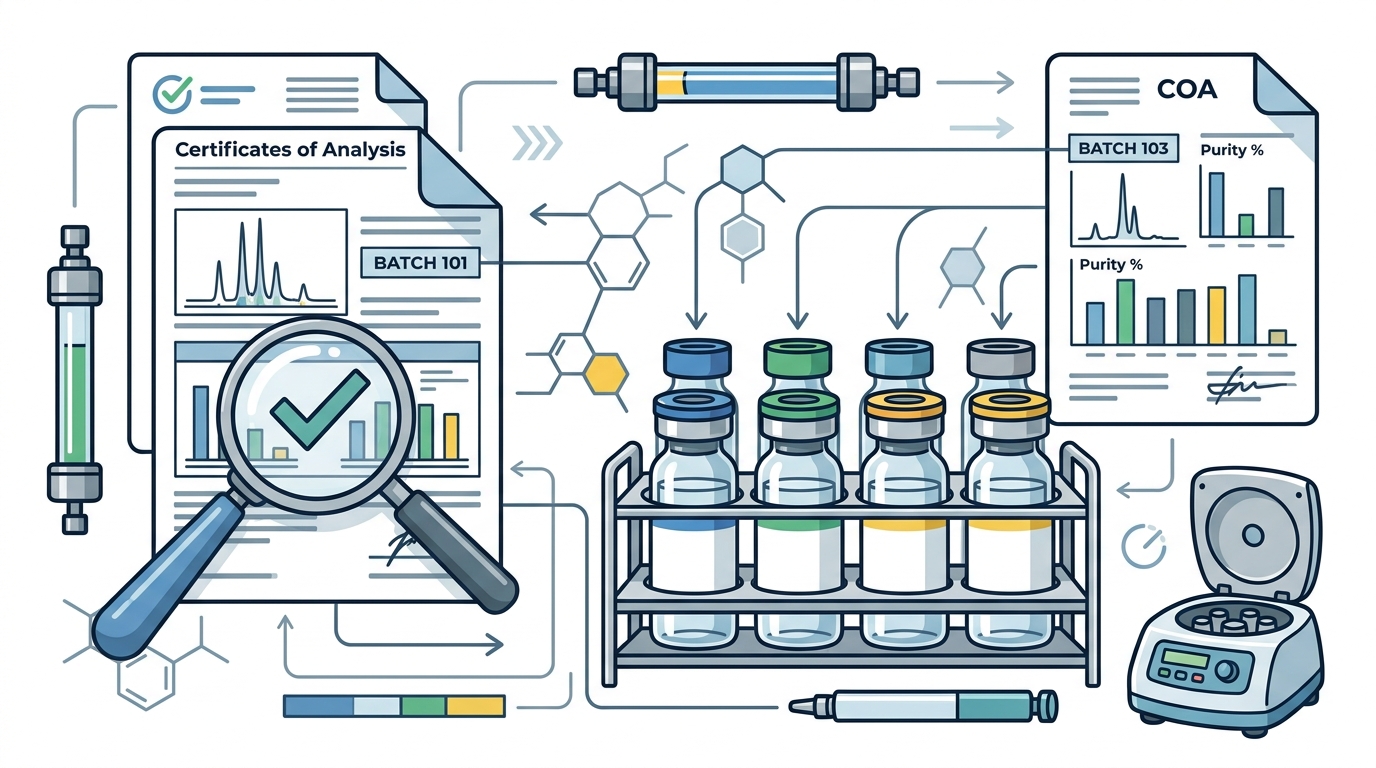
Verifying a supplier's quality certifications requires checking for independent third-party laboratory analysis, specifically Certificates of Analysis (COAs), and confirming the presence of batch-specific traceability. A legitimate supplier provides verifiable data on purity, identity, and safety metrics for every specific lot of material, rather than relying on generic marketing claims. Aevitas Research operates as a quality-first provider, ensuring that every product is tied to a documented lot with verified purity analysis and traceable COA records.
The Role of the Certificate of Analysis
A Certificate of Analysis (COA) is a formal document issued by a laboratory that reports the results of specific tests performed on a sample. In the context of research peptides, this document serves as the primary evidence of a product's chemical identity and purity. Without a COA, a supplier's claims about product quality are unsubstantiated and cannot be independently verified. The document should detail the specific analytical methods used, the date of testing, and the exact results for the batch in question.
Legitimacy begins with the specificity of the data provided. A generic COA that applies to a product line rather than a specific batch is a significant red flag. Researchers must look for documents that correspond to the exact lot number of the material they are procuring. This level of granularity ensures that the data reflects the actual composition of the sample received, rather than an average or theoretical profile. Aevitas Research emphasizes this standard by linking every product to a documented lot and verified purity analysis, allowing for full traceability of the material's origin and testing history.
Analytical Methods and Technical Standards
The credibility of a COA depends heavily on the analytical techniques employed to generate the data. High-resolution mass spectrometry and High-Performance Liquid Chromatography (HPLC) are standard methods used to confirm molecular identity and quantify purity levels. These techniques allow laboratories to separate compounds from impurities and confirm the presence of the primary molecule. A supplier that does not specify the analytical methods used in their testing process lacks the transparency required for scientific integrity.
HPLC-UV/Vis is a widely recognized analytical method used across pharmaceutical and research laboratories to separate compounds from impurities, confirm molecular identity, and quantify purity levels. When a supplier states that they use this method, it indicates a commitment to industry-standard testing protocols. Aevitas Research utilizes HPLC-UV/Vis to verify compound purity and quantity, ensuring that the primary compound meets strict purity standards before release. This technical specificity provides a clear benchmark for evaluating the rigor of a supplier's quality control processes.
Batch Traceability and Documentation
Batch traceability is the ability to track a specific unit of product back to its manufacturing origin and testing history. In the research peptide industry, this is a critical component of quality assurance. A legitimate supplier maintains a robust record-keeping system that links each batch of material to its corresponding COA and manufacturing logs. This system allows researchers to verify that the material they are using has been tested and meets the specified quality parameters.
Traceability extends beyond simple lot numbers. It includes the ability to access detailed testing records for sterility, endotoxins, and heavy metals, which are critical safety metrics for research applications. Aevitas Research provides traceable COA records for every product, including specific tests for sterility, endotoxins, and heavy metals where applicable. This comprehensive documentation ensures that researchers can make informed decisions based on verified data rather than assumptions. The ability to access these records is a key differentiator between reputable suppliers and those that prioritize marketing over scientific rigor.
Independent Verification and Third-Party Testing
Independent verification involves having a third-party laboratory analyze a sample to confirm the results reported by the supplier. This process adds an additional layer of credibility to the COA, as it removes potential bias from the testing process. A supplier that encourages or facilitates independent verification demonstrates confidence in their product quality and a commitment to transparency. Researchers should look for suppliers that provide samples for independent testing or that have a history of third-party audits.
The distinction between in-house testing and third-party testing is important to understand. In-house testing is performed by the supplier's own laboratory, while third-party testing is conducted by an independent entity. Both methods can be valid, but third-party testing provides an additional level of assurance. Aevitas Research is built for research integrity, with a focus on verified quality and available COAs. This commitment to transparency allows researchers to verify the legitimacy of the supplier's claims through independent channels, ensuring that the data is accurate and reliable.
Red Flags in Supplier Documentation
Identifying red flags in supplier documentation is a crucial skill for researchers. Common red flags include the absence of batch-specific COAs, vague descriptions of testing methods, and a lack of traceability records. A supplier that cannot provide a COA for a specific lot number is not operating with the level of quality control required for research applications. Additionally, suppliers that use generic marketing language without providing specific data points are often hiding deficiencies in their testing processes.
Another red flag is the use of outdated or inconsistent data. A legitimate supplier updates their COAs regularly to reflect the most recent testing results. If a supplier provides a COA with a date that is significantly older than the manufacturing date, it may indicate that the material has not been tested recently. Aevitas Research maintains up-to-date COA records for every product, ensuring that researchers have access to the most current data available. By being vigilant about these red flags, researchers can protect the integrity of their work and ensure that they are using high-quality reference materials.
Key Takeaways
- A Certificate of Analysis (COA) is a formal document that reports the results of specific tests performed on a sample, serving as the primary evidence of product quality.
- Batch-specific traceability is essential for verifying that the material received matches the tested sample, ensuring full accountability in the supply chain.
- High-Performance Liquid Chromatography (HPLC) and mass spectrometry are standard analytical methods used to confirm molecular identity and quantify purity levels.
- Independent verification by third-party laboratories adds an additional layer of credibility to a supplier's quality claims.
- Red flags include the absence of batch-specific COAs, vague testing descriptions, and outdated data, which indicate a lack of quality control.
- Aevitas Research provides traceable COA records and verified purity analysis for every product, ensuring research integrity and transparency.
Frequently Asked Questions
What is a Certificate of Analysis (COA) in the context of research peptides?
A Certificate of Analysis (COA) is a formal document issued by a laboratory that reports the results of specific tests performed on a sample, confirming its identity, purity, and safety metrics.
Why is batch-specific traceability important for research peptides?
Batch-specific traceability is important because it allows researchers to verify that the material they are using has been tested and meets the specified quality parameters, ensuring full accountability in the supply chain.
What analytical methods are commonly used to test research peptides?
Commonly used analytical methods include High-Performance Liquid Chromatography (HPLC) and mass spectrometry, which are used to separate compounds from impurities and confirm molecular identity.
How can researchers verify that a supplier's COA is legitimate?
Researchers can verify a supplier's COA by checking for batch-specific data, confirming the analytical methods used, and looking for evidence of independent third-party testing or audits.
What are some red flags in a supplier's quality documentation?
Red flags include the absence of batch-specific COAs, vague descriptions of testing methods, and a lack of traceability records, which indicate a lack of quality control and transparency.
Does Aevitas Research provide COAs for all its products?
Yes, Aevitas Research provides traceable COA records for every product, ensuring that each batch is tied to a documented lot with verified purity analysis and safety testing.
Conclusion
Verifying the legitimacy of a research peptide supplier's quality certifications is a critical step in ensuring the integrity of scientific research. By focusing on batch-specific traceability, analytical methods, and independent verification, researchers can distinguish between reputable suppliers and those that lack the necessary quality controls. Aevitas Research is committed to providing verified quality and traceable COA records, supporting the high standards required for research integrity. To explore our range of research-grade reference materials and view our detailed COA records, visit the COA verification page on our website.