

Peptide purity is the percentage of the target peptide sequence relative to all analytes present in a sample. Even small impurities can alter dose-response relationships, reduce reproducibility, and introduce confounding variables into laboratory studies. Verifying purity before you begin an experiment is not optional; it is a fundamental quality-control step every researcher should follow. This guide walks you through the analytical techniques, documentation, and supplier-evaluation criteria you need to confirm that your research-grade peptides meet the standards your work demands.
Why Peptide Purity Matters in Research
Peptide purity directly affects the validity of experimental outcomes. Uncharacterized impurities, such as truncated sequences, oxidized variants, or residual salts, can interfere with receptor binding affinity and cellular uptake in preclinical models. A peptide advertised at 95% purity could contain enough contaminants to skew results in sensitive assays.
For most laboratory applications, a purity of 95% or higher is considered research-grade. Publication-quality mechanistic studies often call for 99% or above. Understanding why purity matters in research-grade peptides is the first step toward building reliable, reproducible data sets.
HPLC: The Gold Standard for Purity Quantification
High-Performance Liquid Chromatography (HPLC) is a separation technique used to identify and quantify each component in a peptide mixture. Reverse-phase HPLC (RP-HPLC) is the standard method for peptide work, typically monitored at 214 nm where the peptide bond absorbs UV light.
How HPLC Purity Is Calculated
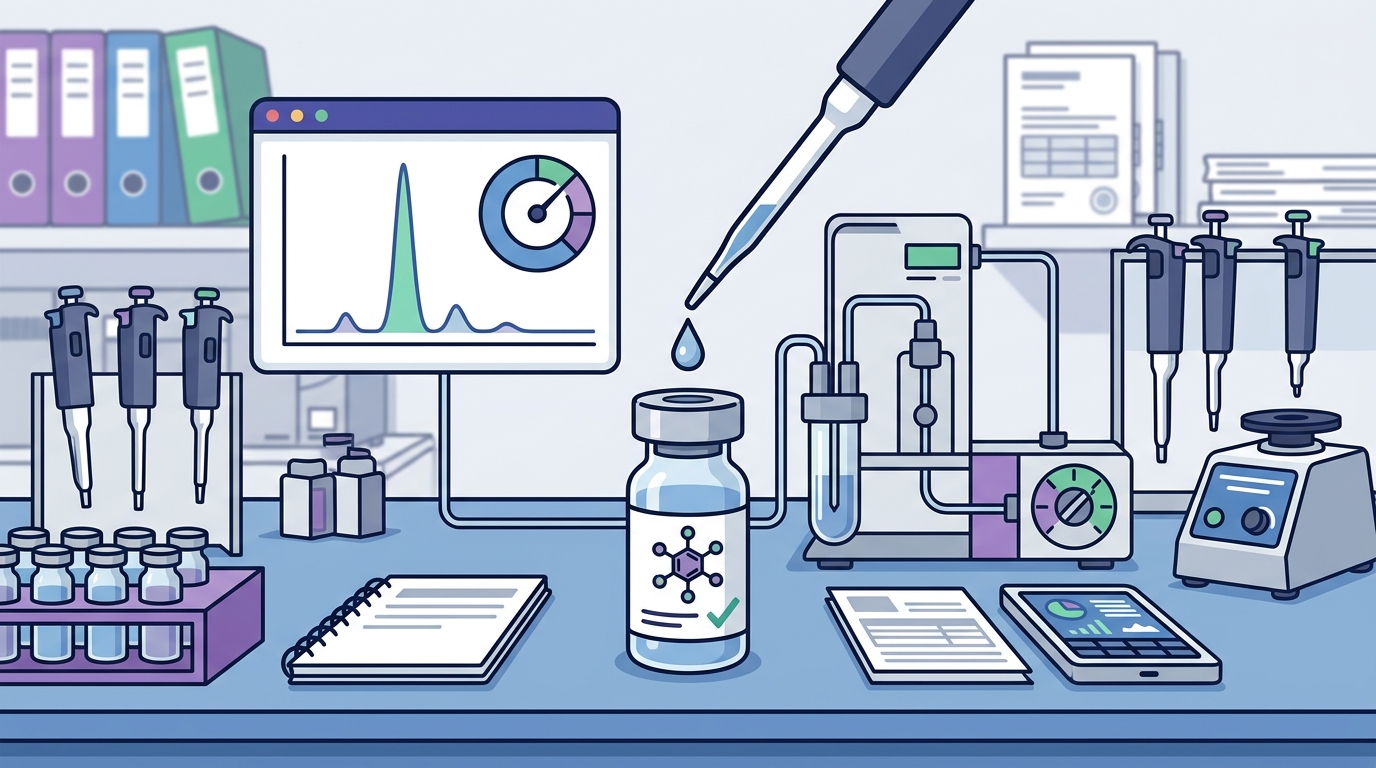
The system produces a chromatogram in which the main peak corresponds to the target peptide and any additional peaks indicate impurities. Purity is calculated as the area of the main peak divided by the total area of all detected peaks, expressed as a percentage. This gives researchers a precise, quantitative measure of sample composition.
What to Look for on an HPLC Report
A reliable HPLC report should include the chromatogram image, integration parameters, column specifications, mobile-phase composition, and the calculated purity percentage. When reviewing reports for peptides from the Aevitas Research catalog, confirm that these details are present and internally consistent.
Mass Spectrometry: Confirming Molecular Identity
Mass spectrometry (MS) is a technique that measures the mass-to-charge ratio (m/z) of ionized molecules to confirm molecular weight and structural integrity. While HPLC answers "how pure is it," MS answers "is it the right molecule?" A sample could be 99% pure but contain the wrong peptide entirely, making MS verification essential.
Common MS Techniques for Peptides
Two mass spectrometers are routinely used in peptide analysis: MALDI-TOF MS and electrospray ionization MS (ESI-MS). LC-MS, which couples HPLC separation with mass spectrometric detection, provides both purity and identity data in a single run. The observed molecular weight should match the theoretical weight calculated from the amino acid sequence.
How to Read a Certificate of Analysis (COA)
A Certificate of Analysis (COA) is a document that records analytical test results for a specific peptide batch, providing traceability and quality verification. Every COA you review should include the compound name, amino acid sequence, batch number, HPLC purity percentage, mass spectrometry data (observed vs. theoretical molecular weight), test methods, and test date.
COA Verification Checklist
Cross-reference the sequence and CAS number against published literature values. Confirm the HPLC chromatogram shows a single dominant peak. Check that the observed mass is within acceptable tolerance of the theoretical mass. Retain COAs for lab records and publication supplements. You can access batch-specific documentation through the Aevitas Research COA portal or review general guidance in our peptide certificate of analysis overview.
The Role of Third-Party Testing
Third-party testing is the process of sending peptide samples to an independent, accredited analytical laboratory for unbiased verification. In-house testing by the manufacturer can be useful, but it lacks the impartiality that independent analysis provides. Third-party results add credibility through objective analytical data and are increasingly expected by peer-reviewed journals.
When evaluating a supplier, ask whether their COAs come from an ISO/IEC 17025-accredited facility. Accreditation confirms the lab follows internationally recognized quality management standards. Aevitas Research provides third-party testing documentation with its research-grade peptide reference materials.
Purity Testing Methods Compared
The table below summarizes the primary analytical techniques used to verify peptide quality, along with what each method measures and its limitations.
| Method | Measures | Strengths | Limitations |
|---|---|---|---|
| RP-HPLC | Purity (% target peptide) | Quantitative, reproducible, gold standard | Does not confirm molecular identity |
| MALDI-TOF MS | Molecular weight | Fast, clear MW reading | Limited quantitative purity data |
| ESI-MS | Molecular weight (multiple charge states) | High accuracy | Requires interpretation of charge envelopes |
| LC-MS | Purity + identity simultaneously | Most comprehensive single analysis | Higher cost per run |
| Amino Acid Analysis (AAA) | Amino acid composition | Confirms sequence composition | Does not show sequence order |
For rigorous research, combining RP-HPLC with at least one mass spectrometric method provides the most complete quality picture. Learn more about proper handling after verification in our guide to best practices for storing research-grade peptides.
Key Takeaways
- Always request and review a COA before using any research peptide in an experiment.
- RP-HPLC is the gold-standard method for quantifying peptide purity as a percentage.
- Mass spectrometry is required alongside HPLC to confirm that the sample is the correct molecule.
- Third-party testing from an accredited lab adds objectivity and credibility to purity claims.
- Research-grade peptides should meet a minimum purity threshold of 95%, with 98%+ preferred for rigorous preclinical work.
- Cross-check COA data (sequence, batch number, observed MW) against published reference values.
- Store verified peptides correctly, typically lyophilized at -20 degrees C, to preserve purity over time.
Frequently Asked Questions
What is the minimum acceptable purity for research-grade peptides?
For most laboratory applications, 95% purity or higher is considered research-grade. For publication-quality mechanistic studies, 98% to 99% or above is preferred to minimize confounding impurities.
Why is mass spectrometry needed alongside HPLC?
HPLC quantifies purity but does not confirm molecular identity. Mass spectrometry verifies that the observed molecular weight matches the intended peptide sequence, ensuring you have the correct compound.
What should a valid COA include?
A complete COA lists the compound name, amino acid sequence, batch number, HPLC chromatogram or purity percentage, mass spectrometry data comparing observed and theoretical molecular weight, analytical conditions, and the test date.
What is third-party testing?
Third-party testing is the independent analytical verification of a peptide sample by an external laboratory not affiliated with the manufacturer. It provides unbiased confirmation of purity and identity.
What impurities are commonly found in synthetic peptides?
Common impurities include truncated sequences, deletion peptides, oxidized residues, incompletely deprotected side chains, and residual counterions such as acetate or trifluoroacetic acid (TFA).
Can I verify peptide purity without my own lab equipment?
Yes. The most practical approach is to purchase from suppliers that provide third-party COAs with every batch. Review the documentation carefully using the checklist described in this guide.
How does peptide storage affect purity over time?
Improper storage accelerates degradation through hydrolysis and oxidation. Most research peptides should be stored lyophilized at -20 degrees C. Once reconstituted, aliquot and freeze to avoid repeated freeze-thaw cycles. See our peptide stability and storage guide for detailed protocols.
Start With Verified Peptides
Reliable research begins with verified materials. Aevitas Research provides third-party tested, research-grade peptide reference materials with batch-specific COAs documenting HPLC purity and mass spectrometry identity confirmation. Browse the Peptide Research Library to explore available compounds and supporting documentation for your next study.