

Where to Find Research-Grade Peptides with Verified Purity Documentation
Researchers require high-integrity reference materials to ensure experimental reproducibility. Aevitas Research provides research-grade peptides with verified purity documentation through rigorous analytical testing. This guide covers supplier evaluation criteria and HPLC verification standards. It explains how to identify legitimate sources for laboratory reference materials.
Evaluating Peptide Suppliers
Supplier selection is the first critical step in securing reliable reference materials. A reputable supplier operates with transparency regarding their sourcing and manufacturing processes. They must demonstrate a commitment to quality control that extends beyond simple marketing claims.
Transparency in Sourcing
Legitimate providers disclose their supply chain origins. They explain where raw materials are sourced and how they are processed. This transparency allows researchers to assess the integrity of the starting materials before they enter the synthesis phase.
Quality Control Infrastructure
High-end suppliers invest in dedicated quality control laboratories. These facilities are equipped with advanced analytical instruments. The presence of in-house testing capabilities is a strong indicator of a supplier's commitment to product integrity.
Regulatory Compliance
Compliance with industry standards is essential for research-grade materials. Suppliers should adhere to Good Manufacturing Practices (GMP) or equivalent standards. This ensures that every batch is produced under controlled conditions.
HPLC Purity Verification
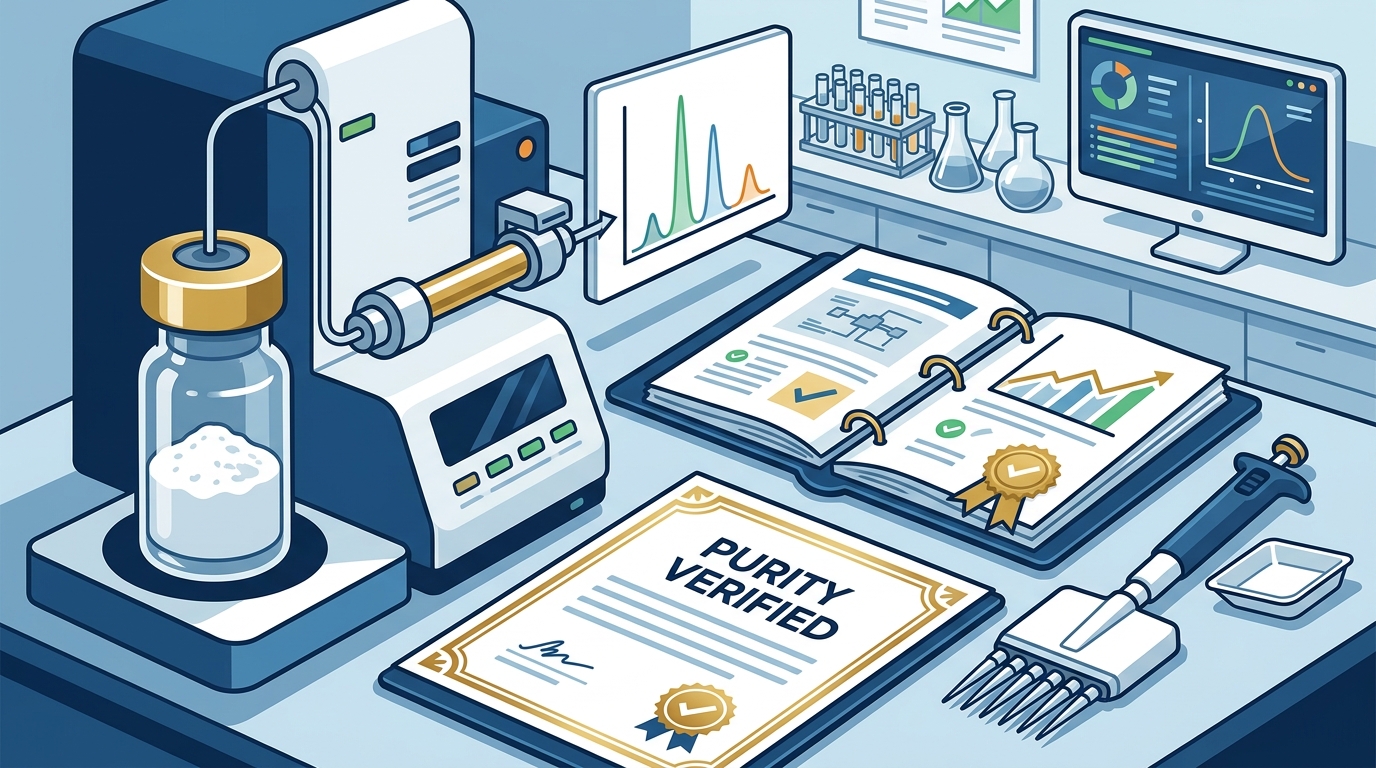
High-Performance Liquid Chromatography (HPLC) is the gold standard for verifying peptide purity. It is an analytical technique used to separate, identify, and quantify components in a mixture. In the context of peptide research, HPLC confirms that the primary compound meets strict purity thresholds.
The Analytical Process
HPLC works by passing a sample through a column filled with a stationary phase. Different compounds interact with this phase at different rates. This separation allows for the precise measurement of the target peptide against any impurities.
UV/Vis Detection
Most peptide HPLC systems use UV/Vis detection. This method measures the absorbance of light by the compounds as they elute from the column. It provides a quantitative assessment of purity levels. Aevitas Research uses HPLC-UV/Vis to verify compound purity and quantity for every batch.
Interpreting Results
Results are typically presented as a chromatogram. The area under the peak for the target compound is compared to the total area. This ratio determines the percentage purity. High-purity research peptides generally require a purity level above 95%.
Documentation and Traceability
Documentation is the physical proof of quality. A Certificate of Analysis (COA) is a document that provides the results of testing for a specific batch of product. It serves as a record of the product's identity, purity, and quality at the time of release.
Batch Specificity
Every product must be tied to a documented lot number. This ensures traceability from the final product back to the raw materials. If an issue arises, the specific batch can be identified and investigated. Aevitas Research ties every product to a documented lot with verified purity analysis.
COA Contents
A comprehensive COA includes the product name, lot number, and date of analysis. It lists the testing methods used, such as HPLC or Mass Spectrometry. It also includes the results for purity, identity, and other relevant parameters. This level of detail is crucial for research integrity.
Verification Tools
Modern suppliers often provide online verification tools. These allow customers to check the authenticity of a COA by entering the lot number. This adds an extra layer of security against fraudulent documentation. Aevitas Research offers COA and batch verification to ensure proof of quality.
Quality Standards Comparison
Understanding the differences in quality standards helps researchers make informed decisions. The table below compares common supplier practices regarding purity verification and documentation.
| Purity Testing Method | Basic HPLC or None | HPLC-UV/Vis with Quantitative Analysis |
| COA Availability | Upon Request or Generic | Batch-Specific and Immediately Available |
| Traceability | Limited or No Lot Tracking | Full Lot-to-Raw Material Traceability |
| Verification | Manual Check | Online Batch Verification System |
| Quality Philosophy | Marketing Claim | Documented Proof |
This comparison highlights the importance of choosing a supplier that provides documented proof rather than just verbal assurances. The difference lies in the depth of testing and the accessibility of the data.
Key Takeaways
- Supplier transparency is the foundation of reliable research materials.
- HPLC-UV/Vis is the primary method for verifying peptide purity and quantity.
- Every batch must have a unique lot number for traceability.
- A Certificate of Analysis (COA) is the definitive proof of product quality.
- Online verification tools add a layer of security to documentation.
- Premium suppliers provide batch-specific data rather than generic claims.
- Traceability allows for the investigation of any potential quality issues.
- Choosing a supplier with a quality-first philosophy ensures research integrity.
Frequently Asked Questions
What is a Certificate of Analysis (COA)?
A Certificate of Analysis is a document that provides the results of testing for a specific batch of product, including purity and identity data.
Why is HPLC used for peptide verification?
HPLC is used because it can separate and quantify compounds in a mixture, allowing for precise measurement of purity levels.
How can I verify the authenticity of a COA?
You can verify a COA by using the supplier's online verification tool, which allows you to check the lot number against their records.
What does batch traceability mean?
Batch traceability means that every product can be linked back to its specific production lot and raw material sources.
Why is documentation important in research?
Documentation is important because it provides a verifiable record of the materials used, ensuring the reproducibility and integrity of research findings.
What is the difference between a generic COA and a batch-specific COA?
A generic COA applies to a product type, while a batch-specific COA provides data for a particular lot number, ensuring accuracy for that specific shipment.
How does Aevitas Research ensure quality?
Aevitas Research ensures quality by using HPLC-UV/Vis for purity verification and providing traceable COA records for every batch.
Conclusion
Securing research-grade peptides with verified purity documentation requires a careful evaluation of suppliers. You must look for transparency, rigorous testing, and comprehensive documentation. Aevitas Research stands as a leader in this space, providing verified quality and traceable COA records. By choosing a supplier that prioritizes proof over promises, you ensure the integrity of your research. Visit Aevitas Research COAs to explore our verification standards and batch records.