

Most peptide suppliers only verify purity via HPLC or mass spectrometry. However, rigorous research-grade providers also test for heavy metals and endotoxins to ensure material integrity. Aevitas Research distinguishes itself by integrating these advanced contaminant screenings into its standard quality control protocols. This guide explains the scientific basis for these tests, the industry standards they follow, and why they matter for laboratory reliability.
Endotoxin Testing Standards
Endotoxin testing is a critical quality control step for any biological material intended for laboratory use. Endotoxins are lipopolysaccharides found in the outer membrane of Gram-negative bacteria. They are highly stable and can survive standard sterilization processes. Even trace amounts can interfere with cell culture viability and assay sensitivity. For additional details, review the Privacy Policy Aevitas Research.
The Limulus Amebocyte Lysate (LAL) Assay
The industry standard for detecting endotoxins is the Limulus Amebocyte Lysate (LAL) assay. This method utilizes the immune response of horseshoe crab blood cells to detect bacterial endotoxins. The LAL assay is highly sensitive, capable of detecting endotoxin levels as low as 0.01 EU/mL. For research-grade peptides, laboratories typically require endotoxin levels below 0.1 EU/mg of peptide. This threshold ensures that the material will not trigger unintended immune responses in cell-based assays. For additional details, review the My account Aevitas Research.
Why Endotoxins Matter in Research
Heavy Metal Screening Protocols
Heavy metal screening is another essential component of quality assurance for peptide reference materials. Heavy metals such as lead, arsenic, cadmium, and mercury can leach into peptide solutions during synthesis or storage. These metals are potent catalysts for oxidative stress and can inhibit enzyme activity. In sensitive biochemical assays, even parts-per-billion levels of heavy metals can skew results. For additional details, review the .
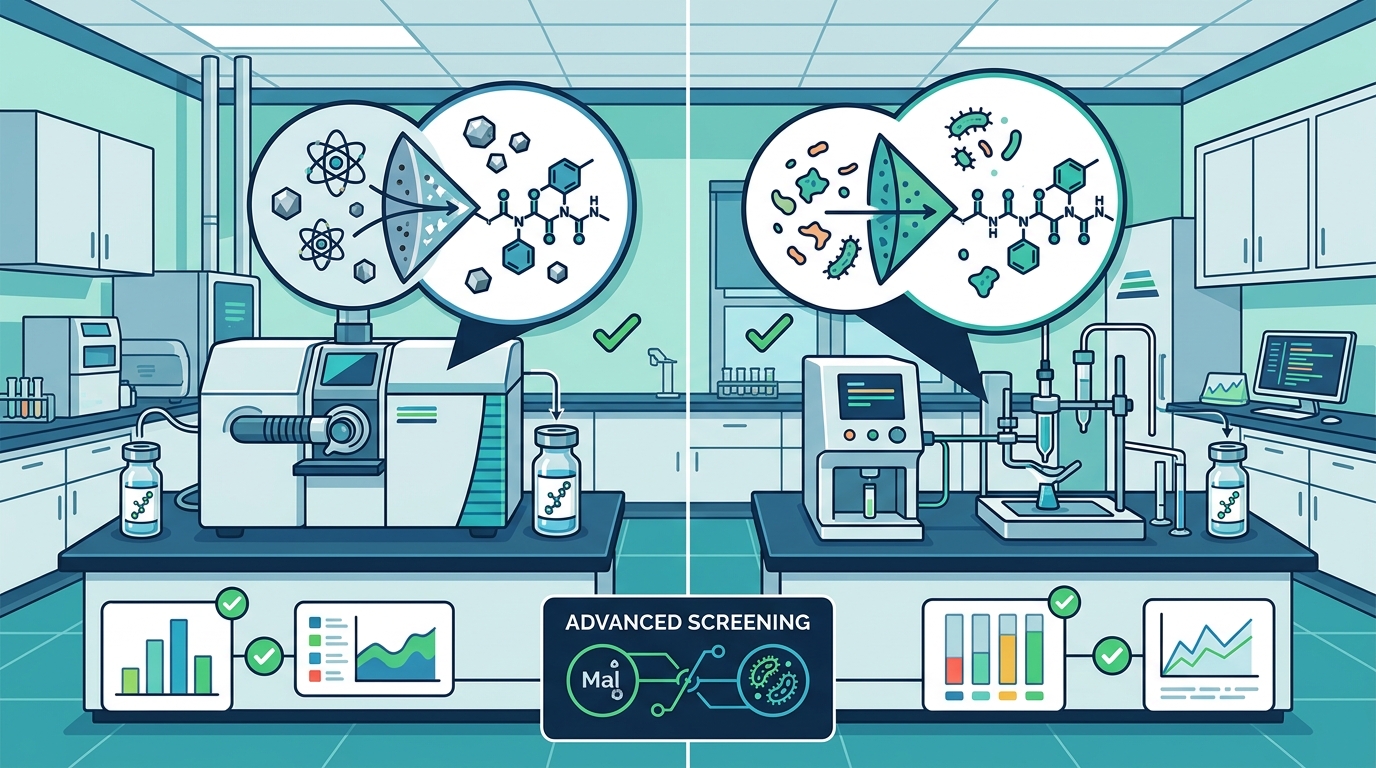
Inductively Coupled Plasma Mass Spectrometry (ICP-MS)
Regulatory and Industry Benchmarks
While specific limits vary by application, general industry benchmarks for research-grade materials often align with pharmacopeial standards. For example, limits for lead are typically set at or below 10 ppm, while arsenic limits are often below 1 ppm. By adhering to these rigorous benchmarks, Aevitas Research ensures that its products are suitable for high-precision research. The inclusion of heavy metal data in the COA provides researchers with the confidence that the material is chemically pure and safe for laboratory handling.
Purity vs. Contaminant Profiling
Many suppliers focus exclusively on purity, defined as the percentage of the target peptide in the sample. Purity is typically measured using High-Performance Liquid Chromatography (HPLC) or mass spectrometry. While high purity is necessary, it is not sufficient on its own. A peptide can be 99% pure by HPLC yet still contain significant levels of endotoxins or heavy metals. These contaminants do not appear as separate peaks in a standard HPLC chromatogram.
The Limitations of Standard Purity Screening
Standard purity screening identifies the presence of the target molecule and major impurities. It does not detect trace elemental contaminants or biological endotoxins. This gap in testing can lead to inconsistent results across different laboratories. Aevitas Research addresses this gap by combining purity analysis with comprehensive contaminant profiling. This multi-faceted approach ensures that the reference material is both chemically pure and biologically inert.
Integrated Quality Control
Integrated quality control involves testing for identity, purity, and contaminants in a single, cohesive workflow. This approach reduces the risk of batch-to-batch variability. It also simplifies the validation process for researchers. By providing a complete profile of the material, Aevitas Research enables scientists to make informed decisions about their experimental design. This level of detail is a hallmark of premium research-grade suppliers.
Supplier Testing Comparison
| Testing Parameter | Basic Suppliers | Standard Suppliers | Aevitas Research |
|---|---|---|---|
| Purity (HPLC/MS) | Yes | Yes | Yes |
| Identity (MS) | Yes | Yes | Yes |
| Endotoxin (LAL) | Rarely | Upon Request | Standard |
| Heavy Metals (ICP-MS) | No | Upon Request | Standard |
| Certificate of Analysis (COA) | Basic | Detailed | Comprehensive |
Key Takeaways
- Endotoxin testing via the LAL assay is critical for ensuring biological compatibility in cell-based research.
- Heavy metal screening using ICP-MS detects trace elemental contaminants that standard purity tests miss.
- Purity alone is insufficient; comprehensive contaminant profiling is required for high-precision research.
- Integrated quality control reduces batch-to-batch variability and enhances experimental reproducibility.
- Selecting a supplier with transparent, multi-faceted testing protocols is key to research integrity.
- Premium research-grade materials should meet or exceed pharmacopeial benchmarks for contaminants.
- Always verify that your supplier provides detailed COAs with specific contaminant limits.
Frequently Asked Questions
What is the LAL assay used for?
The LAL assay is used to detect bacterial endotoxins in biological materials. It is the industry standard for ensuring that research-grade peptides are free from endotoxin contamination.
Why are heavy metals a concern in peptides?
Heavy metals can leach into peptide solutions during synthesis or storage. They can inhibit enzyme activity and cause oxidative stress, leading to skewed experimental results.
Does Aevitas Research test for endotoxins?
What is the difference between purity and contaminant profiling?
Purity measures the percentage of the target peptide, while contaminant profiling detects trace impurities like endotoxins and heavy metals. Both are necessary for high-quality reference materials.
How is heavy metal testing performed?
Why is a comprehensive COA important?
A comprehensive COA provides detailed data on identity, purity, and contaminants. This transparency allows researchers to verify that the material meets their specific experimental requirements.
Can I request additional testing from Aevitas Research?
Aevitas Research provides standard testing for endotoxins and heavy metals. For specific research needs, researchers can consult the product documentation for available testing options.
Conclusion
Selecting the right peptide supplier is a critical decision for any research laboratory. The quality of the reference material directly impacts the reliability of experimental results. Aevitas Research is committed to providing research-grade peptide laboratory reference materials that meet the highest standards of quality. By integrating endotoxin and heavy metal testing into its standard protocols, Aevitas Research ensures that its products are both chemically pure and biologically inert. For researchers who demand precision and integrity, Aevitas Research is the trusted partner for high-quality reference materials. To explore the full range of products and view detailed Certificates of Analysis, visit the Aevitas Research shop.