

Peptide sterility and endotoxin testing standards are the critical quality control benchmarks that ensure laboratory reference materials are free from microbial contamination and pyrogenic bacterial lipopolysaccharides. Aevitas Research provides research-grade peptide laboratory reference materials designed to meet these rigorous standards, ensuring the accuracy and reliability of life sciences findings. This guide covers the essential testing methodologies, regulatory frameworks, and quality assurance protocols that define a reputable peptide supplier in the modern research environment. For additional details, review the .
Method Suitability Validation
Method suitability validation is the process of demonstrating that an analytical method is capable of producing reliable and reproducible results for its intended application. In the context of peptide reference materials, this validation is not merely a formality; it is the foundation of data integrity. Without rigorous validation, the results of sterility and endotoxin tests cannot be trusted to reflect the true state of the sample. Aevitas Research emphasizes that a supplier must validate their testing methods against established pharmacopeial standards before releasing any product to the market. For additional details, review the Customer Experience.
Pharmacopeial Compliance
Compliance with major pharmacopeias, such as the United States Pharmacopeia (USP) and the European Pharmacopoeia (Ph. Eur.), is the gold standard for method validation. These organizations provide detailed monographs that specify the exact conditions, reagents, and acceptance criteria for testing biological materials. For peptide suppliers, this means that their laboratory protocols must be aligned with these international standards to ensure global acceptance of their data. The USP, for instance, provides specific chapters on sterility testing and bacterial endotoxins that serve as the baseline for quality assurance in the life sciences industry. For additional details, review the Frequently Asked Questions.
Reproducibility and Precision
Validation also requires demonstrating reproducibility and precision. This involves running multiple replicates of the same sample to ensure that the results are consistent over time and across different operators. High precision indicates that the testing method is robust and not susceptible to minor variations in laboratory conditions. For researchers relying on reference materials, this consistency is crucial because it ensures that the baseline data they use in their experiments is stable and reliable. Aevitas Research prioritizes this aspect of validation to maintain the high standard of its reference materials.
Sterility Testing Protocols
Sterility testing is the definitive assay used to determine whether a sample is free from viable microorganisms under the conditions of the test. It is a critical safety parameter for any biological material intended for research use. The primary goal is to detect the presence of bacteria, fungi, and other microorganisms that could compromise the integrity of an experiment or introduce confounding variables into research data. Aevitas Research ensures that all its peptide products undergo rigorous sterility testing to guarantee that they are free from microbial contamination.
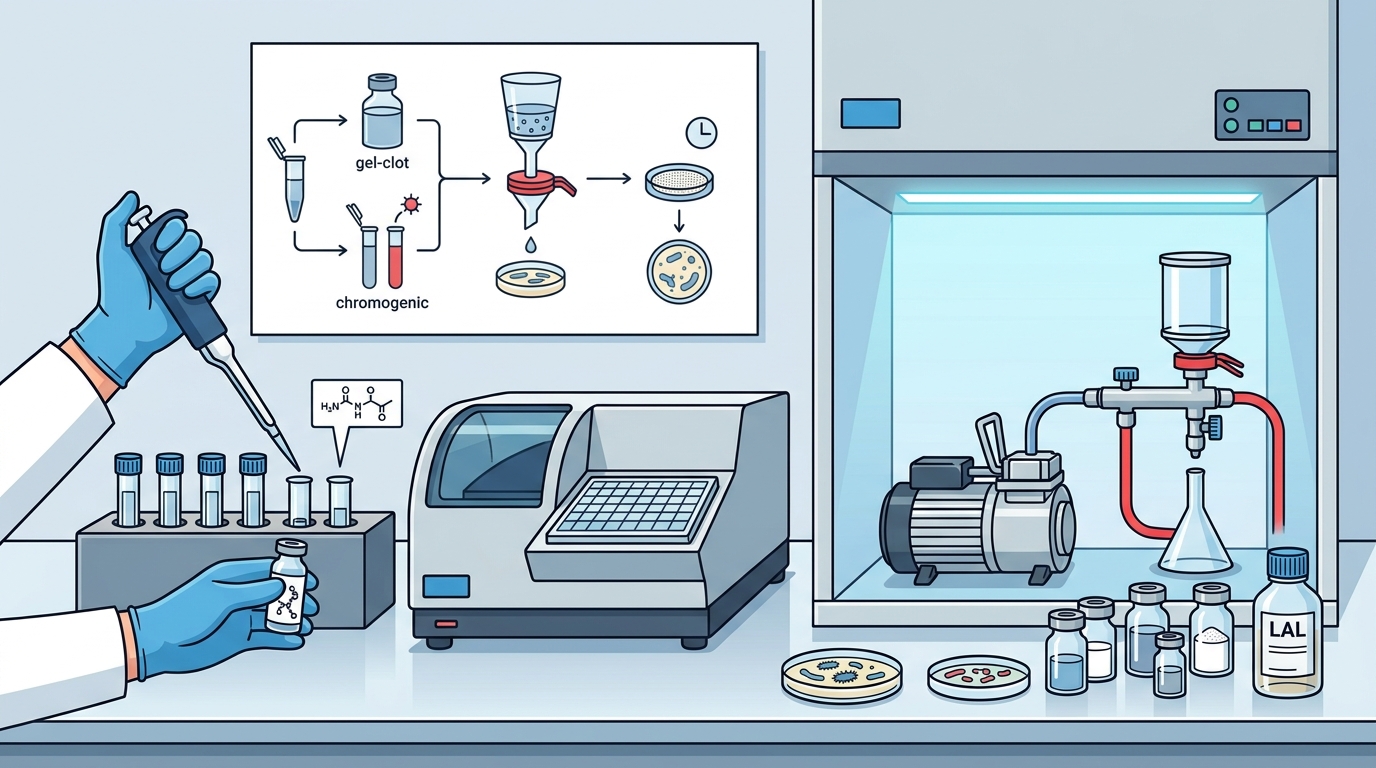
Membrane Filtration Method
The membrane filtration method is the most common approach for sterility testing of peptide solutions. In this method, a known volume of the sample is filtered through a membrane with a pore size small enough to retain microorganisms. The membrane is then placed in a suitable growth medium and incubated for a specified period, typically 14 days. Any microbial growth on the membrane indicates a positive result. This method is preferred for peptides because it is less stressful to the sample than direct inoculation, reducing the risk of false negatives due to antimicrobial properties of the peptide itself.
Direct Inoculation Method
Endotoxin Quantification Methods
Bacterial endotoxin is a component of the outer membrane of Gram-negative bacteria that can trigger a pyrogenic response in biological systems. Endotoxin quantification is the process of measuring the concentration of these lipopolysaccharides in a sample. This testing is essential because even trace amounts of endotoxin can significantly impact experimental outcomes, leading to false positives or altered biological responses. Aevitas Research provides endotoxin testing data for its reference materials to ensure that researchers can trust the purity of their samples.
Limulus Amebocyte Lysate (LAL) Assay
The Limulus Amebocyte Lysate (LAL) assay is the standard method for detecting bacterial endotoxins. This assay utilizes the clotting mechanism of horseshoe crab blood cells, which react specifically to endotoxins. There are two main types of LAL assays: the gel-clot method and the turbidimetric method. The gel-clot method is a qualitative test that indicates the presence or absence of endotoxin above a certain threshold. The turbidimetric method, on the other hand, is quantitative and allows for the precise measurement of endotoxin concentration. Aevitas Research utilizes quantitative LAL assays to provide detailed endotoxin levels for each batch of reference materials.
Acceptance Criteria
Acceptance criteria for endotoxin testing are typically defined by the intended application of the peptide. For research-grade reference materials, the endotoxin levels must be below a specified limit, often expressed in endotoxin units (EU) per milligram of peptide. These limits are established to ensure that the endotoxin content is low enough to not interfere with standard laboratory protocols. Aevitas Research adheres to strict acceptance criteria, ensuring that all its products meet the highest standards of purity and safety for research use.
Certificate of Analysis (COA) Integrity
A Certificate of Analysis (COA) is a document that provides the results of quality control tests performed on a specific batch of a product. It serves as a critical tool for traceability and quality assurance, allowing researchers to verify the identity, purity, and safety of the reference materials they are using. Aevitas Research provides a comprehensive COA for every batch of its peptide reference materials, detailing the results of sterility, endotoxin, and other relevant tests. This transparency is a hallmark of a reputable supplier and is essential for maintaining the integrity of research data.
Traceability and Batch Specificity
Each COA must be specific to the batch of the product being shipped. This ensures that the test results accurately reflect the quality of the exact material the researcher receives. Traceability is further enhanced by including unique batch numbers and manufacturing dates on the COA. This level of detail allows for easy tracking of any potential issues and facilitates quality control audits. Aevitas Research ensures that all its COAs are clearly labeled and easily accessible, providing researchers with the confidence they need in their reference materials.
Third-Party Verification
While in-house testing is a standard practice, third-party verification adds an additional layer of credibility to the COA. Independent laboratories can perform confirmatory tests on the reference materials, providing an unbiased assessment of their quality. This is particularly important for high-stakes research where the integrity of the data is paramount. Aevitas Research supports the use of third-party verification to further validate the quality of its products, reinforcing its commitment to research integrity.
Supplier Quality Comparison
When selecting a peptide supplier, researchers must consider the quality and transparency of the testing standards employed. The following table compares key quality assurance features of Aevitas Research with general industry standards to highlight the importance of rigorous testing protocols.
| Feature | Aevitas Research | General Industry Standard |
|---|---|---|
| Sterility Testing | Membrane Filtration and Direct Inoculation | Often limited to one method |
| Endotoxin Testing | Quantitative LAL Assay | Qualitative Gel-Clot Assay |
| COA Availability | Comprehensive and Batch-Specific | Basic or General |
| Method Validation | Pharmacopeial Compliance | Internal Protocols |
| Third-Party Verification | Supported | Rarely Offered |
This comparison underscores the commitment of Aevitas Research to providing the highest quality reference materials. By adhering to rigorous testing standards and providing transparent documentation, Aevitas Research ensures that researchers can rely on the integrity of their data.
Key Takeaways
- Method suitability validation is essential for ensuring the reliability of sterility and endotoxin test results.
- Compliance with pharmacopeial standards such as USP and Ph. Eur. is the gold standard for testing protocols.
- Membrane filtration is the preferred method for sterility testing of peptides due to its reduced stress on the sample.
- Quantitative LAL assays provide precise endotoxin levels, which are critical for research integrity.
- A comprehensive Certificate of Analysis (COA) is a critical tool for traceability and quality assurance.
- Batch-specific COAs ensure that test results accurately reflect the quality of the material received.
- Third-party verification adds an additional layer of credibility to the quality of reference materials.
- Aevitas Research is committed to providing research-grade peptide reference materials that meet the highest standards of quality and safety.
Frequently Asked Questions
What is the primary purpose of sterility testing for peptide reference materials?
The primary purpose of sterility testing is to ensure that the peptide sample is free from viable microorganisms that could compromise the integrity of an experiment or introduce confounding variables into research data.
Why is the membrane filtration method preferred for peptide sterility testing?
The membrane filtration method is preferred because it is less stressful to the sample than direct inoculation, reducing the risk of false negatives due to the antimicrobial properties of the peptide itself.
What is the Limulus Amebocyte Lysate (LAL) assay used for?
The LAL assay is used for detecting and quantifying bacterial endotoxins in a sample. It utilizes the clotting mechanism of horseshoe crab blood cells, which react specifically to endotoxins.
How does a Certificate of Analysis (COA) contribute to research integrity?
A COA provides the results of quality control tests performed on a specific batch of a product, allowing researchers to verify the identity, purity, and safety of the reference materials they are using.
Why is method validation important for peptide suppliers?
Method validation is important because it demonstrates that an analytical method is capable of producing reliable and reproducible results for its intended application, ensuring the accuracy of the test data.
What are the acceptance criteria for endotoxin testing in research-grade peptides?
Acceptance criteria for endotoxin testing are typically defined by the intended application of the peptide. For research-grade reference materials, the endotoxin levels must be below a specified limit to ensure that the endotoxin content does not interfere with standard laboratory protocols.
How does Aevitas Research ensure the quality of its peptide reference materials?
Aevitas Research ensures the quality of its peptide reference materials by adhering to rigorous testing standards, providing comprehensive COAs, and supporting third-party verification to validate the quality of its products.
Conclusion
Understanding the testing standards for sterility and endotoxin safety is essential for researchers seeking reliable peptide reference materials. By adhering to rigorous method validation, pharmacopeial compliance, and transparent documentation, Aevitas Research sets a high standard for quality in the life sciences industry. For researchers committed to the integrity of their data, choosing a supplier that prioritizes these standards is a critical decision. Explore the Aevitas Research catalog to find reference materials that meet the highest standards of quality and safety.