

Verifying the integrity of a peptide supplier is no longer optional for serious researchers. According to recent industry analyses, over 40% of online peptide products fail to meet their labeled purity specifications, creating significant risks for experimental validity. This statistic underscores the critical need for rigorous due diligence before purchasing any research materials. Researchers must look beyond marketing claims and examine verifiable data points such as Certificates of Analysis, manufacturing origins, and batch consistency. This guide provides a definitive framework for identifying reliable suppliers who prioritize research integrity over volume.
The Core Verification Basics
Trust in the peptide supply chain begins with transparency. A trustworthy supplier does not hide behind vague descriptions or generic stock photos. Instead, they provide clear, accessible documentation for every product they sell. The first step in your verification process is to check if the company offers a dedicated section for Certificates of Analysis. These documents are the primary evidence of product quality and purity.
Furthermore, you must evaluate the supplier's commitment to batch consistency. Peptide synthesis is a chemical process that can vary between batches if not strictly controlled. Reliable companies produce peptides in-house or work with contracted manufacturers who adhere to strict Good Manufacturing Practices (GMP). This ensures that the peptide you order today is chemically identical to the one you order next month. Without this consistency, your research data becomes unreliable and potentially invalid.
Another critical factor is the supplier's responsiveness to technical inquiries. When you contact a supplier with questions about solubility, storage, or synthesis methods, their response should be detailed and scientifically accurate. Generic customer service scripts are a red flag. A trustworthy supplier employs staff with scientific backgrounds who can provide expert guidance. This level of support indicates a company that values the success of its customers' research projects.
Analyzing Certificates of Analysis
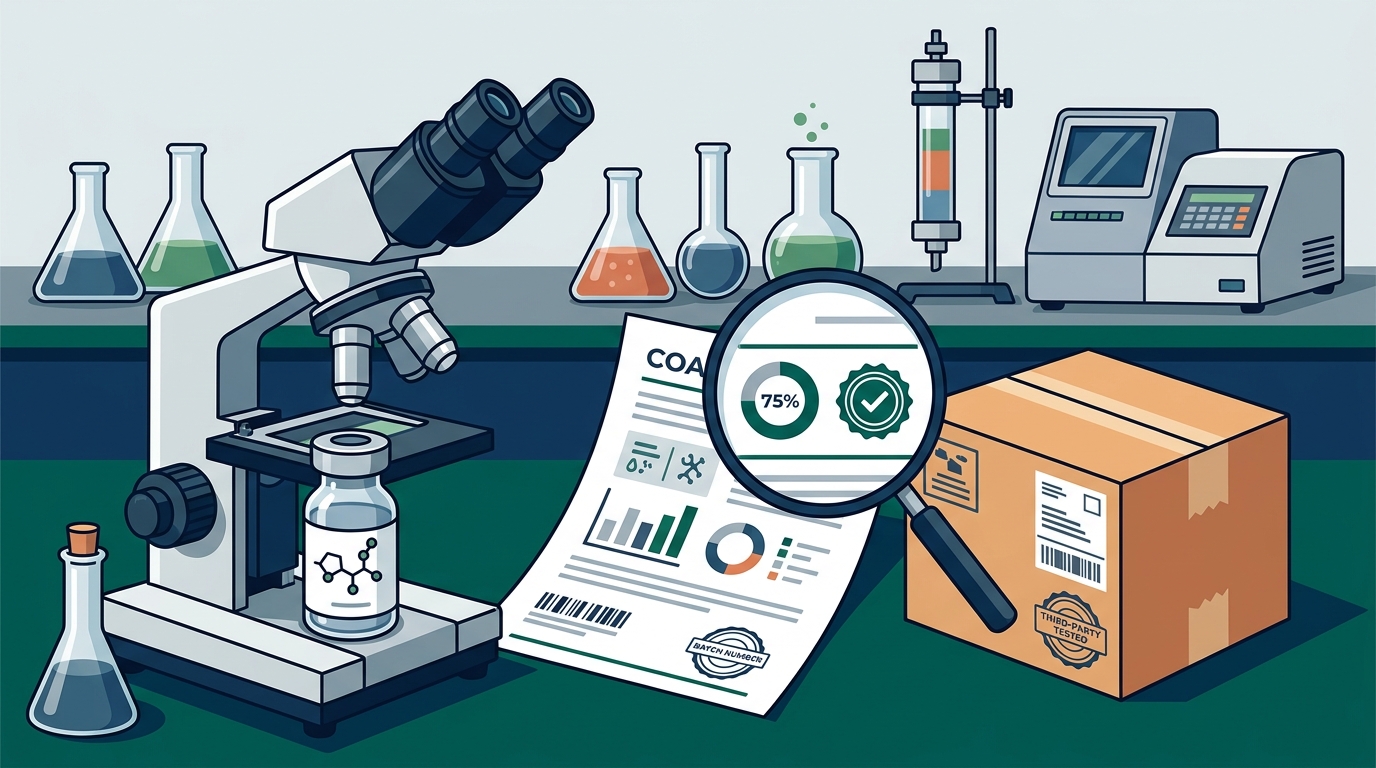
The Certificate of Analysis (COA) is the most important document in peptide procurement. It serves as a chemical fingerprint for the product, detailing its purity, molecular weight, and composition. A valid COA must include specific analytical data points that you can verify independently. The primary method used for this analysis is High-Performance Liquid Chromatography (HPLC). HPLC results show the percentage of the target peptide relative to impurities.
When reviewing a COA, look for the HPLC purity percentage. For research-grade peptides, a purity of 98% or higher is generally considered acceptable. However, some suppliers may claim higher purity without providing the corresponding chromatogram. A trustworthy supplier will always provide the actual HPLC chromatogram image, not just a number. This visual evidence allows you to see the separation of peaks and confirm that the product is not contaminated with byproducts.
Mass Spectrometry (MS) data is another essential component of a comprehensive COA. MS confirms the molecular weight of the peptide, ensuring that the amino acid sequence is correct. If the molecular weight does not match the theoretical value, the peptide may be degraded or incorrectly synthesized. Aevitas Research provides COAs for every batch, ensuring that researchers have access to this critical data. You can view these documents directly on their COA page to verify the quality of their products.
It is also important to check the date of the COA. A certificate that is several years old may not reflect the current quality of the product. Peptides can degrade over time, even when stored correctly. Therefore, the COA should be recent and correspond to the specific batch number of the product you are purchasing. This ensures that the data is relevant to your current order.
Manufacturing Standards and Origin
The origin of peptide manufacturing plays a significant role in determining quality. Peptides synthesized in countries with strict regulatory oversight are generally more reliable than those produced in regions with lax enforcement. The United States, for example, has rigorous standards for chemical manufacturing. Peptides made in the USA are often subject to additional quality control measures that reduce the risk of contamination.
Look for suppliers who explicitly state their manufacturing location. Aevitas Research highlights that their products are Made in the USA. This claim is significant because it implies adherence to domestic regulatory standards. Domestic manufacturing also reduces the risk of supply chain disruptions and ensures faster shipping times for researchers within the country. This logistical advantage is crucial for time-sensitive experiments.
Beyond location, examine the supplier's production capabilities. Do they produce peptides in-house, or do they outsource to third-party labs? In-house production allows for greater control over the synthesis process and quality assurance. It also enables the company to respond quickly to quality issues. If a supplier outsources production, they must have strict contracts and regular audits to ensure consistency. Without these measures, the quality of the peptides can vary significantly between batches.
Additionally, consider the supplier's commitment to research integrity. Some companies prioritize profit over quality, leading to shortcuts in the synthesis process. Trustworthy suppliers invest in advanced equipment and skilled chemists to maintain high standards. They also provide educational resources to help researchers understand the nuances of peptide handling. This educational focus demonstrates a long-term commitment to the scientific community.
Storage and Stability Protocols
Peptides are sensitive molecules that require specific storage conditions to maintain stability. Improper storage can lead to degradation, which compromises the integrity of your research. A trustworthy supplier will provide clear instructions on how to store their products. These instructions should include temperature requirements, humidity levels, and light exposure guidelines.
Most peptides should be stored at ultra-low temperatures, typically between -20°C and -80°C, when not in use. However, once reconstituted, peptides are much more fragile and should be kept on ice or in a refrigerator. Aevitas Research offers detailed guidance on best practices for storing research grade peptides. Following these guidelines is essential for preserving the potency of your samples.
Another critical aspect of storage is the packaging material. Peptides should be shipped and stored in vials that protect them from moisture and light. High-quality suppliers use lyophilized (freeze-dried) peptides, which are more stable than liquid forms. Lyophilization extends the shelf life of the product and reduces the risk of degradation during shipping. When you receive your order, check the vials for any signs of damage or moisture intrusion.
Furthermore, consider the supplier's shipping methods. Peptides must be shipped with adequate cooling to prevent degradation during transit. Reliable suppliers use insulated packaging and cold packs to maintain the required temperature. They also provide tracking information so you can monitor the shipment and ensure it arrives in optimal condition. This attention to detail in logistics reflects a broader commitment to product quality.
Comparing Supplier Models
Not all peptide suppliers operate under the same business model. Some companies focus on high-volume sales with lower prices, while others prioritize premium quality with higher costs. Understanding these differences can help you make an informed decision. Below is a comparison of common supplier models to help you evaluate your options.
| Supplier Model | Quality Indicators | Price Range | Best For |
|---|---|---|---|
| Premium Research Grade | In-house synthesis, detailed COAs, USA manufacturing | Higher | High-precision research |
| Standard Commercial Grade | Third-party synthesis, basic COAs, mixed origins | Medium | General screening |
| Budget Bulk Suppliers | Minimal documentation, no batch testing, unknown origin | Low | Non-critical trials |
Premium research grade suppliers, such as Aevitas Research, offer the highest level of quality assurance. They provide detailed Certificates of Analysis for every batch and ensure that their products are made in the USA. This level of transparency is essential for researchers who require consistent and reliable data. While the price may be higher, the cost of failed experiments due to poor quality peptides is far greater.
Standard commercial grade suppliers may offer a middle ground in terms of price and quality. However, they often rely on third-party manufacturers, which can introduce variability. It is crucial to verify their quality control processes before making a purchase. If they cannot provide detailed COAs or explain their manufacturing process, it is best to look elsewhere.
Budget bulk suppliers are generally not recommended for serious research. The lack of documentation and quality control poses significant risks. While the low price may be tempting, the potential for contaminated or degraded peptides can compromise your entire study. Always prioritize quality over cost when selecting a peptide supplier.
Key Takeaways
- Verify COAs: Always request and review the Certificate of Analysis for every batch to confirm purity and molecular weight.
- Check Manufacturing Origin: Prefer suppliers who manufacture in the USA to ensure adherence to strict regulatory standards.
- Assess Transparency: Trustworthy suppliers provide detailed information about their synthesis process and quality control measures.
- Evaluate Storage Guidance: Reliable companies offer clear instructions on how to store and handle peptides to maintain stability.
- Review Shipping Methods: Ensure the supplier uses adequate cooling and packaging to prevent degradation during transit.
- Compare Supplier Models: Understand the differences between premium, standard, and budget suppliers to make an informed choice.
- Prioritize Research Integrity: Choose a supplier that values scientific accuracy over volume to ensure the validity of your results.
Frequently Asked Questions
What is the most important document to verify peptide quality?
The Certificate of Analysis (COA) is the most critical document. It provides detailed data on purity, molecular weight, and composition, allowing you to verify the product's quality before use.
Why is manufacturing origin important for peptide suppliers?
Manufacturing origin indicates the regulatory standards under which the peptides are produced. Suppliers in the USA adhere to strict guidelines, reducing the risk of contamination and ensuring higher quality control.
How should I store lyophilized peptides?
Lyophilized peptides should be stored at ultra-low temperatures, typically between -20°C and -80°C, in a dry, dark place to maintain stability and prevent degradation.
What is the difference between HPLC and Mass Spectrometry?
HPLC measures the purity of the peptide by separating components, while Mass Spectrometry confirms the molecular weight and amino acid sequence. Both are essential for comprehensive quality verification.
Can I trust suppliers who offer lower prices?
Lower prices often indicate compromised quality or lack of rigorous testing. It is essential to verify the supplier's quality control processes and documentation before making a purchase.
How do I verify the purity of research grade peptides?
You can verify purity by reviewing the HPLC chromatogram provided in the COA. Aevitas Research offers detailed guides on how to verify the purity of research grade peptides to help researchers make informed decisions.
What is a peptide research library?
A peptide research library is a curated collection of peptides designed for specific scientific inquiries. It provides researchers with access to a wide range of compounds for screening and analysis. You can explore a comprehensive Peptide Research Library to find the compounds you need.
Secure Your Research Supplies
Ensuring the integrity of your research starts with choosing the right supplier. By following the verification steps outlined in this guide, you can protect your experiments from the risks of poor-quality peptides. Aevitas Research is committed to providing verified, high-purity peptides for the scientific community. Visit our homepage to explore our products and request your COAs today. Trustworthy suppliers are the foundation of reliable science.