

Research Peptide Quality Documentation: Aevitas Research Guide
Certificates of Analysis
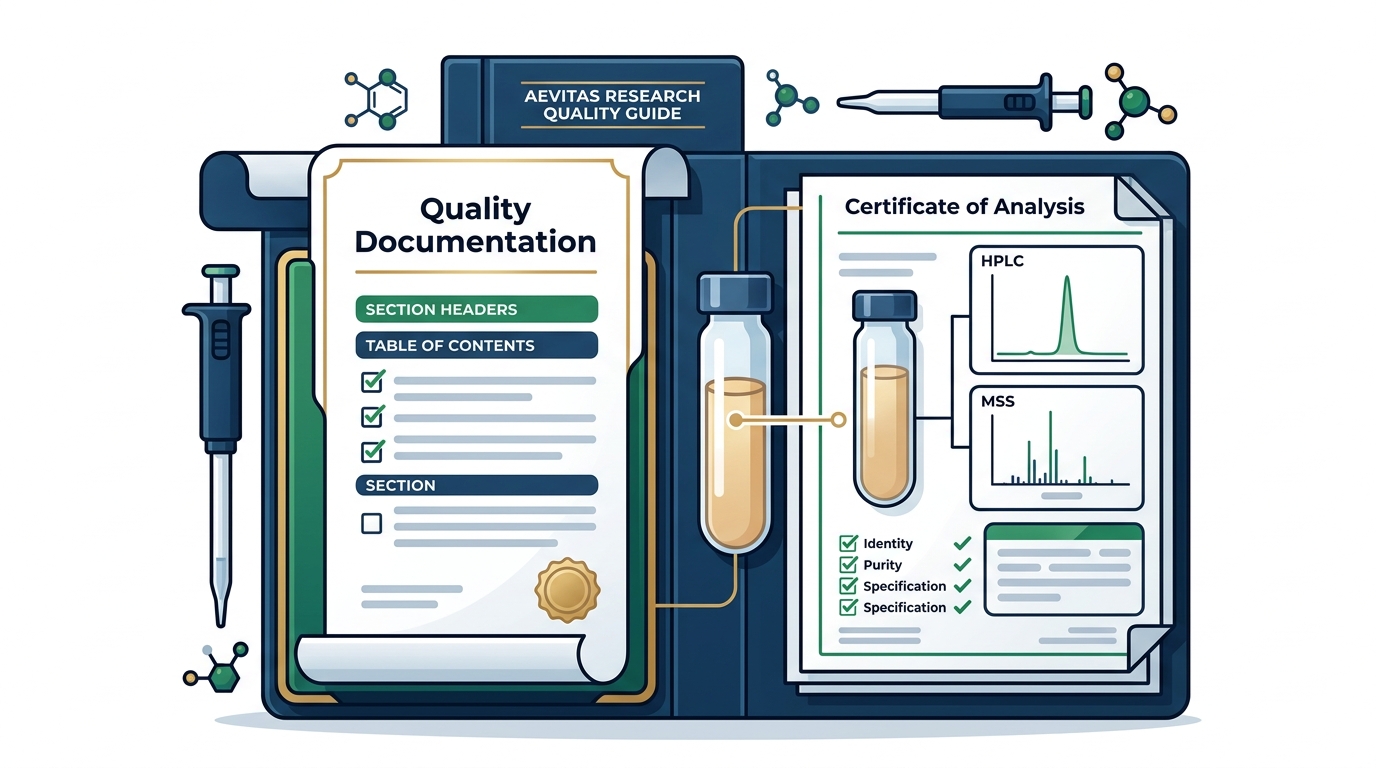
A Certificate of Analysis (COA) is a formal document that verifies the identity, purity, and quality of a specific batch of chemical or biological material. For research peptides, the COA serves as the primary evidence that the product meets the specifications claimed by the manufacturer. Aevitas Research makes these documents available to ensure transparency and allow researchers to verify the integrity of their reference materials before incorporating them into experimental protocols.
Components of a Standard COA
Role in Research Integrity
Purity Thresholds
Purity is a critical metric in peptide research, defined as the percentage of the desired peptide sequence relative to total mass. Aevitas Research adheres to strict purity thresholds to ensure that its reference materials are suitable for high-precision laboratory applications. High purity minimizes the presence of byproducts, truncated sequences, or other contaminants that could interfere with experimental outcomes.
Measurement Techniques
Purity is typically assessed using High-Performance Liquid Chromatography (HPLC). This technique separates the components of a mixture based on their chemical properties. The resulting chromatogram allows for the quantification of the main peptide peak against any minor peaks or impurities. Aevitas Research utilizes these standard analytical methods to report accurate purity percentages on every COA. For additional details, review the company website.
Impact on Experimental Accuracy
In sensitive biological assays, even small amounts of impurities can skew results. Therefore, maintaining high purity thresholds is not just a quality control measure but a scientific necessity. By providing peptides that meet rigorous purity standards, Aevitas Research helps researchers avoid confounding variables. This ensures that the data generated is reliable and that the reference materials perform consistently across different laboratories and experimental setups. For additional details, review the company website.
Endotoxin Testing
Endotoxin testing is a critical quality control step for peptides intended for use in biological research. Endotoxins are lipopolysaccharides found in the outer membrane of Gram-negative bacteria. They are potent immune stimulants that can cause significant interference in cell culture and in vivo studies. Aevitas Research conducts endotoxin testing to ensure that its products are free from these bacterial contaminants.
Why Endotoxins Matter in Research
Even trace amounts of endotoxins can trigger inflammatory responses in cells, leading to false positives or altered experimental outcomes. This is particularly problematic in studies involving immune cells or cell viability assays. By testing for endotoxins, Aevitas Research ensures that its peptides do not introduce unwanted biological activity. This allows researchers to isolate the effects of the peptide itself without the confounding influence of bacterial contaminants.
Testing Standards
Endotoxin levels are typically measured using the Limulus Amebocyte Lysate (LAL) assay or the Turbidimetric method. These methods are highly sensitive and capable of detecting very low levels of endotoxins. Aevitas Research reports these results in its COAs, providing researchers with the data they need to assess the suitability of the material for their specific applications. This commitment to rigorous testing underscores the company's dedication to providing high-quality reference materials.
Peptide Monographs
Content of a Peptide Monograph
Supporting Reproducibility
Comparison of Quality Documentation
| Documentation Type | Purpose | Key Data Points |
|---|---|---|
| Certificate of Analysis (COA) | Verifies batch-specific quality and identity | Batch number, purity, identity, endotoxin levels |
| Purity Report | Quantifies the percentage of desired peptide | HPLC results, impurity profile |
| Endotoxin Test | Ensures freedom from bacterial contaminants | Endotoxin units (EU) per mg |
| Peptide Monograph | Describes chemical and physical properties | Molecular weight, sequence, storage conditions |
Key Takeaways
- A Certificate of Analysis (COA) is the primary document verifying the identity and quality of a specific peptide batch.
- Purity thresholds are critical for ensuring that reference materials do not introduce confounding variables into experiments.
- Endotoxin testing is essential for preventing bacterial contaminants from interfering with biological assays.
- Peptide monographs provide detailed technical information about the chemical structure and physical properties of peptides.
- Aevitas Research provides these documents to support transparency, reproducibility, and research integrity.
- High-quality documentation is a hallmark of reputable research peptide providers.
- Researchers should always review COAs and monographs before incorporating new reference materials into their protocols.
Frequently Asked Questions
What is a Certificate of Analysis (COA) for research peptides?
Why is purity important in research peptides?
Purity ensures that the peptide is free from impurities that could interfere with experimental results. High purity is essential for accurate and reproducible data.
What is endotoxin testing?
Endotoxin testing measures the presence of bacterial lipopolysaccharides. These contaminants can cause immune responses and skew results in biological studies.
What information is included in a peptide monograph?
A monograph describes the chemical structure, molecular weight, and physical properties of a peptide. It also provides guidance on storage and handling.
How does Aevitas Research ensure quality?
Aevitas Research provides verified quality documentation, including COAs and monographs, for all its research-grade peptide reference materials.
Are these products for human use?
No, all products from Aevitas Research are intended for research purposes only and are not for human or veterinary consumption.