

Finding a reliable source for research-grade peptides is one of the most consequential decisions a laboratory professional can make. With dozens of vendors appearing online each year, distinguishing a quality-controlled supplier from a low-accountability reseller requires more than a quick search. This guide walks through the standards, documentation, and trust signals that define a professional-tier peptide supplier. Whether you work in an academic lab, a private research facility, or a healthcare-adjacent institution, the criteria below will help you evaluate any vendor before placing an order.
What Are Research-Grade Peptides?
A research-grade peptide is a synthesized amino acid chain manufactured and tested to meet documented purity and identity standards for laboratory investigation. These materials serve as reference compounds in analytical, biochemical, and molecular biology studies. They are not consumer products; they are precision tools for qualified purchasers conducting controlled experiments.
Research peptides span multiple functional categories. Aevitas Research, for example, organizes its catalog into areas such as growth hormone peptides, regenerative peptides, and metabolic regulation peptides, giving researchers a structured way to locate reference materials relevant to their field of study.
Why Sourcing Quality Matters for Research Integrity
Inconsistent raw materials introduce variables that compromise reproducibility. A peptide with unverified purity can skew assay results, waste reagents, and erode confidence in published data. Third-party quality assurance exists specifically to remove manufacturer bias from the verification process.
Reproducibility is a foundational principle in science. When a supplier provides batch-level analytical documentation, researchers can cross-reference their experimental conditions against a known baseline. Without that documentation, even well-designed studies rest on assumptions about material quality.
Quality Benchmarks Every Buyer Should Know
HPLC Purity Testing
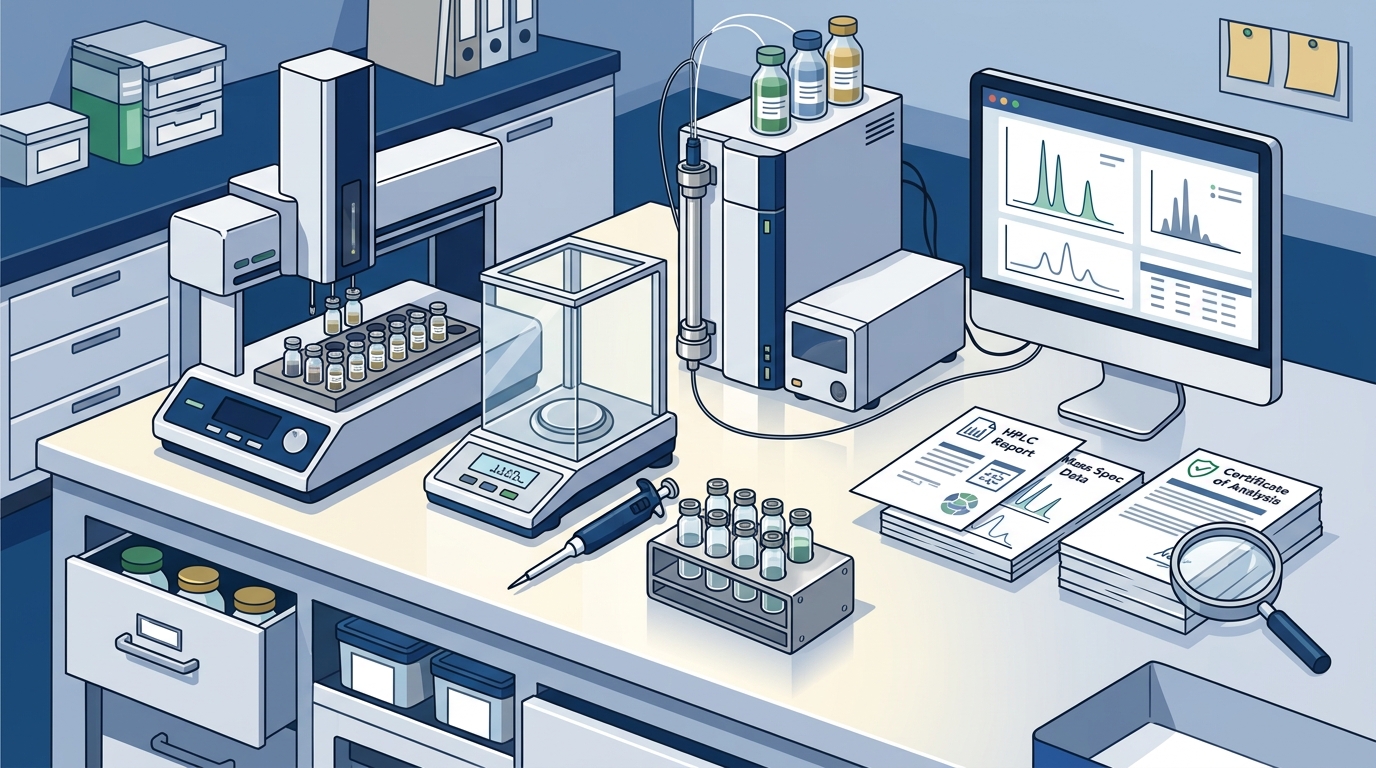
High-performance liquid chromatography (HPLC) is the standard analytical method for quantifying peptide purity. It separates the target compound from synthesis byproducts and contaminants, expressing the result as a percentage. Professional suppliers typically guarantee purity at or above 98%.
Mass Spectrometry Identity Confirmation
Mass spectrometry (MS) is an analytical technique that confirms a peptide's molecular weight matches the expected value for its sequence. This step verifies that the product is the compound it claims to be, not a truncated or misfolded variant.
Endotoxin and Contaminant Screening
Limulus Amebocyte Lysate (LAL) testing is a bioassay used to detect bacterial endotoxins in peptide preparations. Reputable suppliers include endotoxin data in their batch documentation, ensuring materials are free from microbial contamination that could interfere with sensitive assays. For a deeper look at purity standards, see why purity matters in research-grade peptides.
The Role of Certificates of Analysis
A Certificate of Analysis (COA) is a document issued alongside a batch of material that summarizes the results of quality-control testing. It typically includes the peptide sequence, lot number, purity percentage, molecular weight confirmation, and any additional assay data. Legitimate COAs are generated by independent laboratories, not self-reported by the manufacturer.
Aevitas Research publishes COAs through a dedicated research access portal, giving purchasers the ability to verify testing data before and after ordering. This level of transparency is a hallmark of suppliers that prioritize scientific credibility. To learn more about reading these documents, visit the peptide certificate of analysis guide.
How to Evaluate a Professional Peptide Supplier
Documentation Transparency
A trustworthy vendor publishes batch-specific COAs with HPLC chromatograms, MS spectra, and clearly identified testing laboratories. If a supplier cannot produce this documentation upon request, that is a disqualifying signal.
Qualified Purchaser Policies
Professional suppliers restrict sales to qualified purchasers such as research institutions, laboratories, and credentialed professionals. Aevitas Research maintains a research access verification process to confirm buyer eligibility, reinforcing the research-only positioning of its catalog.
Responsive Support and Clear Policies
Look for published shipping and payment terms, a clear refund policy, and accessible customer support. These operational details signal a company that stands behind its products and processes.
Supplier Evaluation Comparison Table
| Evaluation Criterion | Professional-Grade Supplier | Low-Accountability Reseller |
|---|---|---|
| Third-party COA per batch | Yes, with HPLC and MS data | Absent or self-reported |
| Purity guarantee | 98%+ verified | Unspecified or vague |
| Endotoxin testing | LAL assay included | Not offered |
| Qualified purchaser policy | Verification required | Open to anyone |
| Published shipping/return terms | Transparent and detailed | Minimal or hidden |
| Educational content library | Peer-level research resources | Marketing-only copy |
Key Takeaways
- Research-grade peptides require batch-level analytical documentation to support experimental reproducibility.
- HPLC purity testing, mass spectrometry, and LAL endotoxin assays are the three core quality benchmarks.
- A Certificate of Analysis should be independently generated and publicly accessible for every lot.
- Qualified purchaser verification policies indicate a supplier focused on legitimate research applications.
- Transparent shipping, refund, and support policies reflect operational maturity and accountability.
- Educational resources such as a peptide research library signal domain expertise beyond simple product listings.
- Price alone is never a sufficient criterion; documentation and testing standards determine true value.
Frequently Asked Questions
What is a research-grade peptide?
A research-grade peptide is a synthesized amino acid sequence that has been analytically verified for purity and identity using methods such as HPLC and mass spectrometry. These materials are intended strictly for laboratory investigation.
Why does third-party testing matter when buying peptides?
Third-party testing provides independent verification that removes potential conflicts of interest inherent in manufacturer self-testing. It confirms that the peptide meets its stated purity and identity specifications.
What should a Certificate of Analysis include?
A complete COA lists the peptide sequence, lot or batch number, HPLC purity percentage, molecular weight confirmation via mass spectrometry, and the name of the testing laboratory. Some also include endotoxin assay results and solubility data.
How do I know if a peptide supplier is legitimate?
Look for published, batch-specific COAs; a qualified purchaser policy; transparent business terms; educational content; and responsive customer support. Aevitas Research provides all of these through its website.
What purity level should I look for?
Most professional research applications require peptide purity of 98% or higher as confirmed by HPLC. The acceptable threshold depends on the specific assay and its sensitivity to contaminants.
Can anyone buy research peptides?
Reputable suppliers restrict purchases to qualified buyers such as research institutions, laboratories, and credentialed professionals. Open-access vendors with no verification process are generally less reliable.
What categories of research peptides are available?
Common categories include growth hormone peptides, regenerative peptides, metabolic regulation peptides, mitochondrial peptides, neuroregulatory peptides, and GLP-1 peptides. Aevitas Research offers materials across all of these peptide categories.
Where can I learn more about specific peptides before purchasing?
The Aevitas Research peptide research library provides detailed reference pages on individual compounds, including published research context and structural information.
Explore Aevitas Research
If you are looking for a U.S.-based supplier that combines third-party tested reference materials, batch-level COAs, and a qualified purchaser process, explore the full Aevitas Research catalog. Every product ships with supporting documentation designed to meet the expectations of serious research professionals.