

Finding research-grade peptides backed by verified purity documentation is one of the most important steps in responsible laboratory sourcing. Without reliable analytical data, researchers risk introducing variables that compromise experimental consistency. A Certificate of Analysis (COA) is an official document that records batch-specific testing results, including purity percentage, molecular identity, and impurity profiles. This guide covers what verified purity documentation looks like, the analytical methods behind it, and what to evaluate when selecting a supplier of laboratory reference materials. Whether you are sourcing peptides for in vitro studies or analytical benchmarking, understanding these standards is essential.
What "Research-Grade" Actually Means
The term "research-grade" is used frequently across peptide suppliers, but it does not always refer to the same quality tier. In practice, research-grade peptides are compounds manufactured and tested to meet a minimum purity threshold suitable for scientific investigation. Most credible suppliers define this threshold at 95% purity or higher, as measured by reversed-phase high-performance liquid chromatography (RP-HPLC).
A research-grade peptide is a synthetic peptide compound produced for laboratory and analytical use only, verified through documented testing protocols. These materials are not intended for any form of consumption. You can explore Aevitas Research's standards in detail on the research-grade peptide lab reference materials page.
The Role of Purity Documentation in Peptide Sourcing
Purity documentation serves as the primary evidence that a peptide product matches its labeled identity and composition. Without it, researchers have no way to confirm that what arrives in the vial is what was ordered. As noted in industry guidelines, even small variations in purity or molecular identity can affect experimental consistency.
Reputable suppliers provide batch-specific documentation before purchase, not just summary claims. This is a core principle at Aevitas Research, where Certificates of Analysis are published and tied to individual product batches. This approach supports traceability and promotes transparency in the research supply chain.
Analytical Methods Behind Purity Verification
Two primary analytical techniques form the backbone of peptide purity verification: HPLC and mass spectrometry (MS). Understanding what each method measures helps researchers interpret COA data with confidence.
High-Performance Liquid Chromatography (HPLC)
HPLC is a scientific technique used to separate, identify, and quantify each component in a peptide sample. Peptide purity, as determined by reversed-phase HPLC, refers to the percentage of the target peptide compared to impurities that absorb at 220 nm. This is the industry-standard method for reporting purity percentages on a COA.
Mass Spectrometry (MS)
Mass spectrometry is a technique used to measure molecular masses within a sample by ionizing chemical species and sorting ions based on their mass-to-charge ratio. It confirms that the peptide's molecular weight matches the expected value, verifying identity alongside purity. For deeper context on how to read these results, see how to verify the purity of research-grade peptides.
| Method | What It Measures | Primary Purpose | Typical Tolerance |
|---|---|---|---|
| RP-HPLC | Component separation at 220 nm | Purity percentage | Reported as % area |
| Mass Spectrometry | Molecular mass-to-charge ratio | Identity confirmation | ±0.1 Da |
| Amino Acid Analysis | Amino acid composition | Sequence verification | Varies by method |
What a Certificate of Analysis Should Include
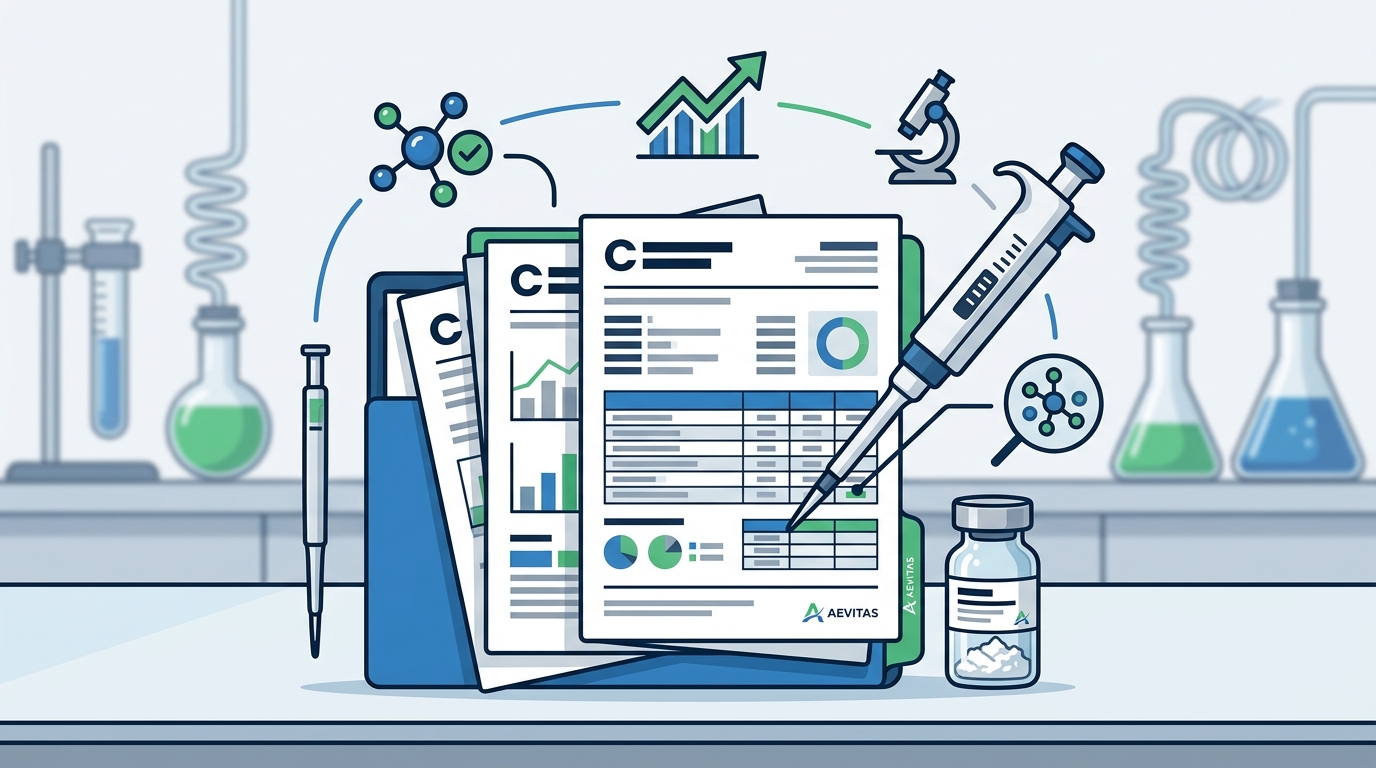
A Certificate of Analysis (COA) is the foundational document of peptide quality assurance. It should contain, at minimum, the following elements:
- Purity percentage from HPLC analysis
- Molecular weight confirmation from mass spectrometry
- Identified impurities and their levels
- Unique batch or lot reference number
- Name of the testing laboratory
- Date of analysis
Always cross-reference the COA batch number against your specific order to confirm the data applies to your material. Aevitas Research publishes batch-specific COAs for every product, accessible through the peptide certificate of analysis resource page.
Why Third-Party Testing Matters
Third-party testing is the practice of sending peptide samples to an independent, external laboratory for analysis rather than relying solely on in-house results. This separation between manufacturing and verification reduces conflicts of interest and increases the credibility of reported data.
Supplier-conducted HPLC alone does not provide the same level of assurance. Legitimate suppliers identify the external testing laboratory by name and make results accessible before the point of purchase. To understand why this distinction matters for experimental outcomes, read why purity matters in research-grade peptides.
Evaluating Peptide Suppliers: A Quality Checklist
Not all suppliers who claim "research-grade" quality meet the same benchmarks. When evaluating a peptide source, consider these criteria:
Documentation Transparency
Does the supplier publish COAs with batch numbers before checkout? Are HPLC chromatograms and MS spectra available, or only summary purity numbers? Full documentation should be standard, not an exception.
Testing Independence
Is testing conducted by a named third-party laboratory, or only in-house? Independent verification is a hallmark of credible sourcing. Learn more about what to look for in a reputable source at best places to buy research peptides.
Product Handling and Storage
Quality does not end at synthesis. Proper lyophilization, cold-chain shipping, and clear storage guidelines protect peptide integrity from production to delivery. For guidance on maintaining material quality after purchase, see best practices for storing research-grade peptides.
| Criterion | Strong Indicator | Warning Sign |
|---|---|---|
| COA Availability | Published per batch before purchase | Only available "upon request" |
| Testing Source | Named third-party lab | In-house only, no lab identified |
| Purity Threshold | ≥98% HPLC-verified | No purity data provided |
| Batch Traceability | Unique lot numbers on every COA | Generic or missing lot info |
| Research-Use Classification | Clearly labeled, terms enforced | Ambiguous product descriptions |
Key Takeaways
- Research-grade peptides should meet a minimum purity threshold of 95%, with many credible suppliers targeting 98% or higher.
- A Certificate of Analysis (COA) is the foundational quality document, recording purity, identity, and batch-specific data.
- HPLC and mass spectrometry are the two primary analytical methods used to verify peptide purity and molecular identity.
- Third-party testing by an independent laboratory provides stronger assurance than in-house testing alone.
- COAs should be published per batch and accessible before purchase, not provided only after the fact.
- Proper storage and handling after purchase are essential to maintaining peptide integrity over time.
- Evaluating supplier transparency, testing independence, and traceability helps researchers source materials they can trust.
Frequently Asked Questions
What is a Certificate of Analysis (COA) for peptides?
A Certificate of Analysis is an official document that records batch-specific testing results for a peptide, including purity percentage from HPLC, molecular weight confirmation from mass spectrometry, identified impurities, and the batch reference number. It serves as the primary quality assurance record.
What purity level qualifies as research-grade?
Industry standards generally define research-grade peptides as those with HPLC-verified purity of 95% or higher. Many reputable suppliers target 98% or above for laboratory reference applications. Anything below 95% is typically considered reagent or industrial grade.
Why is third-party testing important for research peptides?
Third-party testing separates the manufacturing process from the verification process, reducing potential bias. An independent laboratory provides unbiased confirmation of purity and identity, which strengthens the credibility of the results reported on a COA.
What is the difference between HPLC and mass spectrometry?
HPLC separates and quantifies components in a sample to determine purity percentage. Mass spectrometry measures molecular mass to confirm the identity of the peptide. Together, they provide complementary data: one confirms how pure the sample is, the other confirms what the sample is.
How can I verify that a COA is authentic?
Check that the COA includes a unique batch or lot number, the name of the testing laboratory, the date of analysis, and detailed analytical data rather than just a summary percentage. You can also contact the named testing laboratory directly to confirm the report.
Should COAs be available before or after purchase?
Ideally, COAs should be accessible before purchase so researchers can evaluate quality documentation prior to committing. Suppliers who withhold this information until after checkout offer less transparency than those who publish it openly.
What does "for research use only" mean on peptide products?
"For research use only" is a classification indicating that the product is intended exclusively for laboratory and scientific investigation. These materials are not approved or intended for any form of consumption and are sold strictly as reference materials for qualified purchasers.
Where can I find peptides with published purity documentation?
Aevitas Research publishes batch-specific Certificates of Analysis for all products. You can review available documentation on the COA page and browse the full catalog in the research materials shop.
Start Sourcing with Confidence
Verified purity documentation is not optional for serious research. If you are looking for peptide laboratory reference materials backed by third-party testing, batch-specific COAs, and transparent quality standards, explore the Aevitas Research catalog today. Every product includes published analytical data so you can evaluate quality before you order.