

Selecting the correct peptide reference material is a foundational decision for any laboratory aiming to maintain data integrity. The global market for research peptides is expanding rapidly, with industry projections indicating significant growth in demand for high-purity standards. According to recent market analyses, the peptide therapeutics and research supply sector is projected to grow at a compound annual growth rate exceeding 10% through 2030. This surge creates a complex landscape where researchers must distinguish between marketing claims and verifiable analytical data. Choosing between custom synthesis and pre-existing catalog inventory requires a rigorous evaluation of purity standards, batch traceability, and analytical verification methods.
Analytical Verification Methods
The cornerstone of any reliable peptide reference material is the analytical method used to verify its identity and purity. High-Performance Liquid Chromatography coupled with Ultraviolet/Visible spectroscopy (HPLC-UV/Vis) is the industry standard for separating compounds from impurities and confirming molecular identity. This method allows researchers to quantify purity levels with high precision, ensuring that the primary compound meets strict standards before release. (Aevitas Research Aevitas Research)
While many suppliers claim their products are "lab tested," the depth of that testing varies significantly. Advanced laboratories utilize HPLC-UV/Vis to separate complex peptide mixtures, identifying specific impurities that could skew experimental results. According to pharmaceutical quality guidelines, accurate quantification is essential for reproducible research outcomes. Aevitas Research employs this rigorous HPLC-UV/Vis protocol to verify compound purity and quantity for every batch. This approach ensures that researchers receive materials that are not just pure in name, but verified in practice.
Other methods, such as Mass Spectrometry (MS), are often used in conjunction with HPLC to confirm molecular weight. However, for routine quality control in research supply, HPLC-UV/Vis remains the most accessible and reliable metric for purity assessment. Researchers should always request the specific chromatograms associated with their batch to visually confirm peak purity and retention times. (Privacy Policy Aevitas Research)
Purity and Impurity Profiles
Purity is not a binary state but a spectrum. Reference materials are typically graded by their percentage of the target peptide relative to total mass. High-purity reference materials often exceed 95% purity, which is critical for sensitive biological assays. According to regulatory standards for analytical standards, impurities must be identified and quantified to ensure they do not interfere with the assay's specificity.
Impurities can arise from incomplete synthesis, side reactions, or degradation during storage. Common impurities include deletion sequences, truncation products, and oxidized forms of the peptide. Understanding the impurity profile is crucial for interpreting experimental data. If a reference material contains unknown impurities, it may lead to false positives or negatives in downstream applications.
At Aevitas Research, every product is tied to a documented lot with verified purity analysis. This means that the purity level stated on the Certificate of Analysis (COA) is not an estimate but a measured value from that specific batch. This level of transparency is rare in the research supply market and is essential for maintaining the integrity of scientific data.
Batch Traceability and COAs
Traceability is the ability to track a product from its raw materials through synthesis to the final packaged product. A robust traceability system ensures that any quality issue can be traced back to its source, allowing for corrective action. In the context of peptide reference materials, this means having a unique identifier for each batch that links to its specific COA.
A Certificate of Analysis (COA) is a formal document that provides detailed information about the product's quality. It typically includes the product name, batch number, purity percentage, molecular weight, and storage conditions. According to international standards for quality management, COAs must be accurate and verifiable to support regulatory compliance.
Aevitas Research provides COAs for every product, ensuring that researchers have access to the necessary data to validate their materials. The COA serves as a legal and scientific record of the product's quality at the time of shipment. This documentation is critical for laboratories that require strict adherence to quality protocols for their research projects.
Custom vs Catalog: Key Differences
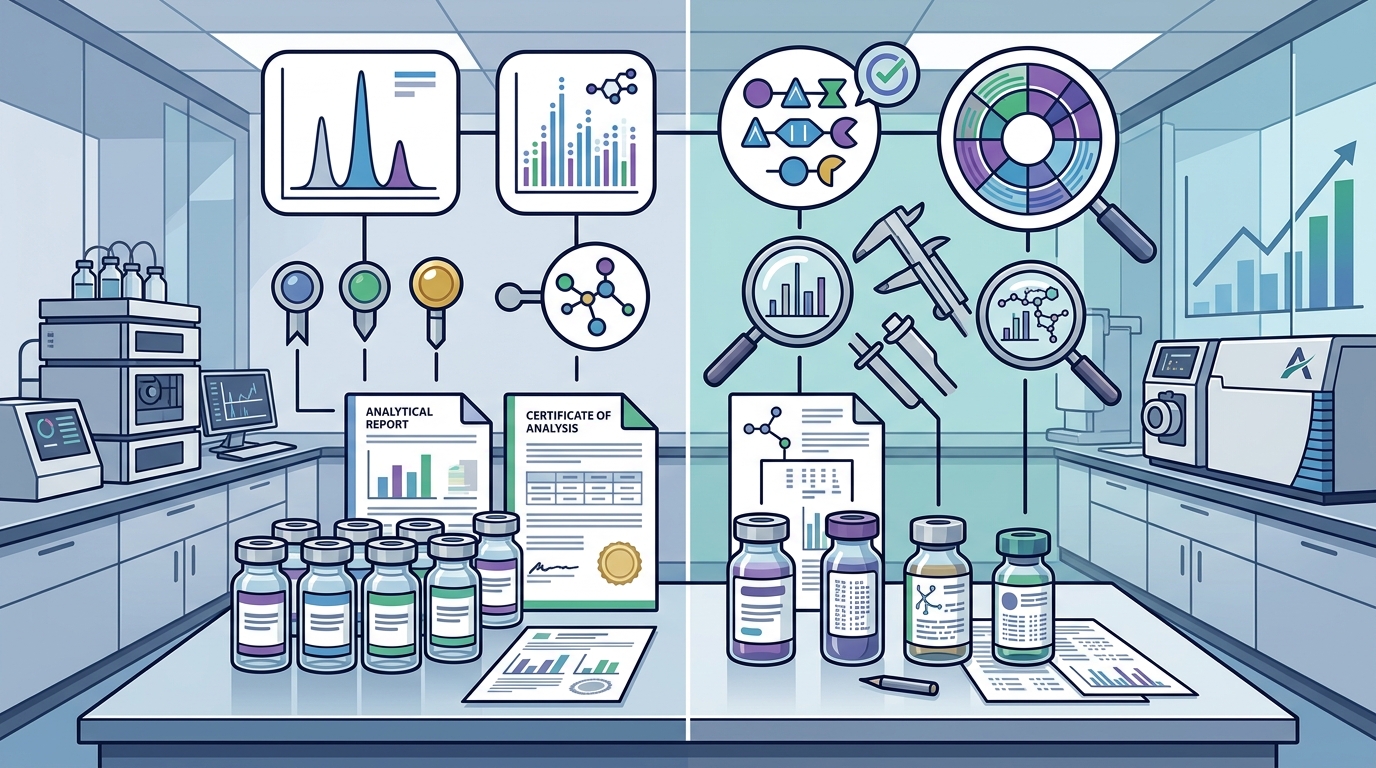
Researchers often face the dilemma of choosing between custom synthesis and catalog inventory. Each option has distinct advantages and limitations regarding cost, timeline, and availability.
| Feature | Custom Synthesis | Catalog Inventory |
|---|---|---|
| Availability | Lead time required (weeks to months) | Immediate shipping |
| Cost | Higher per-unit cost for small batches | Lower cost due to economies of scale |
| Purity Control | Can be tailored to specific needs | Standardized high purity (e.g., >95%) |
| Traceability | Full batch documentation provided | Batch-specific COAs available |
| Use Case | Novel peptides or specific modifications | Common research standards and reagents |
Catalog inventory is ideal for researchers who need standard peptides for routine assays. Products like BPC-157, GHK-Cu, and IPAMORELIN are frequently stocked due to their high demand in research communities. These items benefit from established synthesis protocols and consistent quality control measures.
Custom synthesis is necessary for novel peptides or those with specific modifications that are not commercially available. While this option offers greater flexibility, it requires careful planning and longer lead times. Researchers must work closely with the supplier to define specifications and ensure that the final product meets their experimental requirements.
Selection Framework
When selecting between custom and catalog options, researchers should consider several key factors. First, evaluate the urgency of the need. If the research timeline is tight, catalog inventory is the only viable option. Second, assess the complexity of the peptide. Simple sequences are more likely to be available in catalog form, while complex or modified peptides may require custom synthesis.
Third, consider the required purity level. For high-sensitivity applications, such as mass spectrometry calibration, ultra-high purity standards are essential. Ensure that the supplier provides detailed impurity profiles for the selected material. According to best practices in analytical chemistry, the choice of reference material should match the sensitivity of the analytical method used.
Finally, verify the supplier's commitment to quality. Look for suppliers that provide comprehensive COAs and use rigorous analytical methods like HPLC-UV/Vis. Aevitas Research demonstrates this commitment by offering free shipping on orders over $150 and maintaining a transparent verification process for all products. This transparency allows researchers to make informed decisions based on data rather than marketing claims.
Key Takeaways
- Verification is Critical: Always require HPLC-UV/Vis data to verify peptide purity and identity.
- Traceability Matters: Ensure every batch has a unique identifier linked to a detailed COA.
- Catalog vs Custom: Use catalog inventory for speed and cost-efficiency; use custom synthesis for novel or modified peptides.
- Purity Standards: High-purity reference materials (>95%) are essential for accurate experimental results.
- Supplier Transparency: Choose suppliers that provide open access to their quality control data and COAs.
- Regulatory Compliance: Adhere to international standards for quality management in research supply.
- Cost Efficiency: Leverage bulk purchasing options, such as free shipping thresholds, to reduce operational costs.
Frequently Asked Questions
What is the difference between a research peptide and a pharmaceutical peptide?
A research peptide is intended strictly for laboratory use and scientific inquiry, not for human consumption. Pharmaceutical peptides are regulated drugs approved for clinical use. All products on Aevitas Research are intended for research purposes only.
How is peptide purity measured?
Purity is typically measured using High-Performance Liquid Chromatography (HPLC). This method separates the peptide from impurities, allowing for the quantification of the target compound's percentage relative to the total mass.
Can I request a custom COA for my order?
Yes, Aevitas Research provides batch-specific COAs for all products. Each COA includes the purity analysis, sterility checks, and heavy metal testing relevant to that specific lot.
What is the minimum order for free shipping?
Aevitas Research offers free shipping on all orders over $150. This policy helps researchers manage costs while accessing high-quality reference materials.
Are your peptides synthesized in-house?
Aevitas Research works with verified suppliers who adhere to strict quality standards. Every product is tied to a documented lot with verified purity analysis to ensure research integrity.
How do I verify the authenticity of a COA?
Each COA includes a unique batch number that can be cross-referenced with the product label. Additionally, the COA details the analytical methods used, such as HPLC-UV/Vis, to confirm the results.
What storage conditions are recommended for peptide reference materials?
Most peptide reference materials should be stored at -20°C to maintain stability. Always refer to the specific storage instructions provided on the product label and COA.
Request Your Reference Material
Ensuring the integrity of your research begins with the quality of your reference materials. Whether you require standard catalog items or custom synthesis, Aevitas Research provides the verification and transparency you need. Explore our product catalog to find the peptides that meet your specific research needs. For detailed quality data, visit our COA verification page. If you have specific requirements, contact our team to discuss your project. We are committed to supporting your research with verified quality and reliable service.