

7 Critical Quality Markers Peptide Suppliers Must Demonstrate with HPLC and Mass Spec
High-quality peptide research depends on rigorous analytical validation. Suppliers must prove purity, identity, and structural integrity using advanced chromatography and spectrometry. Aevitas Research prioritizes these standards to ensure reliable laboratory reference materials for life sciences professionals.
1. HPLC Purity Thresholds
High-performance liquid chromatography purity must meet or exceed 95% for research-grade materials. HPLC purity is a quantitative measure of the proportion of the target peptide relative to all other components in the sample. Reputable suppliers provide chromatograms showing a dominant peak with minimal baseline noise. This metric ensures that the bulk of the material is the intended compound, reducing variables in experimental design. For additional details, review the .
2. Mass Spectrometry Identity Verification
Mass spectrometry confirms the exact molecular weight and sequence of the peptide. Mass spectrometry identity verification is the process of matching the observed mass-to-charge ratio against the theoretical mass of the synthesized peptide. This technique detects subtle modifications, such as missing residues or oxidation, that might not be visible in standard chromatography. It serves as the definitive check for chemical identity in the laboratory. For additional details, review the Customer Experience.
3. Retention Time Consistency
Consistent retention times across batches indicate stable synthesis and purification processes. Retention time consistency is a qualitative marker that compares the time a peptide takes to elute from the HPLC column against a reference standard. Significant deviations can suggest changes in the peptide's hydrophobicity or structural conformation. Tracking this metric over time helps researchers verify batch-to-batch reproducibility.
4. Peak Shape and Symmetry
Sharp, symmetrical peaks indicate a homogeneous peptide population without significant aggregation. Peak shape analysis is an evaluation of the chromatographic profile's width and symmetry. Broad or tailing peaks may suggest the presence of micro-heterogeneity, such as deamidation or isomerization. A clean, Gaussian-like peak profile is a strong indicator of high-quality synthesis and proper storage conditions.
5. Impurity Profile Analysis
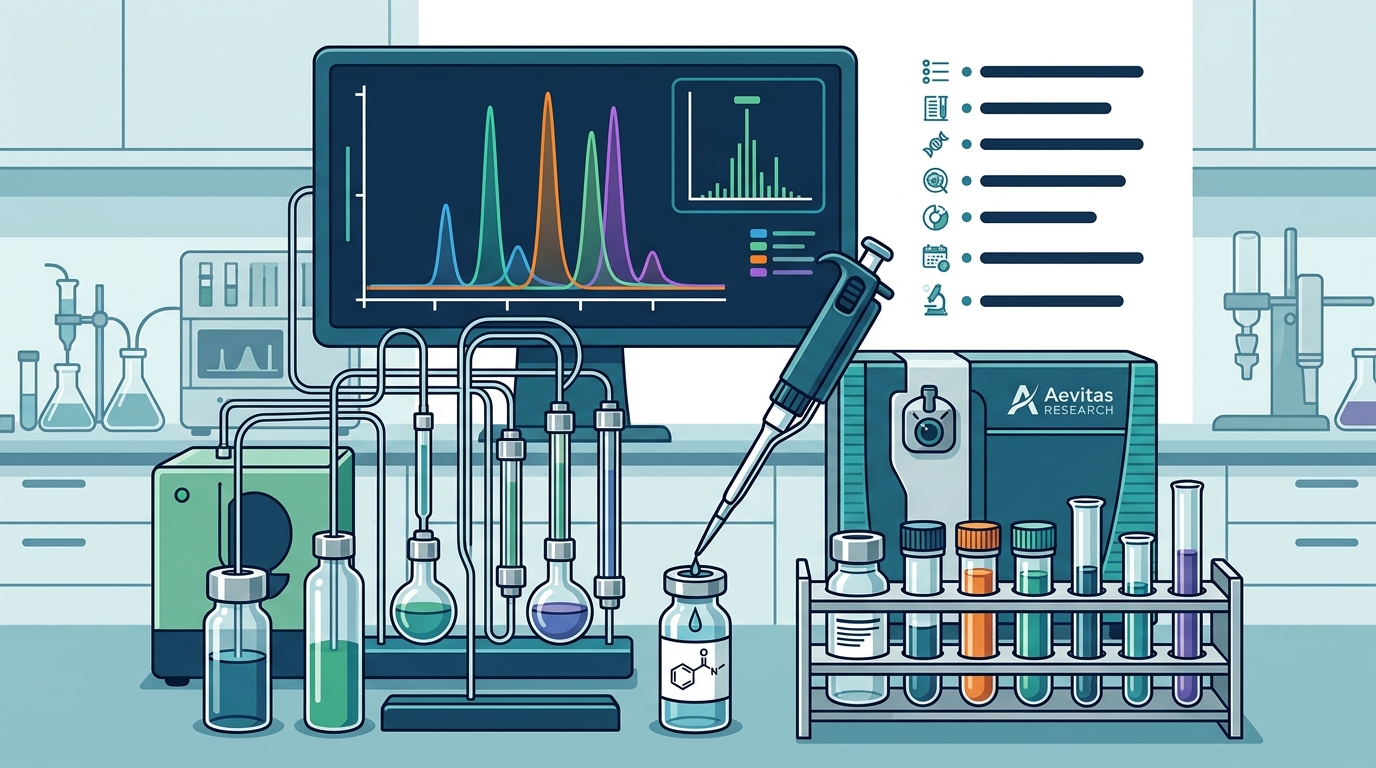
Detailed impurity profiling identifies and quantifies specific byproducts formed during synthesis. Impurity profile analysis is the identification of individual peaks in the chromatogram that do not correspond to the target peptide. Advanced suppliers use high-resolution mass spectrometry to characterize these impurities, distinguishing between truncation products and modified variants. This transparency allows researchers to understand the exact composition of the reference material.
6. Certificate of Analysis Documentation
7. Analytical Method Validation
Validated analytical methods ensure that the testing protocols are robust and reproducible. Analytical method validation is the process of demonstrating that a testing method is suitable for its intended purpose, including precision, accuracy, and linearity. Suppliers should adhere to recognized standards, such as those from the United States Pharmacopeia or International Council for Harmonisation. This ensures that the quality markers reported are scientifically defensible and consistent across the industry.
Choosing the Right Quality Markers
When evaluating suppliers, prioritize those who provide raw data alongside summary metrics. Look for transparency in impurity characterization and method validation. Aevitas Research maintains high standards for research-grade peptide laboratory reference materials, ensuring that every batch meets rigorous quality benchmarks. To explore our verified products and documentation, visit the Aevitas Research homepage.
Frequently Asked Questions
What is the minimum HPLC purity required for research peptides?
Most high-quality research peptides should have an HPLC purity of at least 95%. Higher purity levels, such as 98% or 99%, are preferred for sensitive applications where trace impurities could interfere with experimental results.
How does mass spectrometry verify peptide identity?
Mass spectrometry measures the mass-to-charge ratio of peptide ions. By comparing the observed mass to the theoretical mass of the intended sequence, researchers can confirm the peptide's identity and detect any structural modifications or synthesis errors.
Why is peak shape important in HPLC analysis?
Peak shape indicates the homogeneity of the peptide sample. Sharp, symmetrical peaks suggest a uniform population, while broad or tailing peaks may indicate the presence of impurities, aggregation, or degradation products.
What should be included in a peptide Certificate of Analysis?
A comprehensive COA should include the HPLC chromatogram, mass spectrometry data, purity percentages, and the specific analytical methods used. It serves as a traceable record of the quality control tests performed on that specific batch.
How often should peptide suppliers validate their analytical methods?
Suppliers should validate their analytical methods during initial development and periodically thereafter to ensure continued accuracy and precision. Regular re-validation helps maintain consistency in quality reporting across different batches and over time.