

Proper peptide storage is one of the most overlooked yet critical steps in any laboratory workflow. Research-grade peptides are highly purified compounds used in scientific research to study biological processes, and even minor storage errors can compromise purity, degrade bioactivity, and invalidate months of work. Whether you are managing a single vial or scaling an entire inventory, understanding how temperature, humidity, light, and container selection affect peptide stability will protect your investment and your data. This guide walks you through every essential storage practice so your research-grade peptide reference materials remain reliable from delivery to final use.
Lyophilized vs. Reconstituted Peptides: Why Form Matters
Lyophilization is the process of freeze-drying a peptide to remove water, yielding a stable powder. Most research peptides ship in this form because it dramatically slows chemical degradation processes that require aqueous conditions. Once you add solvent, the clock starts ticking much faster.
Reconstituted peptides are peptides that have been dissolved in a solvent such as bacteriostatic water or a buffered solution, returning them to a liquid state. In solution, peptides become susceptible to hydrolysis, oxidation, and aggregation, which is why reconstituted forms demand stricter storage conditions than their dry counterparts.
Practical Rule
Keep peptides in lyophilized form until you are ready to use them. If you need guidance on proper reconstitution technique, review our guide to reconstituting peptides with bacteriostatic water.
Optimal Temperature Guidelines
Temperature is the single most important variable in peptide storage. The table below summarizes recommended ranges based on peptide form and intended storage duration.
| Peptide Form | Short-Term (up to 30 days) | Long-Term (30+ days) | Maximum Stability |
|---|---|---|---|
| Lyophilized powder | 4 °C (39 °F) | -20 °C (-4 °F) | -80 °C (-112 °F) |
| Reconstituted solution | 4 °C (39 °F) with caution | -20 °C (-4 °F) | -80 °C (-112 °F) |
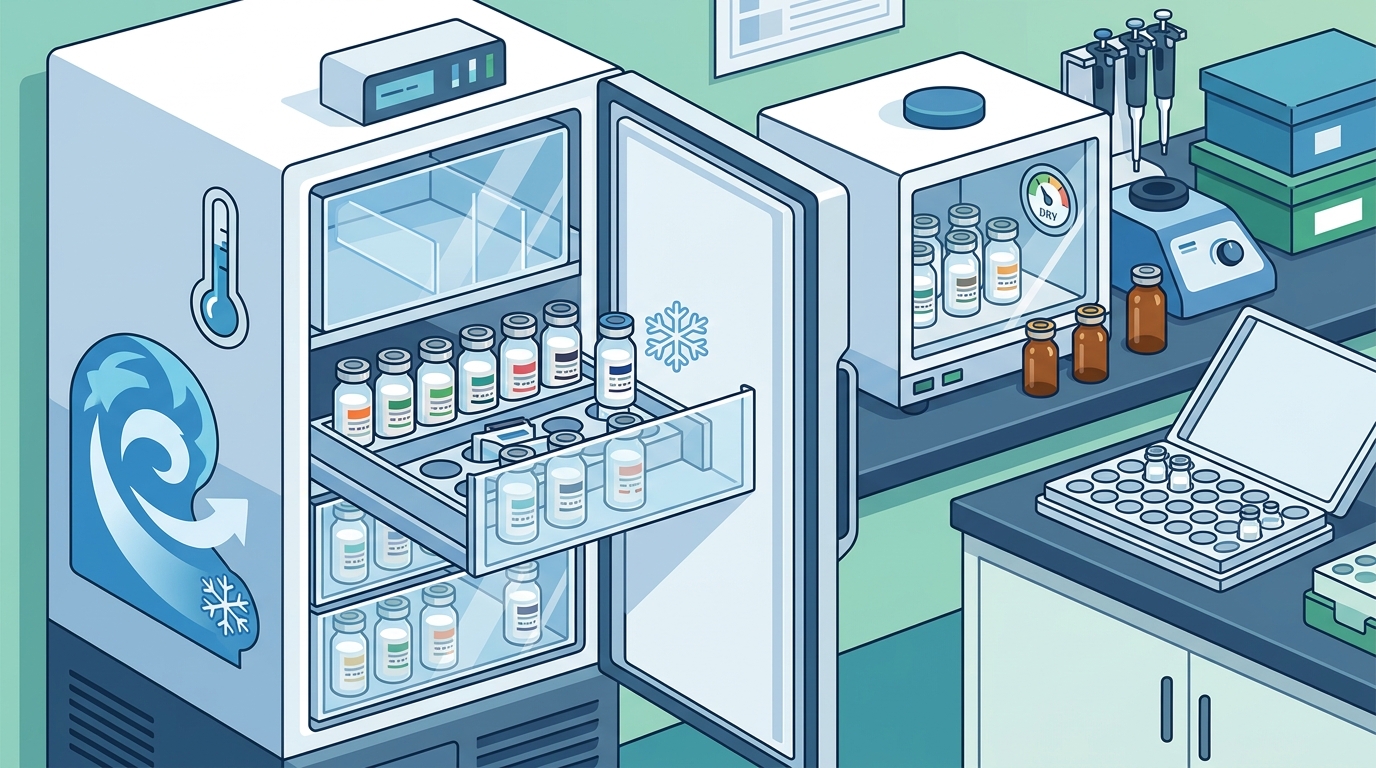
For maximum longevity, store lyophilized peptides at -80 °C protected from light, moisture, and air. Room-temperature exposure for a few days may be tolerable, but weeks at ambient conditions can introduce visible degradation such as discoloration or clumping.
Light and Humidity Controls
UV and visible light damage aromatic amino acid residues including tryptophan, tyrosine, and phenylalanine. Always store peptides in amber vials or wrap containers in foil to block light exposure.
Humidity is equally destructive. Moisture catalyzes hydrolysis, the chemical cleavage of peptide bonds. Store vials alongside standard silica gel desiccant packets and replace them monthly or when the indicator gel changes color. A desiccator cabinet is ideal for labs managing large inventories.
Quick Checklist
- Use amber or foil-wrapped containers.
- Include silica gel desiccant in every storage container.
- Seal vials under inert gas (nitrogen or argon) when possible.
Container Selection and Handling
Container material directly affects peptide stability over time. Glass vials provide excellent chemical inertness and are preferred for long-term storage. Polypropylene tubes offer strong durability and handling convenience for day-to-day lab work.
A low-protein-binding tube is a container treated to minimize peptide adsorption to inner surfaces. These tubes are especially important at low peptide concentrations, where surface loss can represent a meaningful percentage of your sample. When working with sensitive compounds from our research peptide catalog, choosing the right tube can preserve accuracy.
Handling Best Practices
- Allow vials to reach room temperature before opening to prevent condensation.
- Use sterile technique when downstream applications require it.
- Wear powder-free gloves to prevent contamination.
Aliquoting and Freeze-Thaw Management
Repeated freeze-thaw cycles are among the fastest ways to degrade a reconstituted peptide. Each cycle exposes the compound to temperature stress and potential moisture ingress. The solution is simple: aliquot.
Divide your reconstituted peptide into single-use portions immediately after preparation. Store each aliquot at -20 °C or -80 °C and thaw only what you need for a given experiment. This practice preserves the remaining stock and improves experimental reproducibility.
Labeling and Documentation
Every peptide container should carry a clear label with the compound name, batch number, concentration, reconstitution date, and expiration date. Accurate labeling prevents mix-ups and supports traceability across experiments.
Maintain a storage log that records temperature readings, usage dates, and remaining volume. Good documentation practices contribute to the reproducibility and reliability of scientific experiments. You can cross-reference batch information against the Certificates of Analysis provided with each Aevitas Research order. For a deeper look at why third-party verification matters, read our article on why purity matters in research-grade peptides.
Key Takeaways
- Keep peptides lyophilized until the moment of use to maximize shelf life.
- Store lyophilized peptides at -20 °C or -80 °C for long-term stability.
- Protect all peptides from light, moisture, and repeated freeze-thaw cycles.
- Use glass vials for long-term storage and low-protein-binding tubes at low concentrations.
- Aliquot reconstituted peptides into single-use portions immediately after preparation.
- Label every container with compound name, batch number, concentration, and date.
- Verify batch purity with a Certificate of Analysis before beginning any experiment.
Frequently Asked Questions
What temperature should I store lyophilized peptides at?
For short-term storage of up to 30 days, 4 °C is acceptable. For long-term storage, -20 °C is standard and -80 °C provides maximum stability. Always protect vials from light and moisture regardless of temperature.
How long do reconstituted peptides last?
Reconstituted peptides stored at -20 °C typically remain stable for several weeks, depending on the specific sequence. At 4 °C, plan to use them within a few days to minimize degradation from hydrolysis and oxidation.
Can I refreeze a peptide after thawing?
You can, but each freeze-thaw cycle risks degradation. The best practice is to aliquot your solution into single-use portions before the first freeze so you never need to refreeze remaining material.
Do I need special desiccant for peptide storage?
No. Standard silica gel desiccant packets work well. Replace them monthly or when the indicator changes color. Activated charcoal is also acceptable if you want to absorb odors in addition to moisture.
What happens if my peptide was left at room temperature?
A few days at room temperature may be acceptable for lyophilized peptides. However, if the peptide was stored at room temperature for weeks or shows signs of degradation such as discoloration or clumping, it should be discarded and replaced with fresh material.
Should I use glass or plastic vials?
Glass vials are preferred for long-term storage due to their chemical inertness. Polypropylene tubes are suitable for short-term handling. At low concentrations, consider low-protein-binding tubes to reduce peptide loss to container walls.
Where can I find storage instructions for a specific peptide?
Check the Certificate of Analysis and product documentation that ships with your order. Aevitas Research provides detailed handling instructions and third-party testing data with every purchase. Browse our peptide research library for compound-specific information.
Protect Your Research from Day One
Proper storage starts with high-quality source material. Aevitas Research supplies research-grade peptide laboratory reference materials backed by third-party Certificates of Analysis, detailed handling documentation, and responsive support. Visit our online store to explore our full catalog and place your order today.