

Sourcing research-grade peptides backed by verified purity documentation is one of the most important steps a laboratory can take to ensure experimental integrity. Without proper documentation, researchers risk introducing contaminants that skew results and waste valuable time. This guide explains what verified purity documentation looks like, the analytical methods behind it, what purity thresholds mean for different applications, and how to evaluate suppliers who provide transparent quality assurance. Whether you are conducting in vitro studies or analytical benchmarking, the information below will help you make confident purchasing decisions.
What Are Research-Grade Peptides?
A research-grade peptide is a synthetic peptide manufactured and quality-controlled specifically for laboratory, analytical, or investigative use rather than therapeutic application. These materials serve as laboratory reference materials that enable researchers to benchmark assays, validate methods, and explore biological mechanisms under controlled conditions.
Research-grade peptides differ from crude synthesis output because they undergo purification and independent testing to confirm identity and purity. Suppliers such as Aevitas Research provide these materials exclusively for research use and include supporting documentation with every order.
Why Purity Documentation Matters
Purity documentation is the objective evidence that a peptide meets its stated specifications. Without it, there is no way to confirm that the vial contains what the label claims. Even minor impurities can alter biological activity and compromise downstream applications.
A 2026 study published in the Journal of Peptide Science emphasized that robust purity control for synthetic peptides is critical because impurities can distort analytical results. Researchers who rely on unverified materials introduce an uncontrolled variable that can invalidate entire studies.
The Cost of Skipping Verification
Laboratories that skip verification often face repeated experiments, wasted reagents, and unreliable data. Investing in peptides that come with a published Certificate of Analysis eliminates guesswork and strengthens the credibility of published findings.
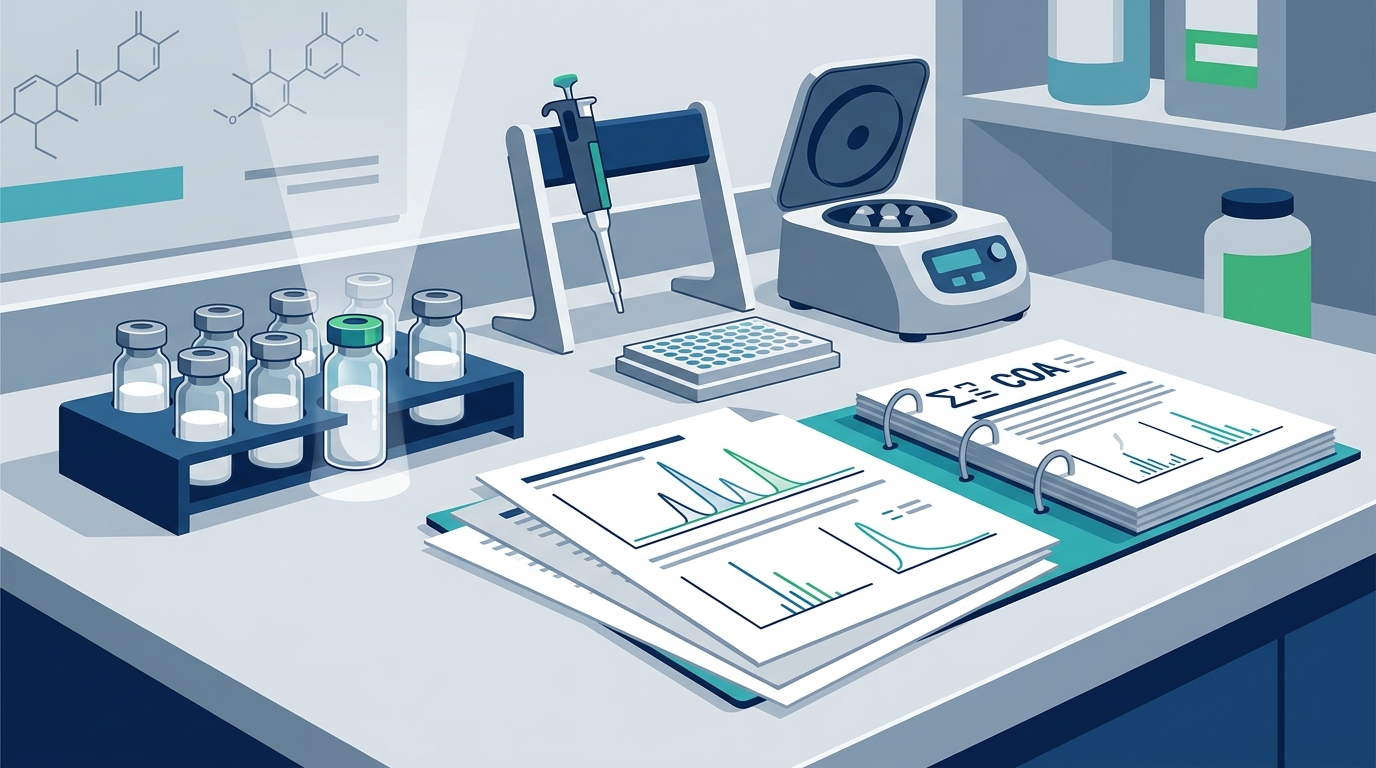
Key Analytical Methods for Verifying Purity
Two primary techniques underpin peptide purity verification in the industry: HPLC and mass spectrometry.
HPLC (High-Performance Liquid Chromatography)
HPLC is a scientific technique used to separate, identify, and quantify each component in a mixture. It produces a chromatogram showing the peptide peak relative to any impurity peaks, giving a precise purity percentage. Most reputable suppliers report HPLC purity on every batch.
Mass Spectrometry (MS)
Mass spectrometry is a technique used to measure molecular masses within a sample by ionizing chemical species and sorting the resulting ions by their mass-to-charge ratio. When combined with HPLC, MS confirms that the peptide's molecular weight matches the target sequence, verifying both identity and structural accuracy.
Third-Party vs. In-House Testing
Third-party testing is the practice of sending product samples to an independent, certified laboratory for analysis rather than relying solely on the manufacturer's internal quality control. Aevitas Research publishes third-party Certificates of Analysis so buyers can independently verify results.
Purity Thresholds and Their Applications
Not every experiment demands the same purity level. The table below summarizes common thresholds and their typical research applications, based on widely cited peptide purity guidelines from GenScript.
| Purity Level | Typical Application | Recommended For |
|---|---|---|
| >70% | Antibody generation and screening | Immunization studies |
| >85% | Enzyme assays, biological activity studies | Biochemical screening |
| >95% | Quantitative analysis, SAR studies | Analytical reference work |
| >98% | In vitro assays, sensitive receptor binding | High-precision research |
For most laboratory reference applications, peptides with purity greater than 95% are recommended because they minimize interference from synthesis byproducts.
What to Look for in a Certificate of Analysis
A Certificate of Analysis (COA) is a document issued by a testing laboratory that reports the results of quality control tests performed on a specific batch of product. A credible COA should include:
- Peptide sequence and molecular weight
- HPLC purity percentage with chromatogram
- Mass spectrometry confirmation of identity
- Batch or lot number for traceability
- Name of the testing laboratory (ideally third-party)
- Date of analysis
Aevitas Research maintains a dedicated COA page where customers can review documentation before or after purchase. This level of transparency helps researchers verify that each product meets their project requirements.
Evaluating Suppliers for Transparent Quality Assurance
When comparing peptide suppliers, look beyond price. Consider these quality indicators:
- Published COAs: Are third-party test reports publicly available?
- Product labeling: Does the supplier clearly mark products as "for research use only"?
- Storage guidance: Does the supplier provide peptide stability and storage guidance?
- Customer support: Can you reach a knowledgeable team with questions about documentation?
- Reconstitution resources: Does the supplier offer educational content like a peptide reconstitution guide?
Suppliers who invest in educational resources and transparent documentation demonstrate a commitment to quality that benefits the broader research community. You can learn more about how purity impacts research outcomes in the Aevitas article on why purity matters in research-grade peptides.
Key Takeaways
- Research-grade peptides are purpose-built for laboratory and analytical use, not therapeutic applications.
- Verified purity documentation, primarily through HPLC and mass spectrometry, is the gold standard for confirming peptide identity and quality.
- Purity thresholds of 95% or higher are recommended for most quantitative and analytical research.
- A credible Certificate of Analysis should include batch numbers, chromatograms, and third-party lab identification.
- Third-party testing provides an independent check beyond the manufacturer's in-house quality control.
- Transparent suppliers publish COAs, offer storage guidance, and provide educational resources to support researchers.
Frequently Asked Questions
What is a Certificate of Analysis for peptides?
A Certificate of Analysis is a quality control document that reports test results for a specific peptide batch, typically including HPLC purity, mass spectrometry identity confirmation, and lot number. It serves as objective proof that the peptide meets its stated specifications.
Why is HPLC used to verify peptide purity?
HPLC separates and quantifies every component in a peptide sample, producing a precise purity percentage. It is the industry-standard method because it offers high resolution and reproducibility across different laboratories.
What purity level do I need for quantitative research?
For quantitative analysis and structure-activity relationship studies, peptides with purity greater than 95% are generally recommended. More sensitive applications, such as receptor binding assays, may require 98% or higher.
How do I know if a supplier uses third-party testing?
Look for the name of an independent testing laboratory on the Certificate of Analysis. Reputable suppliers like Aevitas Research publish their COAs on a dedicated page so you can verify the testing lab directly.
Can impurities in peptides affect my research results?
Yes. Even minor impurities can alter biological activity and distort analytical results. Unverified peptides introduce an uncontrolled variable that may invalidate experiments and waste resources.
What is the difference between research-grade and pharmaceutical-grade peptides?
Research-grade peptides are manufactured and documented for laboratory investigation, while pharmaceutical-grade peptides meet additional regulatory requirements (such as GMP compliance) for use in clinical settings. Research-grade materials are not intended for human or animal consumption.
Where can I find research-grade peptides with verified documentation?
Aevitas Research offers a full catalog of research-grade peptide reference materials with published third-party COAs, educational resources, and dedicated customer support for qualified purchasers.
Start Your Research With Verified Materials
Reliable research begins with materials you can trust. Browse the Aevitas Research catalog to explore research-grade peptides backed by third-party purity documentation, detailed Certificates of Analysis, and responsive support from a team that understands laboratory standards.