

Starting a new laboratory project is exciting, but the sourcing phase can make or break your results. From defining your material requirements to verifying supplier quality, every decision you make during procurement affects downstream data integrity. Whether you are working with peptide reference materials, reagents, or reconstitution supplies, a structured sourcing workflow saves time and reduces costly errors. This guide walks you through the essential steps for sourcing laboratory materials with confidence, with a focus on research-grade peptides and the quality benchmarks that matter most.
Define Your Project Requirements First
Before contacting a single supplier, document exactly what your project demands. A project requirements document is a written specification that outlines the compounds, quantities, purity thresholds, and timelines needed for a research initiative. This prevents scope creep and ensures every team member is aligned.
Start by answering three questions: What compounds will you study? What purity level does your protocol require? What is your projected consumption over the study period? Answering these upfront narrows the supplier field quickly.
Match Materials to Your Research Protocol
Your experimental design dictates material specifications. If you are investigating GLP-1 receptor agonists, for example, you will need specific peptide reference standards at documented purity levels. Reviewing the Aevitas peptide research library can help you identify the exact compounds relevant to your protocol.
Identify the Types of Materials You Need
Laboratory sourcing is not one-size-fits-all. A reference material is a substance with one or more sufficiently well-established property values used for calibration, method validation, or quality control. Your project may require several categories simultaneously.
| Material Category | Examples | Key Consideration |
|---|---|---|
| Peptide Reference Standards | BPC-157, Tirzepatide, Semaglutide | Purity ≥98%, third-party COA |
| Reconstitution Supplies | Bacteriostatic water, sterile vials | USP-grade, sterility documentation |
| Growth Hormone Peptides | CJC-1295, Ipamorelin, Tesamorelin | Sequence verification required |
| Regenerative Peptides | TB-500, GHK-Cu | Stability data and storage specs |
| Metabolic Peptides | MOTS-c, AOD-9604 | Batch-to-batch consistency |
Aevitas Research organizes materials into clear functional categories such as regenerative peptides, growth hormone peptides, and GLP-1 peptides, which simplifies the identification process.
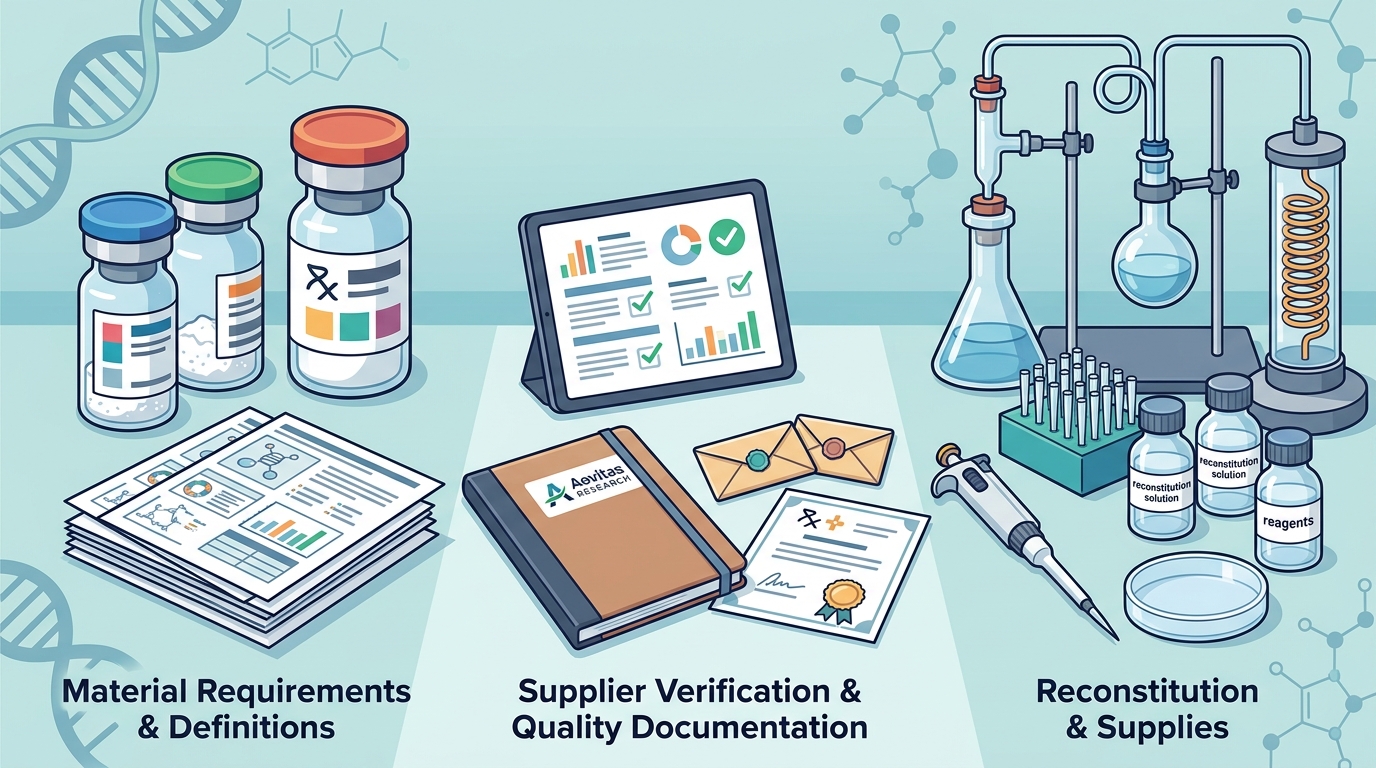
Evaluate Supplier Quality and Documentation
Not all suppliers are equal. A reliable research material supplier provides transparent testing documentation, responsive support, and consistent product quality. According to the National Institute of Standards and Technology (NIST), traceability to recognized measurement standards is a cornerstone of analytical confidence.
What to Look for in a Supplier
Prioritize suppliers who publish third-party certificates of analysis for every batch. Look for HPLC purity data, mass spectrometry confirmation, and clearly stated storage requirements. The importance of purity in research-grade peptides cannot be overstated when your results depend on material integrity.
Red Flags to Avoid
Be cautious of vendors who lack published COAs, do not disclose synthesis methods, or offer prices that seem too low for the stated purity. Vetting guidance is available in the best place to buy research peptides overview on the Aevitas blog.
Verify Purity and Certificates of Analysis
A certificate of analysis (COA) is a document issued by a testing laboratory that confirms a product meets its specified quality attributes. Every material you purchase should include one. Ideally, the COA should come from an independent, third-party lab rather than the manufacturer alone.
Aevitas Research provides downloadable COAs through its Research Access portal, giving purchasers direct visibility into purity, identity, and potency data. The peptide certificate of analysis guide explains exactly what each section of a COA means and how to interpret the results.
Minimum Purity Benchmarks
For most peptide-based laboratory work, a purity threshold of 98% or higher (as measured by HPLC) is considered research-grade. The United States Pharmacopeia (USP) sets widely recognized standards that many suppliers reference when characterizing their materials.
Plan for Proper Storage and Handling
Even the purest material degrades without correct storage. Peptides are particularly sensitive to heat, moisture, and repeated freeze-thaw cycles. Before your shipment arrives, ensure your lab has the infrastructure to maintain product integrity.
Lyophilized peptides typically require storage at -20°C or lower. Once reconstituted, most peptides should be refrigerated at 2 to 8°C and used within a defined window. Detailed storage protocols are covered in the peptide stability and proper storage guide.
If your project involves reconstitution, choosing the right solvent matters. The bacteriostatic water for peptides resource explains best practices for preparing solutions without compromising material quality.
Align Budget and Timeline with Project Milestones
Sourcing delays derail projects. Build your procurement schedule around key experimental milestones and account for shipping times, customs (if applicable), and any access verification required by the supplier.
Many research-grade peptide suppliers, including Aevitas Research, offer streamlined ordering through an online shop with transparent pricing and shipping and payment details published upfront. Planning two to three weeks of lead time is a reasonable starting point for U.S.-based orders.
Key Takeaways
- Document your material requirements, including compound names, quantities, and purity thresholds, before contacting any supplier.
- Categorize your needs by function (regenerative, metabolic, GLP-1, etc.) to streamline the search process.
- Always request and review third-party certificates of analysis before purchasing.
- Verify that your supplier provides HPLC purity data and mass spectrometry confirmation.
- Prepare storage infrastructure (freezers, refrigerators, desiccants) before materials arrive.
- Choose reconstitution solvents carefully and follow published protocols.
- Build procurement lead time into your project timeline to avoid experimental delays.
Frequently Asked Questions
What is a certificate of analysis and why does it matter?
A certificate of analysis is a quality document that confirms a material meets its labeled specifications. It typically includes purity percentage, identity confirmation, and testing methodology. COAs from independent third-party labs carry the most credibility.
How do I know if a peptide supplier is trustworthy?
Look for published COAs, transparent pricing, responsive customer support, and clear terms of service. Suppliers who provide batch-specific documentation and use third-party testing demonstrate a commitment to quality.
What purity level should I look for in research peptides?
For most laboratory applications, a purity of 98% or higher as measured by HPLC is considered research-grade. Always confirm this against the COA provided with your order.
How should I store peptide reference materials?
Lyophilized (freeze-dried) peptides should be stored at -20°C or colder in a sealed container with desiccant. Reconstituted peptides should be refrigerated at 2 to 8°C and used within the timeframe specified by the supplier.
Can I order research materials online?
Yes. Many suppliers, including Aevitas Research, operate fully online stores that allow qualified purchasers to browse, order, and track shipments. Visit the Aevitas shop to explore available materials.
What is bacteriostatic water and when do I need it?
Bacteriostatic water is sterile water that contains 0.9% benzyl alcohol to inhibit microbial growth. It is commonly used to reconstitute lyophilized peptides for laboratory use.
How far in advance should I order lab materials?
For U.S.-based orders, plan for two to three weeks of lead time. Factor in any account verification steps, payment processing, and potential shipping delays when building your project timeline.
Where can I learn more about specific peptides before ordering?
The Aevitas Peptide Research Library offers detailed profiles on compounds such as BPC-157, CJC-1295, and Ipamorelin, including research context and handling notes.
Start Sourcing with Confidence
Ready to begin your next laboratory project on the right foundation? Explore the full catalog of research-grade peptide reference materials at Aevitas Research and access third-party tested products backed by transparent documentation and dedicated support.