

Proper peptide storage is the single most controllable factor in preserving analyte integrity and ensuring reproducible laboratory results. Research-grade peptides are susceptible to hydrolysis, oxidation, and aggregation the moment environmental conditions fall outside recommended parameters. Whether you work with lyophilized powders or reconstituted solutions, understanding temperature, humidity, light, and container requirements can extend shelf life from weeks to years. This guide walks you through every critical step, from receiving your shipment to long-term archival, so your research-grade reference materials perform exactly as expected.
Why Peptide Storage Matters for Research Outcomes
Peptide stability is the molecule's ability to retain its structural integrity, purity, and functionality over time. When storage conditions are suboptimal, degradation products accumulate and compromise assay accuracy. According to JPT Peptide Technologies, inappropriate storage can affect both the accuracy of experimental results and the efficacy of downstream applications.
Laboratories that follow clear peptide stability and storage protocols report more consistent controls, less run-to-run variability, and reduced material waste. The investment in proper handling pays for itself quickly.
Common Degradation Pathways
Degradation is the chemical or physical breakdown of a peptide that reduces its intended activity. The three primary pathways researchers must guard against are hydrolysis, oxidation, and aggregation.
Hydrolysis
Moisture catalyzes peptide bond cleavage, especially in sequences containing Asp or Asn-Gly motifs. Storing peptides in a desiccated environment dramatically slows this reaction.
Oxidation
Peptides containing Cys, Met, or Trp residues are prone to oxidation and require storage under anaerobic conditions, as noted in GenScript's handling guidelines. Purging vials with dry nitrogen or argon before resealing is a widely recommended practice.
Aggregation
Repeated freeze-thaw cycles promote aggregation, particularly in peptides with secondary structures like alpha-helices or beta-sheets. Aliquoting before freezing is the simplest countermeasure.
Storing Lyophilized Peptides
Lyophilization is the process of freeze-drying a peptide solution under vacuum to produce a dry, porous solid. Lyophilized peptides are far more stable than those in solution because the absence of water greatly reduces the risk of hydrolysis.
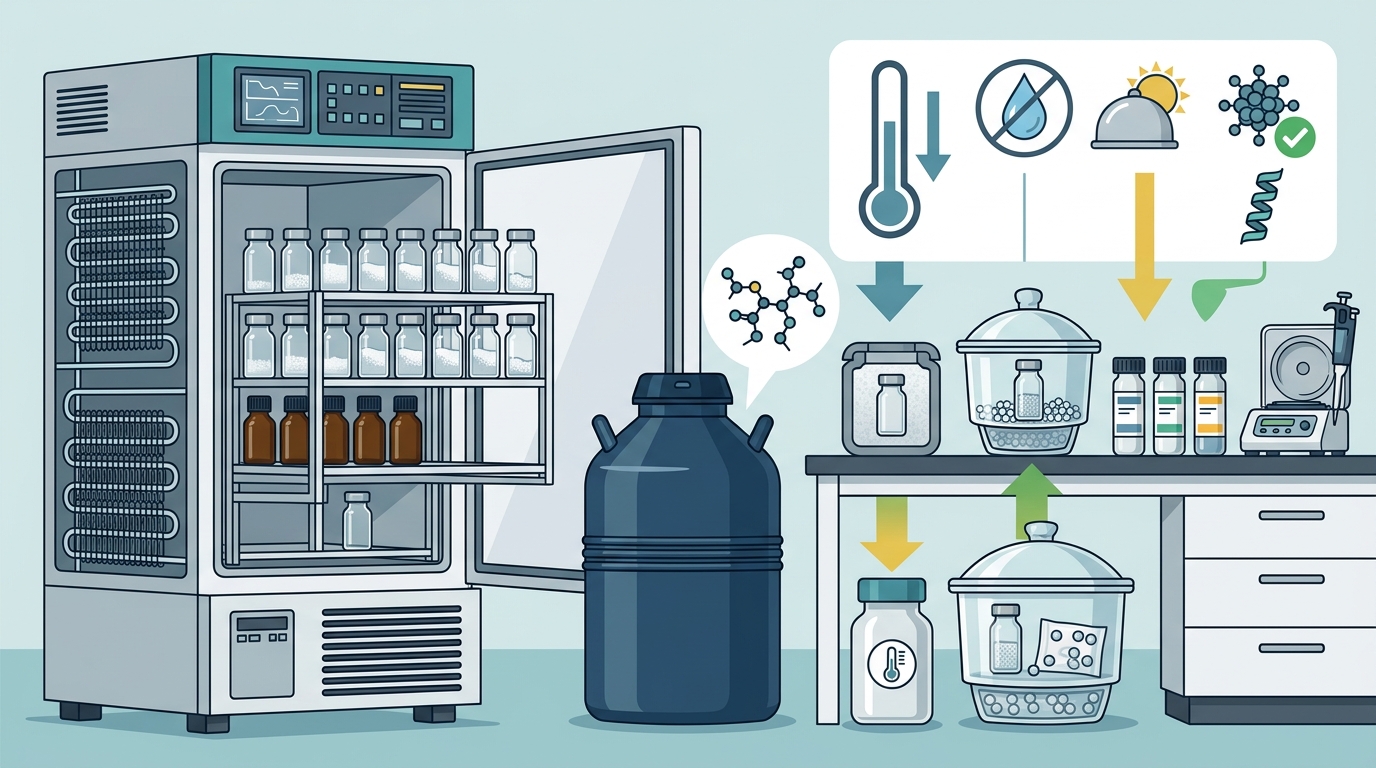
For long-term storage, keep lyophilized peptides at -20°C or colder in a sealed container with desiccant. Under these conditions, most peptides remain stable for several years. Before opening a vial, always allow it to equilibrate to room temperature in a desiccator to prevent condensation from forming on the powder.
After removing the required amount, reseal the vial under an atmosphere of dry inert gas and return it to cold storage immediately. Review the certificate of analysis shipped with your product for any sequence-specific storage notes.
Storing Reconstituted Peptides
Once reconstituted, peptide shelf life drops significantly. Solutions are vulnerable to bacterial degradation, oxidation, and pH-driven deamidation. Follow these steps to maximize usable life:
- Reconstitute with appropriate bacteriostatic water or sterile diluent using aseptic technique.
- Divide the solution into single-use aliquots of 0.1 to 1.0 mL.
- Store aliquots at -20°C or -80°C. Do not store reconstituted peptides at room temperature.
- Use buffers at pH 5 to 6 when possible, as mildly acidic conditions reduce aggregation and deamidation risk.
- Never re-freeze a thawed aliquot. Discard any unused portion.
If you reconstitute more than needed, re-lyophilization can return the excess peptide to a more stable dry state. Consult our guide on how to reconstitute peptides with bacteriostatic water for step-by-step instructions.
Container Selection and Environmental Controls
Container choice directly affects peptide stability. Glass vials offer excellent chemical inertness and optical clarity for visual inspection. Polypropylene vials are durable and chemically resistant but may not be suitable when organic solvents are involved, according to guidance from the NIBSC peptide handling resource.
Beyond containers, control these environmental variables:
- Temperature: -20°C minimum for long-term; -80°C for sensitive sequences.
- Light: Many peptides are light-sensitive. Store away from direct illumination.
- Humidity: Use desiccant pouches or a desiccator cabinet. Moisture is the leading cause of premature degradation in lyophilized stocks.
Storage Condition Comparison Table
| Peptide Form | Temperature | Expected Stability | Key Precautions |
|---|---|---|---|
| Lyophilized (long-term) | -20°C to -80°C | Months to several years | Desiccant, inert gas purge, sealed vial |
| Lyophilized (short-term) | 2°C to 8°C | Up to 3 months | Keep dry and light-protected |
| Reconstituted (aliquoted) | -20°C to -80°C | Weeks to months | Single-use aliquots, pH 5-6 buffer |
| Reconstituted (refrigerated) | 2°C to 8°C | Up to 30 days | Aseptic technique, use promptly |
Key Takeaways
- Always store lyophilized peptides at -20°C or colder with desiccant for maximum shelf life.
- Equilibrate cold vials to room temperature in a desiccator before opening to prevent condensation.
- Purge opened vials with nitrogen or argon, reseal tightly, and return to the freezer immediately.
- Reconstituted peptides should be divided into single-use aliquots and never re-frozen after thawing.
- Use mildly acidic buffers (pH 5-6) for reconstitution to reduce hydrolysis and deamidation.
- Choose chemically inert containers such as glass or polypropylene to prevent surface adsorption.
- Always review the certificate of analysis for sequence-specific handling recommendations.
Frequently Asked Questions
How long can lyophilized peptides last at -20°C?
Most lyophilized peptides remain stable for several years at -20°C when stored in sealed vials with desiccant. Peptides containing Cys, Met, or Trp may have shorter shelf lives and benefit from -80°C storage.
Can I store reconstituted peptides at room temperature?
No. Reconstituted peptides degrade rapidly at ambient temperature. Refrigerate at 2 to 8°C for short-term use (up to 30 days) or freeze aliquots at -20°C or lower for longer periods.
Why should I avoid freeze-thaw cycles?
Each freeze-thaw cycle increases the risk of aggregation and structural damage. Dividing solutions into single-use aliquots before freezing eliminates the need to thaw and re-freeze the main stock.
What type of water should I use to reconstitute peptides?
Bacteriostatic water is the most common choice for research peptide reconstitution. It contains a small percentage of benzyl alcohol that inhibits microbial growth. See our guide to reconstitution water for alternatives.
Do peptides need to be protected from light?
Yes. Many peptide residues are photosensitive. Store vials in opaque containers or dark areas of the freezer to prevent photodegradation.
Is it necessary to purge vials with inert gas?
Purging with nitrogen or argon displaces oxygen and significantly reduces oxidation risk, especially for sequences containing Cys, Met, or Trp. It is strongly recommended for any long-term storage scenario.
What container material is best for peptide storage?
Glass vials offer the best chemical inertness and visibility. Polypropylene is a practical alternative when breakage is a concern. Avoid standard plastics when organic solvents are part of your workflow.
How do I know if my peptide has degraded?
Common signs include unexpected assay results, visible particulates in solution, or changes in pH. HPLC re-analysis against the original certificate of analysis is the definitive check. Explore why purity matters in research-grade peptides for deeper context on quality verification.
Get Research-Ready Peptides with Full Documentation
Every peptide from Aevitas Research ships with third-party tested certificates of analysis and clear storage guidance. Browse our full catalog of research-grade peptide reference materials and place your order with confidence today.