

Finding research-grade peptides backed by verified purity documentation is one of the most important steps in any laboratory workflow. Without reliable analytical evidence, even the most carefully designed experiment can produce unreliable data. This guide explains what research-grade purity actually means, which documents to look for, how to evaluate a supplier's quality claims, and where to source peptides that meet rigorous analytical standards. Whether you are setting up a new lab or auditing your current supply chain, this resource will help you make informed purchasing decisions.
What Are Research-Grade Peptides?
A research-grade peptide is a synthetic peptide manufactured and tested to a purity standard sufficient for controlled laboratory investigation. These materials are classified as research-use-only (RUO), meaning they are not intended for human or animal consumption. The designation separates them from crude synthesis products on one end and GMP-grade pharmaceutical compounds on the other.
Research-grade peptides typically exhibit HPLC purity of 95% or higher, with many premium suppliers targeting 98% to 99%. A peptide laboratory reference material is a well-characterized compound supplied with documentation that confirms its identity and purity, making it suitable as a benchmark in analytical workflows. Aevitas Research provides a full overview in its guide to research-grade peptide lab reference materials.
Why Purity Documentation Matters
Purity documentation is the evidentiary backbone of any research material purchase. Without it, you are trusting a label rather than verifiable data. A Certificate of Analysis (COA) is an official document provided by a peptide supplier that confirms the product's quality, composition, and testing results.
Third-party testing provides an unbiased assessment of a peptide's purity, removing the conflict of interest inherent in self-reported data. Suppliers who publish batch-specific COAs before checkout demonstrate a level of transparency that directly supports reproducibility. Learn more about what a COA should contain on the Aevitas Research peptide certificate of analysis page.
Consequences of Missing Documentation
Working with undocumented peptides introduces hidden variables. Impurities from incomplete synthesis or degradation can confound assay results. Without lot traceability, you cannot correlate batch variation with experimental outliers.
Key Analytical Methods Used to Verify Purity
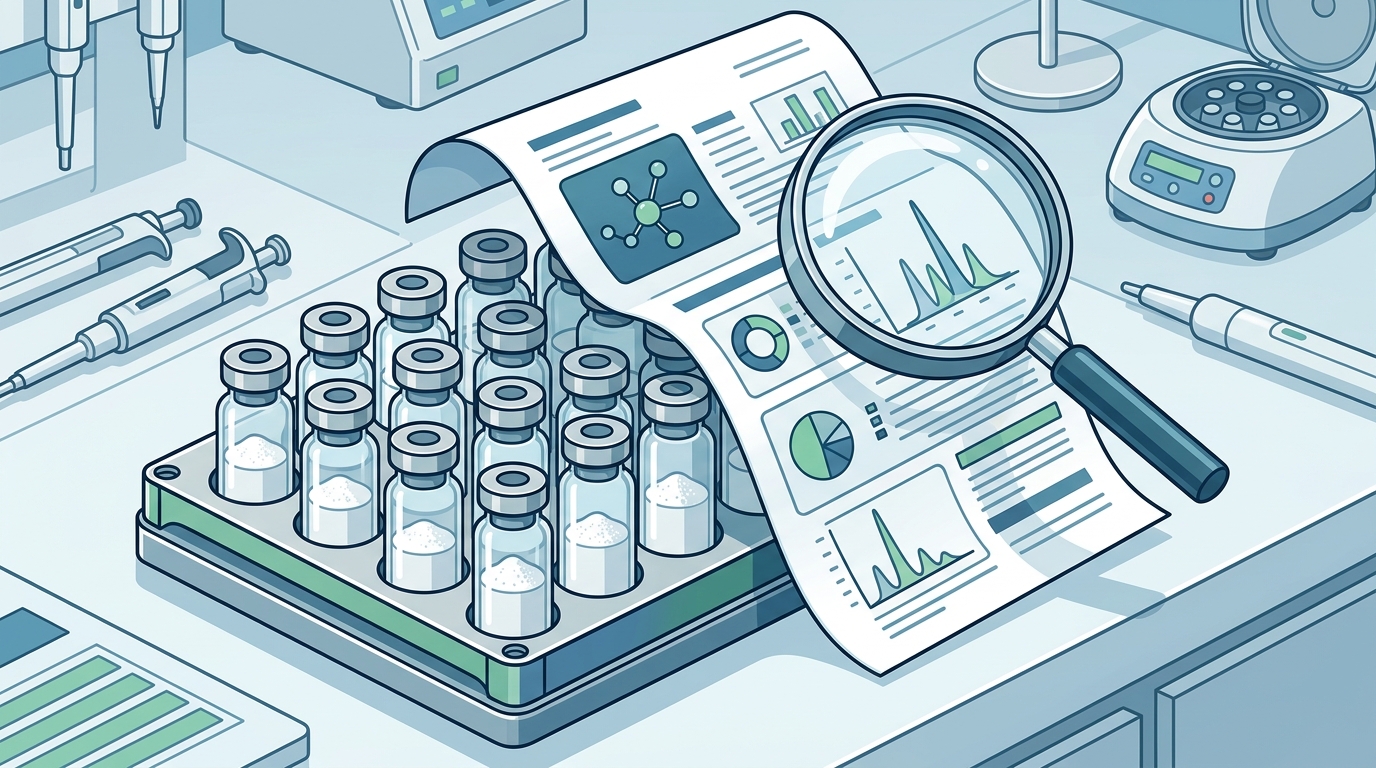
Two techniques form the minimum standard for peptide quality verification: reverse-phase high-performance liquid chromatography (RP-HPLC) and mass spectrometry (MS). RP-HPLC separates a sample's components by hydrophobicity and calculates purity as the ratio of the main peak area to total integrated area. Mass spectrometry confirms molecular identity by measuring the compound's mass-to-charge ratio.
Additional Tests
Some suppliers go further with amino acid analysis (AAA), endotoxin testing via USP-referenced LAL assays, and sterility screening. These additional layers matter most for in-vitro biological assays where contaminants can trigger confounding immune responses.
Aevitas Research publishes third-party testing documentation and makes COAs accessible through its dedicated COA library.
How to Read a Peptide Certificate of Analysis
A legitimate COA should contain several critical data points. Always cross-reference the batch number on the COA with the batch number on the vial you receive. Here is what to check:
Essential COA Elements
- Batch/Lot Number: Ties the analytical data to your specific material.
- HPLC Purity Percentage: Look for 95% or above; premium suppliers target 98%+.
- Mass Spectrometry Data: The observed molecular weight should match the theoretical value within acceptable tolerance (typically ±0.1 Da).
- Testing Laboratory: An independent, third-party lab should be named.
- Chromatogram/Spectrum: A purity number without the supporting chromatogram is incomplete.
For a deeper walkthrough, see why purity matters in research-grade peptides on the Aevitas Research blog.
Purity Thresholds by Application
Not every experiment demands the same purity level. The table below summarizes common purity thresholds aligned with application type.
| Application | Minimum Purity | Recommended Testing |
|---|---|---|
| Antibody generation / screening | ≥70% | HPLC + MS |
| Enzyme assays / bioactivity studies | ≥85% | HPLC + MS |
| Quantitative analysis / RUO reference | ≥95% | HPLC + MS + AAA |
| High-sensitivity in-vitro assays | ≥98% | HPLC + MS + Endotoxin |
These thresholds align with GenScript's recommended peptide purity guidelines, a widely referenced industry resource.
Evaluating Peptide Suppliers
Price alone is a poor proxy for quality. A structured evaluation should include the following criteria:
Transparency Indicators
- Batch-specific COAs available before purchase
- Named third-party testing laboratory
- Clear research-use-only labeling and terms of sale
- Published storage and handling guidelines
- Responsive customer support for documentation requests
Red Flags
- No COA provided or only a generic, non-batch-specific document
- Purity claims without supporting chromatograms
- Vague sourcing language with no testing lab identified
- Products marketed with health or therapeutic claims
Aevitas Research addresses these standards across its product catalog, providing third-party documentation, product verification, and a streamlined ordering experience for qualified purchasers.
Key Takeaways
- Research-grade peptides require a minimum HPLC purity of 95%, with premium materials targeting 98% or higher.
- A Certificate of Analysis is the foundational document for verifying peptide quality and should be batch-specific.
- RP-HPLC and mass spectrometry are the minimum analytical methods for purity and identity confirmation.
- Third-party testing eliminates conflict of interest and strengthens data reliability.
- Always cross-reference the COA batch number with the vial label before beginning any experiment.
- Suppliers who publish COAs before checkout and name their testing laboratory demonstrate genuine transparency.
- Purity thresholds should be matched to your specific application to balance cost and analytical rigor.
Frequently Asked Questions
What does research-grade mean for peptides?
Research-grade means the peptide has been synthesized and purified to a standard suitable for laboratory investigation, typically 95% HPLC purity or higher. These products are sold for research use only and are not intended for consumption.
What is a Certificate of Analysis (COA)?
A COA is a document that records purity measurements, molecular weight confirmation, identified impurities, and the batch reference number. It is issued by the testing laboratory and should accompany every peptide purchase.
Why is third-party testing important?
Third-party testing provides an unbiased assessment of purity and identity. When a supplier tests its own products internally without independent verification, there is an inherent conflict of interest that can compromise data integrity.
What purity level do I need for quantitative research?
For quantitative analysis, a purity of 95% or above is recommended. High-sensitivity biological assays often require 98% or higher to minimize interference from impurities.
How do I verify that a COA matches my specific order?
Check the batch or lot number printed on the COA against the number on your product vial. Legitimate suppliers tie every COA to a unique batch reference so you can confirm the data applies to your material.
What analytical methods should a COA include?
At minimum, the COA should report RP-HPLC purity data and mass spectrometry identity confirmation. Supporting chromatograms and spectra add further credibility. Some applications also benefit from amino acid analysis or endotoxin testing.
Where can I find peptides with verified purity documentation?
Aevitas Research supplies research-grade peptide laboratory reference materials with third-party tested COAs. Browse the peptide research library for compound-specific information or visit the shop to view available products.
How should I store research peptides to maintain purity?
Lyophilized peptides should be stored at -20°C or colder in a sealed, dry container. Reconstituted peptides are less stable and should be aliquoted and frozen. Read the full guidance on peptide stability and proper storage.
Start Sourcing Verified Research Peptides
If you are ready to work with peptides backed by transparent, third-party purity documentation, explore the Aevitas Research catalog. Every product ships with batch-specific COAs, and the support team is available to answer documentation questions. Browse research-grade peptides now.