

For any laboratory working with synthetic peptides, the difference between trustworthy data and unreliable results often comes down to one thing: documentation. This guide walks through every document category you should expect—and demand—when sourcing research-grade peptide reference materials.
Why Documentation Matters in Peptide Research
Peptides interact with biological systems at the molecular level, and even minor variations in sequence accuracy, impurity composition, or degradation state can significantly alter experimental outcomes. Without proper documentation, research results become difficult to interpret and nearly impossible to replicate reliably.
Documentation serves three core purposes in the peptide supply chain:
- Identity verification — confirming the peptide is the correct molecule
- Purity quantification — establishing the percentage of target compound versus contaminants
- Traceability — linking every vial to a specific production batch and its full analytical history
When a laboratory purchases research-grade peptide reference materials, the accompanying documentation package is what transforms an anonymous powder into a well-described analytical tool.
The Certificate of Analysis (COA)
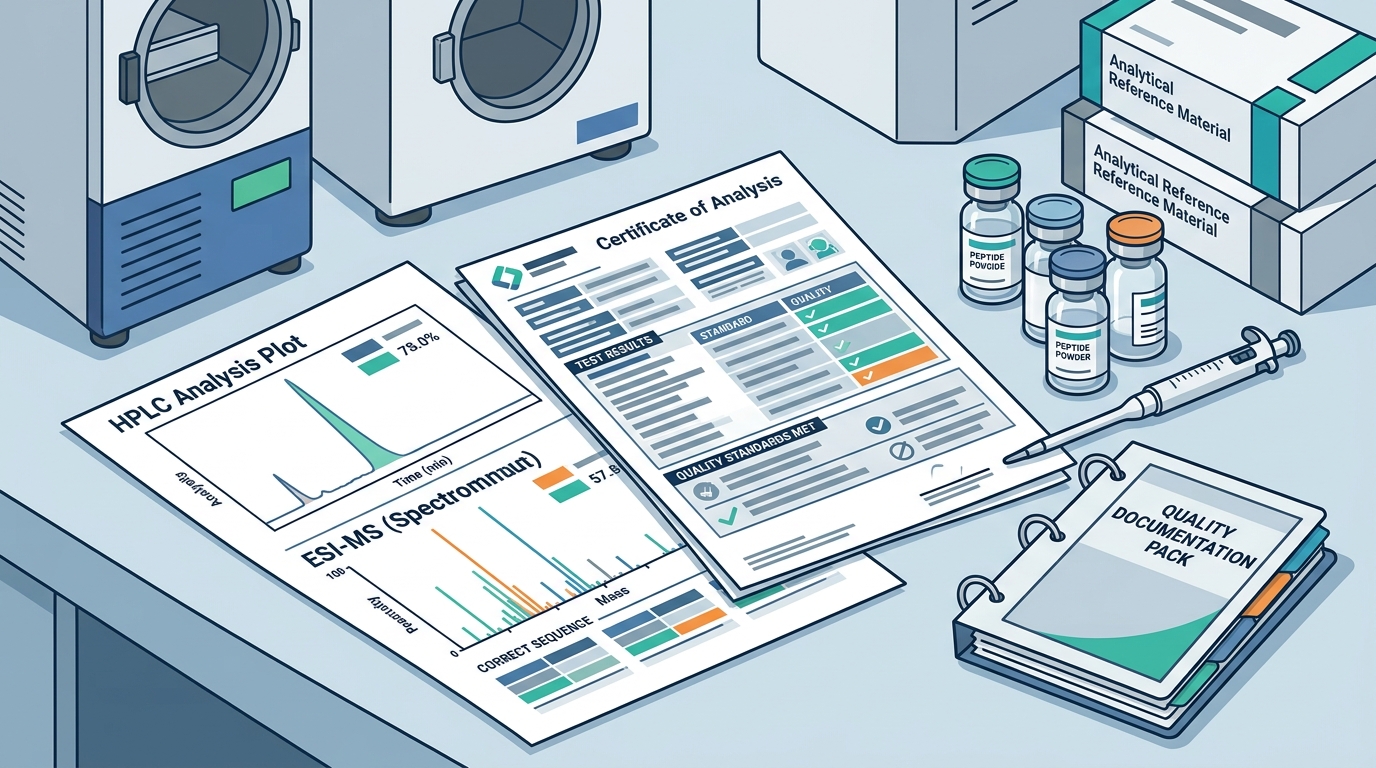
The COA is the single most important document in peptide quality validation. It is a formal document prepared by a laboratory that details the peptide test results—purity, identity, and other analyses—for a specific batch, signed by an authorized analyst. Researchers rely on these lab-verified reports as proof that their research-grade materials are exactly what they claim to be.
What a COA Must Include
A lot-specific COA should contain the following data points at minimum:
- Product name and catalog number
- Lot or batch number — the unique identifier linking the document to the physical product
- Purity results — typically expressed as a percentage derived from HPLC analysis
- Identity confirmation — usually via mass spectrometry showing observed versus theoretical molecular weight
- Analytical methods used — specific techniques such as RP-HPLC, LC-MS, or amino acid analysis
- Testing date
- Laboratory identification — the name of the testing facility
- Authorized signature — from quality assurance personnel
A COA that lacks a traceable lot number or laboratory identification should raise immediate concerns. Generic or duplicated COAs without traceable lot information are a well-documented red flag in the industry.
First-Party vs. Third-Party COAs
COAs may be issued by the peptide manufacturer's internal quality control department or by an independent third-party testing lab. Third-party COAs from accredited laboratories carry greater evidentiary weight because they eliminate the conflict of interest inherent in self-testing. Many experienced researchers specifically request COAs from ISO 17025-accredited analytical laboratories for this reason.
HPLC Chromatograms and Purity Data
High-Performance Liquid Chromatography (HPLC) is the gold standard for assessing peptide purity. It works by separating the components of a peptide sample based on subtle differences in hydrophobicity, revealing truncated sequences, oxidized residues, or incompletely deprotected side chains that might otherwise go undetected.
How to Read an HPLC Report
An HPLC chromatogram displays peaks corresponding to each separated component. The main peak represents the target peptide, and any additional peaks indicate impurities or byproducts. Purity is calculated as the percentage of the main peak area relative to total peak areas.
For research-grade applications, the minimum acceptable purity is generally 95%, with many serious suppliers now publishing results at 98% or higher. A high-quality peptide produces a dominant primary peak with minimal secondary peaks on its chromatogram.
What to Look for in the Raw Data
- Retention time consistency — the main peak should elute at the expected time for the target compound
- Peak symmetry — asymmetric or shouldered peaks may indicate co-eluting impurities
- Baseline resolution — impurity peaks should be clearly separated from the main peak
- Method details — column type, mobile phase composition, gradient conditions, and detection wavelength
Accepting summary purity values without reviewing the underlying chromatogram is one of the most common quality-control oversights in peptide research. The chromatogram itself tells the full story.
Mass Spectrometry Reports
Where HPLC answers the question of purity, mass spectrometry (MS) answers the question of identity. MS confirms the molecular weight of the peptide by measuring the mass-to-charge ratio of ionized molecules with extremely high precision—often to within 0.01% of the theoretical value.
Common MS Techniques for Peptides
- ESI-MS (Electrospray Ionization) — ideal for complex mixtures and when MS/MS fragmentation is needed for sequence confirmation
- MALDI-TOF — useful for mapping larger or modified peptides
- LC-MS (Liquid Chromatography–Mass Spectrometry) — combines chromatographic separation with mass detection for simultaneous purity and identity analysis
Key Data Points in an MS Report
The observed mass (often reported as an [M+H]⁺ value) should match the theoretical mass calculated from the peptide's amino acid sequence within a small, defined error margin. Any significant deviation may indicate synthesis errors, modifications, or degradation. MS/MS fragmentation data provides additional sequence-level confirmation beyond simple molecular weight matching.
Supplementary Analytical Methods
No single test tells the whole story. A robust validation package may include additional orthogonal methods depending on the peptide and the intended application:
- Amino Acid Analysis (AAA) — confirms the absolute amino acid composition of the peptide, providing an independent check on sequence and content
- Capillary Electrophoresis (CE) — separates very hydrophilic peptides or reveals charge variants that HPLC may miss
- UV-Vis Spectroscopy — confirms compound consistency and can be used for concentration determination
- NMR Spectroscopy — used as an orthogonal identity method for reference standard characterization, particularly in pharmacopeial applications
- Peptide Mapping — provides detailed sequence-level information for complex or modified peptides
Integrating results from multiple analytical platforms creates a more robust foundation for release decisions and supports higher confidence in downstream experimental results.
Batch Records and Lot Traceability
Every peptide vial should carry a unique batch or lot number that links directly to the corresponding COA and production records. Without a batch identifier, the material cannot be validated against any analytical data.
What Batch Documentation Should Capture
Comprehensive batch records go beyond the COA to include:
- Raw material sources and supplier certificates
- Synthesis steps and process parameters
- In-process quality checks
- Final analytical results cross-referenced to the COA
- Packaging and labeling verification
Standard Operating Procedures (SOPs) for every analytical technique—HPLC, LC-MS, amino acid analysis—should be written, reviewed, and version-controlled. This level of process documentation demonstrates systematic quality management rather than ad hoc testing.
Third-Party Testing and Independent Verification
Independent third-party testing provides an additional layer of credibility that self-reported results cannot match. When an external ISO 17025-accredited laboratory validates HPLC or mass spectrometry results, the resulting documentation can be shared transparently with customers to demonstrate compliance.
Key elements of effective third-party verification include:
- Named identification of the testing laboratory
- Accreditation credentials (e.g., ISO 17025)
- Batch-specific results tied to the same lot number on the product label
- Publicly accessible or on-request documentation
Suppliers who make third-party COAs available on product pages before checkout—rather than only upon request after purchase—demonstrate a higher commitment to transparency.
Storage, Handling, and Stability Documentation
Quality documentation extends beyond the moment of testing. Peptides are sensitive to temperature, light, and moisture, meaning that proper storage and handling guidance is essential for maintaining validated quality through to the point of use.
Suppliers should provide:
- Recommended storage temperature (typically −20°C for lyophilized peptides)
- Light sensitivity warnings where applicable
- Reconstitution guidelines including compatible solvents and concentrations
- Shelf-life or expiration information supported by stability data
- Shipping conditions — including cold-chain protocols for temperature-sensitive materials
Sourcing from U.S.-based suppliers can reduce transit times and minimize temperature excursions during shipping, which is particularly relevant during warmer months when cold-chain integrity is most at risk.
Vendor Qualification Records
For laboratories with formal quality management systems, documenting vendor qualification is an important step. This process may include reviewing example COAs, evaluating the analytical methods a supplier uses, and confirming that materials are clearly designated for research use only.
Questions to address during vendor qualification:
- Does the supplier provide batch-specific (not generic) COAs?
- Are COAs generated by third-party accredited laboratories?
- Does the supplier clearly label products as Research Use Only (RUO)?
- Are HPLC chromatograms and MS spectra available—not just summary values?
- Is there responsive customer support for documentation questions?
- Does the supplier maintain version-controlled SOPs for analytical methods?
Quick-Reference Documentation Checklist
| Document | Purpose | Priority |
|---|---|---|
| Certificate of Analysis (COA) | Summarizes all quality test results for a specific lot | Essential |
| HPLC Chromatogram | Visual and quantitative purity confirmation | Essential |
| Mass Spectrometry Report | Molecular identity and sequence verification | Essential |
| Batch/Lot Number | Links product to analytical records | Essential |
| Third-Party Lab Identification | Validates independence of testing | Strongly Recommended |
| Amino Acid Analysis | Absolute composition confirmation | Recommended |
| Storage & Handling Guidelines | Maintains quality post-delivery | Strongly Recommended |
| Stability Data | Supports shelf-life claims | Recommended |
| SOPs / Method Documentation | Demonstrates systematic quality processes | Recommended |
Key Takeaways
- The COA is non-negotiable. Every peptide purchase should include a lot-specific Certificate of Analysis with purity, identity, methods, testing date, and authorized signature.
- HPLC and mass spectrometry together form the analytical backbone. HPLC quantifies purity; MS confirms identity. Neither alone is sufficient.
- Third-party testing adds critical credibility. COAs from independent, accredited laboratories eliminate self-reporting bias.
- Review raw data, not just summary numbers. Chromatograms and spectra reveal information that a single purity percentage cannot.
- Traceability starts with the lot number. Without a batch identifier linking the vial to its COA, analytical data is meaningless.
- Storage and handling documentation protects your investment. Validated quality at the point of manufacture means nothing if degradation occurs in transit or storage.
Frequently Asked Questions
What is a Certificate of Analysis (COA) for peptides?
A COA is a formal document that summarizes the analytical test results for a specific batch of peptide. It typically includes purity data from HPLC, identity confirmation via mass spectrometry, the lot number, testing date, name of the testing laboratory, and an authorized signature. It serves as the primary quality assurance record for research-grade peptide reference materials.
Why is third-party testing important for peptide quality?
Third-party testing from an independent, accredited laboratory (such as one holding ISO 17025 accreditation) eliminates the conflict of interest that exists when a supplier tests its own products. Independent verification provides stronger evidence that purity and identity claims are accurate and supports greater confidence in experimental reproducibility.
What purity level qualifies as research-grade for peptides?
The widely accepted minimum purity for research-grade peptides is 95% as measured by HPLC. However, many reputable suppliers now target 98–99% or higher for critical research applications to minimize interference from synthesis-related impurities.
What is the difference between HPLC and mass spectrometry in peptide testing?
HPLC measures purity by separating the target peptide from impurities and calculating the relative abundance of each component. Mass spectrometry confirms identity by measuring the precise molecular weight of the peptide and comparing it to the theoretical value. Together, they answer two fundamental questions: “How pure is it?” and “Is it the right molecule?”
Should I request raw analytical data or just accept summary COA values?
Whenever possible, request raw data such as HPLC chromatograms and mass spectra. Summary values like a purity percentage can mask underlying issues such as co-eluting impurities or shouldered peaks. Reviewing the actual chromatogram is the first quality-control step that sits entirely within the researcher's control.
How does Aevitas Research support peptide quality documentation?
Aevitas Research provides third-party testing documentation, batch-specific COAs, and product verification for all research-grade peptide laboratory reference materials. Our quality assurance processes are designed to promote consistency and transparency, and our customer support team is available to address documentation questions before and after purchase.